Showing posts with label census. Show all posts

Saturday, January 7, 2017

The Seedy Side of Censuses

The other day, someone mentioned an individual on the 1880 census with the occupation "thief" and that in the next census, he was in jail and his wife was now recorded as a "whore". I was intrigued by this because I was surprised one would admit to a criminal career, if not already in jail. And indeed, a quick search of the 1880 census by occupation "thief" turns up 74 results, mostly people serving time in jail.

However, a few are not in prison. Most amusing is one which actually says:
"'Thief' Would Dignify Him. To Low For Anything"
This was reported of a Wm. Cameron, 36, in West Del Norte, Rio Grande, Colorado. He was living with his wife so one has to wonder if she, perhaps an embittered and griping wife, was the informant. I can just imagine the conversation between her and the enumerator:
Enumerator: "And what does your husband do for a living, ma'am?"
Mary Cameron: "He's a good-for-nothing, lowlife scumbag, is what he is."
Enumerator: "I'm sorry, ma'am, that's not an occupation."
Mary Cameron: "Well, that's what he is!"
Enumerator: "How about 'thief'? Would that be close?"
Mary Cameron: "Thief?! Ha! That would dignify him. No, he's too low for anything. Write that down! Too... low... for... anything. That's right."
On a more serious note, there are many more people recorded as prostitutes, in one term or another. 155 people are described as a "whore" (yes, that actual word was used 155 times), while 4,891 people are reported as a prostitute/prostitution. Another 109 were noted under "house of ill fame/repute" or "sporting house", and one woman even a "bordello." 42 were "harlots", 27 "bawds", and 19 women were called "strumpets". Another 49 had something to do with a "pleasure house" or being a "lady/woman of pleasure" or "pleasure girl", not to be confused with a lady of leisure, but amusingly one said:
"Gratifying The Pleasure Of The One Paying Her Board"
I wonder who was paying her board? I guess whoever he was, she made it worth his while.

All in all, they added up to about 5,293. And they are not all women. Barring any recording or transcription errors, 125 of those 5,293 prostitutes were male, although some of them may have been managers and not prostituting themselves. Indeed, 164 individuals, some male, some female, were recorded as some kind of keeper, madam, or proprietor of a brothel, prostitution/pleasure/sporting/bawdy house, house of ill fame/repute, or "whore house", and 24 men were some kind of "pimp" such as a "harlot pimp".

I'm guessing actual numbers were probably even higher than this. There were likely people who lied about their occupation, and there might have been others recorded under some terminologies I'm not thinking of at the moment.

I recommend you stop reading now if you don't want to delve into the more disturbing side of this data: ages.

There were 256 individuals who were 17 and younger. Of those who were 14 and younger, the majority were Chinese. Technically, I even found a few who were 10 years old and younger, but I highly suspect most, if not all of them were actually just children of prostitutes. One of them, 5 years old, had a question mark next to the occupation and the youngest was 8 months, so I think the enumerator often just marked down "prostitute" for everyone living in a brothel without paying attention to their age. As such, it's difficult to tell what the youngest age of an actual prostitute was. Let's hope it was much higher than what this data suggests on the surface.

Apologies if you now feel the need to take a shower.

Update: Apparently the city of Philadelphia even had it's own guide book of brothels in 1849, amusingly titled "A Guide to the stranger, or Pocket companion for the fancy, : containing a list of the gay houses and ladies of pleasure in the city of brotherly love and sisterly affection."


Source:
  • 1880 United States Federal Census [database on-line]. Provo, UT, USA: Ancestry.com Operations Inc, 2010. 1880 U.S. Census Index provided by The Church of Jesus Christ of Latter-day Saints © Copyright 1999 Intellectual Reserve, Inc. All rights reserved. All use is subject to the limited use license and other terms and conditions applicable to this site. Original data: Tenth Census of the United States, 1880. (NARA microfilm publication T9, 1,454 rolls). Records of the Bureau of the Census, Record Group 29. National Archives, Washington, D.C.

Wednesday, April 8, 2015

US Immigration Stats in History

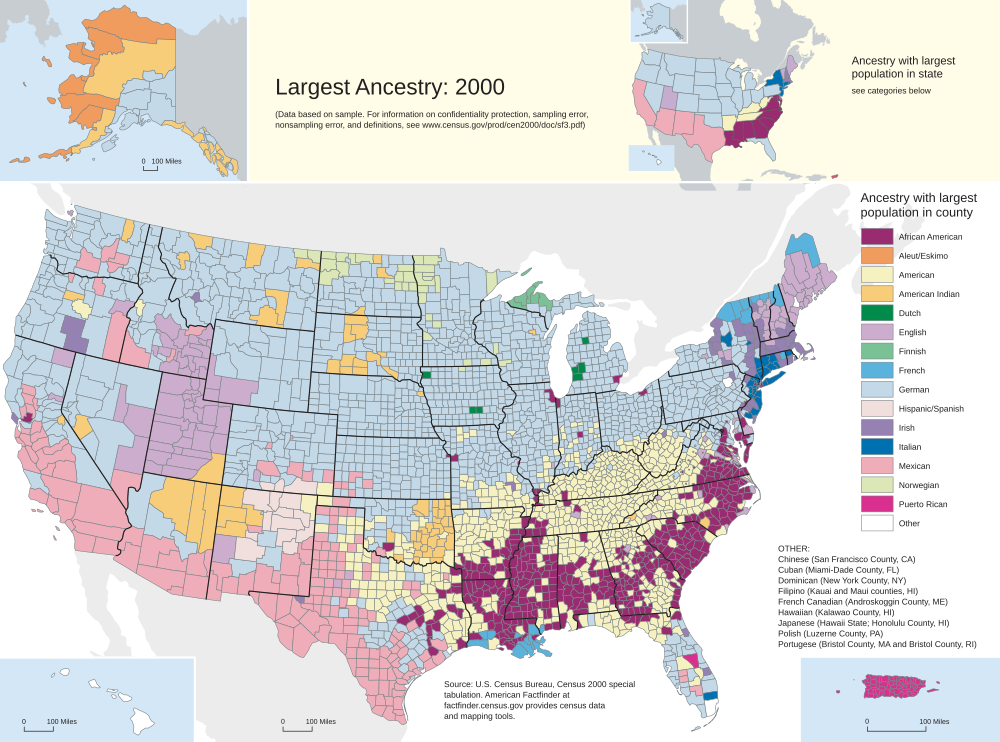
2000 US Census Data on Self Reported Ancestry
I often see people trying to determine which European ethnicity most Americans are descended from. Some attempt to use self reported ancestry from census data to show the major European groups Americans today claim to descend from. The trouble with this is that self reported data is unreliable and most Americans are a mix of ancestries but only able to report one. Many actually reported 'American', which although technically may not be inaccurate (if you have ancestors born in the US, then you have American ancestry - the census did not ask what our non-American ancestry was), it's not helpful for these purposes. Probably because of these reasons, the US Census has since dropped this question and therefore the most recent data for ancestry is from 2000.

Others try to calculate which group most Americans today have roots in by using immigration numbers plus basic multiplication to determine their population growth. The trouble with this is that the multiplication is an estimate, and again, so many Americans today are a mixture of European ethnic groups. In the end, we can only say that it's impossible to determine with any real accuracy which single European ethnic group most Americans today are descended from. But the immigration stats are still helpful by showing us the largest European groups to legally settle in the US.

Over the course of history, from colonial times up to 1969, the largest groups to immigrate were the Germans totaling just over 7 million, followed by the British totaling over 5 million. The Italians came in a close third, also equally just over 5 million, with less than 100,000 fewer than the British numbers. Finally, we have the Irish amounting to slightly more than 4 and half million. Those from Austria-Hungary came in fifth at a little over 4 million, and then the Russians with just over 3 million. Finally, we have those from Norway-Sweden with barely over 2 million, and if you add in the Danes and Finnish to maximize the Scandinavian results, it still only equals about 2 and a half million. The spreadsheet (linked below) shows numbers for more groups in case it interests you but none of them exceed 1 million.

When estimating the amount of descends today from each of these groups, it's important to consider the time periods in which they immigrated. The longer an immigrant has been here, the more descendants they will likely have because they had more time to multiple. For example, the Italians may have had more immigrants than the Irish, but the largest period of Irish immigration occurred decades before the bulk of the Italians arrived so theoretically, it's possible the Irish have more descendants. Considering many Irish and Italians intermarried, it would not surprise me if they were about equal though.

With this in mind, if you look at the stats I compiled in this spreadsheet, you'll see that the Germans and British not only have the highest immigrant numbers in total, but also are the only groups to have been consistently immigrating in mass numbers since colonial times all the way up to 1969. I think it's safe to say that most Americans today have German and/or British ancestry. It would probably be impossible to determine which out of the two of them would rank higher, and many people probably also have some other groups mixed in there - personally I also have Italian and Norwegian, but not everyone else will. But it seems obvious from these stats that most Americans with European heritage have some German and/or British ancestry, even if they don't know it.

Sources:
  1. Demographic History of the United States
  2. US Department of Homeland Security Yearbook 2008

Friday, February 14, 2014

Primary & Secondary Sources

In genealogy, we often come across conflicting data that leaves us wondering which fact is accurate, or more likely to be accurate, and therefore should be put into our tree. The best way to determine this is to understand the documents you're using, how and why they were recorded, and assess whether they are a primary or secondary source.

Marriage records, primary source for the marriage fact
but a secondary source for the birth fact.
A primary source is a document which was recorded at the time the event took place. A birth certificate is a primary source for a birth event, a marriage record is a primary source for a marriage, etc. Many documents also supply information of previous events, such as a marriage record listing the ages or birth years of the couple marrying. This is a secondary source, a document which was recorded well after the event occurred. So a marriage record is a primary source for the marriage event but a secondary source for a birth event. Needless to say, a primary source is more likely to be accurate than a secondary source, though that doesn't mean it's impossible for a primary source to be inaccurate too, but it's generally more trustworthy than a secondary source. Watch out for deceptive documents that might seem like they are a primary source but which may actually have been recorded years after the fact. This is why it's so important to understand what type of document it is that you're looking at and when it was recorded.

A secondary source can also be a document in which the informant is someone other than the individual that the document is about, particularly when it comes to information which is not really a time sensitive event, such as the names of a person's parents. A death certificate is a primary source for the death event in the sense that it is recorded at the time of the death, but can also be considered a secondary source considering all the information on it is supplied usually by a near relative of the deceased and/or a doctor/medical examiner. For example, a widow who never met her deceased husband's parents may provide their names incorrectly on the death certificate because she is a secondary source for that information. So with death records, it's especially important to examine who supplied the information and assess how reliable they might have been. Take into consideration that grief can confuse people and even close relatives can be estranged for so long that they don't know many of the facts of the deceased's life.

The other half of assessing a document's accuracy is understanding why and how it was recorded. Census records, for example, are frequently misunderstood by beginners to genealogy. I think in today's world, there is a common belief that any sort of government document is 100% accurate but that is certainly not the case. They're likely more accurate now than they were in history, because our record keeping has become more efficient, but even census records today are taken for demographic purposes, not identification. This means that it is not as crucial for many of the personal details filled out to be totally accurate. In the past, when censuses were taken by enumerators going door-to-door, this was especially true since there was more room for error, census records are like secondary sources twice over. The enumerator might have misheard or misunderstood the informant and don't dismiss the possibility that the informant themselves might have provided the wrong information. Generally, one person provided the information for everyone in the household, making them a secondary source for everyone but themselves. They might have been an in-law or youngster who wasn't confident about exact birth dates or locations, or a forgetful grandparent. If no one was home when the enumerator knocked on the door, they were supposed to return to the address later, but sometimes it was all they could do to simply ask a neighbor for your ancestor's details. Names and spellings weren't of the highest priority and I've even seen genders recorded inaccurately. Many censuses didn't even record a birth year or date, only the age of the individual and so naturally, this means that birth years calculated from an age are commonly out by a year or two. So everything on a census document should be taken with a grain of salt (except perhaps the date and location where the census was taken). This doesn't mean you should discount census data, but until you can confirm it with other, more reliable sources, keep in mind that the information from it might be subject to change at some point down the line. Birth years from census records should be input into your tree with "abt." (about) in front of them so you know it's approximate. Same goes for immigration dates, marriage years, etc. The census is a secondary source for all of these types of facts, except maybe if the event occurred immediately preceding the census.

Lastly, don't dismiss the possibility that an individual doesn't even know certain details about themselves, like when or where they were born, especially if they were born before the government began issuing official birth certificates. I know this seems impossible by our standards - how can someone not know when or where they were born? Didn't they celebrate their birthday? It's possible they did not. While birthday parties and birthday gift giving became popular in the 19th century, many poorer folk may not have been able to celebrate a birthday like we do today and certain cultures may not have participated. In any case, if an individual did not even know when or where they were born, naturally, recording these details in secondary documents would have been problematic and therefore they may vary on different records. This is why primary sources are so important.

Thursday, May 23, 2013

Seeking Margaret Ann McCracken Mills Bentley

New discovers in my own tree are fewer and farther between so to fill the gaps, I have also been periodically researching my husband's tree (as well as my sister-in-law's tree). This has been difficult because my husband has zero interest in genealogy - he doesn't mind me working on it but he doesn't know much about his family beyond his parents and doesn't see why he should. I've tried to tell him about my discoveries in his family tree but he just shrugs his shoulders. Sometimes, he pretends to be interested for my sake but I know he's just indulging me.

1901 Census of Bentley
family.
Click to enlarge
Anyway, I hit a roadblock rather quickly when looking for my mother-in-law's paternal grandparents, Francis (Frank) William and Margaret Ann Bentley. I quickly traced Frank's lineage back several generations but I didn't even know Margaret's maiden name, just that she was born in Salford, England around 1868.

In the 1901 census (left), I found them living in Salford with several children, three of whom were listed as Frank's stepchildren, Thomas, Sarah and Albert Mills. I also found an 1897 marriage index for Francis William Bentley to Margaret Ann Mills.

So is Margaret's maiden name Mills or is it her name from her first marriage? I don't know why I didn't just order the marriage record to see if her father's name was on it. Trying to cut corners, I guess. But Margaret married Frank in Salford when she was 29 and I couldn't find any earlier census records of an unmarried Margaret Mills born in Salford about 1868, even though she should theoretically be on the 1871, 1881, and 1891 censuses. So I was thinking it was more likely Margaret was married previously to a man by the name of Mills, given the names of Frank's stepchildren. There's also no record of Frank being married before Margaret so it's unlikely the Mills children are his orphaned stepchildren from a previous marriage of his own. Unfortunately, the children are too young to be found on the 1891 census so trying to trace Margaret through them is not possible.

1891 Census of Mills family
In the 1891 census, there are two married Margaret Mills who were born in the right area around the right time, one of them was married to Richard Mills and the other to Albert Mills in Oldham (just outside Manchester/Salford). Already, I am leaning towards Albert because we know Frank's stepson's name was the same. Sure enough, later census records confirm Richard Mills and his wife still living together when Margaret had married Frank so that rules out Richard. To further support the idea that Albert Mills from Oldham is the guy I'm looking for, I can't find him in the censuses after 1891 and there is a death index of what looks like him in 1895, two years before Margaret married Frank Bentley (but not before Albert Jr. was born the same year).

Another tree suggested that Margaret's maiden name was Warburton so I then found an 1889 marriage in the England & Wales FreeBMD Index suggesting Albert Mills had married Margaret Ann Warburton in Manchester. But the way the index works is by listing everyone on the same page without telling you who married who. However, the fact that they were on the same page (below, right) must not be a coincidence, right? The date fits, the names fit, the location fits.

Incorrect marriage index of Margaret Ann Warburton
Wrong! I tried to order the record under Margaret's name only to be told the record didn't exist. What? So I ordered it under Albert's name and it turns out, Albert had married the other woman on the list: Sarah Ann Weedle. Who did Margaret Ann Warburton marry? You may notice on the index listing to the left, there are five names listed, which is unusual because it's uneven amount and marriages come in couples, polygamy being illegal. As it turns out, Margaret Ann Warburton was transcribed on the incorrect page. If you view the original document, it says Vol. 8d, Page 358 but it was transcribed as Page 858, thus incorrectly listing her along with Albert Mills! So this Margaret Ann Warburton has NO connection to Albert Mills and this is why it's so important to look at the original document, not just the index. Looking at the index for Page 358, it looks like Warburton married either Daniel Silk or Christopher Harland. This is also why it's so important to be careful about what is added to other trees! I should really know better on both counts but everything did seem to add up at first.

Hopefully correct marriage index of Margaret Ann.
It still seems likely to me that Mills was Margaret's name from a first marriage since Frank has stepchildren with that name. And maybe it was the Albert Mills in Oldham she was married to - after all, the census of them in 1891 does list his wife as Margaret A. Mills, not Sarah. So where is the record for the correct Albert Mills marrying Margaret Ann? I don't know why but finding the likely candidate took some digging. I had to search only within the England & Wales Free BMD Index and restrict all the fields to "exact", then entered Albert Mills, married between 1887 and 1891 in Oldham. Then I did another one for Salford and finally found the record to the right. This makes sense because even though Albert was born in Oldham and he and Margaret lived in Oldham, Margaret was born in Salford. Additionally, I knew I'd seen the name McCracken somewhere else. Take a look at who is listed with Albert and Margaret Mills in the 1891 census above: a "visitor" Sarah McCracken.

I have since ordered Margaret's marriage record to Frank, which is what I should have just done in the first place but I thought finding her first marriage record would be more likely to give me her maiden name. I'm hoping that the full record for her marriage to Frank names her father, thus finally confirming her maiden name. Hopefully, it is McCracken and I will have redeemed myself in the eyes of the genealogy gods who had apparently forsaken me and taken me down a wayward path called Warburton.

In the mean time, I did some more research on McCracken and found Margaret's father was from Scotland. Excited, I told my husband that his mother may have had a Scottish ancestor and what does he tell me? "I already knew that." I must have looked aghast because he laughed and said "Oh, sorry, I meant to say 'Oh my God, that's brand new information!'" (Kudos to anyone who gets the 'Friends' reference).

On one hand, I'm glad because it confirms that I am on the right path with McCracken. On the other hand, I feel like strangling my husband for not telling me sooner.

Wednesday, January 16, 2013

Think Outside the Household

1850 US Census showing patriarch listed separately
from family household.
This is another one of those "how could I have missed this?" moments. Sometimes, I get so caught up in trying to find a family on a census that I forget to look for an individual on his or her own. Recently, I was reminded of this when I assumed a male ancestor died before the 1850 US Census was taken on June 1 because I had already found his wife and children living together but he was not listed among the household.

Land ownership map showing the
two properties of my ancestors.
In fact, he was still alive and recorded on the census, he was just listed separately. Why? Because, as I should have remembered, I had a land ownership map which proved he had owned two separate properties - one large, main one where I think the family was living and another, smaller lot not far away. My guess is that my ancestor was tending to the secondary property when the census taker came around. And sure enough, I found him listed on the very same census page, just two house away from his family! He was only listed by his initials, which is probably another reason why I overlooked him or why he wasn't showing up in any auto hints. I am unsure whether he was actually permanently living there or just there temporarily to tend to the secondary property but I lean towards the latter being the case.

This is also a reminder of why land ownership maps can be very important! Without it, I may have still been scratching my head as to why my ancestor was listed separately. I might have assumed he had a second property but without confirmation, the facts would have remained muddled.

1850 US Census showing son apprenticing in another
household.
Also be sure to look for missing children with other households - a neighbor or relative may have taken in a child if the family didn't have enough living space (or financially couldn't support all their children) or if the child was actually helping out around the property of an older neighbor or relative or may have been apprenticing with the head of the household. I also thought a child of the same family may have died before 1850 but then I found him apprenticing as a blacksmith with another family.

Tuesday, November 13, 2012

Norwegian Ancestry Online

A typical parish record from the Norwegian Digital Archives
Anyone with Norwegian ancestry should be aware of the biggest free Norwegian online database of records: The Digital Archives. Here you will find a wealth of information: censuses, parish records, property and tax lists, etc. The trick is finding the ones specific to your ancestors, which can be difficult because many of the records aren't indexed so you may have to manually go browsing through the scanned images. There are some ways to avoid this though.

But the easiest starting point is with the Norwegian National Censuses, since several of them are indeed indexed. You'll notice that they only have indexed censuses for 1801, 1865, 1875, 1900, and 1910. And given that most Norwegian immigration to the US occurred pre 20th century, you'll be lucky if you can make use of three of them. For me personally, all my Norwegian ancestors had left or died by 1865 so I can only benefit from the 1801 census. There are digitized records for earlier censuses but since the latest one is 1701, your research may not reach back that far just yet. There are also more censuses for local areas, which I'll cover below.

The other tricky thing about searching Norwegian records is their names. As I have described before, Norwegians were big on patronymic surnames for each generation, which meant that each individual had a different surname from their parents. For example, Ole Tronsen is the son of Tron Gundersen and his father was Gunder Leegsen. Not always knowing what an individual's parent's surnames were makes searching difficult sometimes but keep in mind that namesakes within families were popular. Also be aware that it was not an uncommon practice to name a child after their deceased sibling. This may seem insensitive, as though merely trying to replace a deceased child with another, but in the past, it was probably viewed as honoring and remembering the deceased. Lastly, some Scandinavian given names can be difficult to read, because they are unfamiliar to the rest of the world. Often, they do not appear on my given names reference source, BehindTheName.com, so a good reference for this can be found from FamilySearch.org's wiki: Scandinavian Given Names.

After you have found census records, the parish records will probably be your next and biggest source. Be aware that some of them are indexed over on another free source, FamilySearch.org. I believe these are the same records which have been indexed by volunteers in what's called The Digital Inn which can also be searched on the Digital Archives website here. Though I find FamilySearch much easier to use, they only have the BMD parish records, whereas the Digital Inn has all kinds of other documents including local censuses, another source not to miss.

With both FamilySearch and The Digital Inn, it's important to try alternate spellings. For example, one of my branches called Narum was alternately spelled Nærum and Norum. This brings me to another point about the Norwegian alphabet having extra letters: Ã¦, Ã¸, Ã¥ - so that's another thing to watch out for.

One thing to know about parish records is that an individual was often identified by the farm name they lived on. This often makes up for the lack of a consistent surname but of course individuals would move around, especially from generation to generation. But if you know a family lived on the farm named "Fladen", you can often more easily find siblings of ancestor by looking for the farm name.

But once you know what name, parish and date you're looking for, you can usually find the original document pretty easily. Keep in mind, of course, varying spellings can mean you might miss some indexes and sometimes it's good to browse through the images to see what you can find. This is not easy since they are hand written and in Norwegian. That's why I like to keep a "cheat sheet" of regularly used words in documents. Here's a few:
  • Fødte og døpte - Born and baptized 
  • Konfirmerte - Confirmations
  • Ekteviede - Wedded
  • Døde og begravede - Dead and buried
  • Trolovede - Betrothed 
  • Introduserte kvinner - Introduced women
  • tittel- og registersider m.m. - title and index pages etc
  • Kronologisk liste - Chronological list
  • Vaksinerte - Vaccinated
  • Enkemand - Widower
  • Ungkarl - Bachelor
  • Vigd - Marriage/wedding
  • Forl/Forlove - Engagement
  • Ã¥r - years
  • mÃ¥neder - months
  • uker - weeks
  • dager - days
  • alder / alderen - age / aged
If you need more translations, I always use Google Translate. Be aware that spellings have changed since some of these records were written and sometimes, abbreviations were used. Occasionally, I find that the translate app offers a slightly different spelling or that the original spelling is has other origins, like Danish.

Once you've got your census and BMD parish records, and therefore adequate vital data of your ancestors going back as far as possible, see if you can find any other records such as lax lists, land property documents, emigration parish records, etc.

I find the Digital Archives website is not super easy to navigate, in part because the English version doesn't always seem to "stick" when searching the indexes. This combined with the fact that many of the records aren't indexed at all, I think a lot of people don't use the website to it's full potential. Hopefully, this will help point you in the right direction but if not, just ask in the comments section below and I will do my best to answer.

Monday, August 27, 2012

Historical Fiction and Author's Notes

I'm going to take a slight diversion from the topic of genealogy for a moment and address an issue concerning historical novels. I am a historical fiction enthusiast as much as I am interested in non-fiction and genealogy but I am not the type that requires my fiction to be perfectly accurate. It is, after all, fiction and some creative license should be expected.

What concerns me is the issue of the Author's Note in the back of many historical novels in which it's become common for authors to detail which parts of the novel are factual, which are grey areas, and which are complete fabrications. This would normally be a great little educational tool but readers tend to take this as gospel, which they unfortunately shouldn't. In two specific cases, I have come across an Author's Note that contains false statements of fact.

The first of which was Jeanne Kalogridis' The Borgia Bride. It's an excellent work of fiction based on Sancha of Aragon, wife of Joffre Borgia (son of Pope Alexander VI, Rodrigo Borgia). But in her Author's Note at the end, she claims:
"Historians have speculated for centuries as to who actually poisoned Alexander VI and his eldest son. The mystery has never been solved."
My understanding is that most historians feel there is no conclusive proof that Alexander and his son were even poisoned at all. In fact, after reading The Borgias and Their Enemies by Christopher Hibbert, I am more convinced that they were merely the victims of a naturally occurring bacterial or viral infection. Take a look at the timeline detailed in Hibbert's work of non-fiction:
"On August 5, just four days before Cesare was due to leave Rome, father and son accepted an invitation to dinner at the villa of Cardinal Adriano Castellesi in the countryside some miles outside of Rome. On this occasion it was Cesare's health that caused the greater anxiety, since he was not only suffering from pain in his stomach, but also, according to Burchard, he was "much irritated by the skin on his face in the lower part, which falls apart like rotten leaves and results in a pus that he is much concerned to hide with his mask." On their arrival at Castellesi's villa, father and son were both extremely thirsty and asked for cups of wine, which they drank "most gratefully." It was a sultry evening, and the guests dined alfresco, thankful for the shade cast by the trees in the garden. The next day their host felt ill and went to bed; a week later the pope also took to his bed; Cesare then fell ill; so did several of the cardinal's other guests, as well as some of his servants. Poison was naturally suspected."
The illness Cesare was suffering from prior to the incident was Syphilis, though probably of no importance regarding this. Hibbert does mention that poison was suspected; it often was. But people at the time had little understanding of illness, disease, and poison. After all, they still believed malaria was caused by "bad air". With the knowledge we have today, one only needs to look at the timeline of events (which I've bolded) to understand that it could not have been poison. After the dinner at which they were supposedly poisoned, the host first falls ill the next day. A full week later, the pope takes ill and soon after, so does Cesare and several of the other guests and servants who had attended the dinner. I admit I am no expert on poison but I've never heard of one which, after only one dosage, takes a week to kick in and then kicks in hard. I can not see how that would even be medically possible. Gradual poisoning wasn't possible, not with so many ill who were all only in the same place one night. It seems more likely to me that this is the result of a natural disease and the timeline we're seeing is due to the incubation period (the time between one is infected and one shows symptoms). The host of the night was already infected but not showing symptoms yet (at least not strong or obvious ones, he could have been ignoring minor, beginning symptoms in order to host the party) and was unknowingly infecting many others at the dinner, since one can be contagious during the incubation period. With an incubation period of about one week, everyone else at the party who had been infected suddenly comes down ill too.

Surely, that makes more sense than an unknown poison which, after only one dose, takes a week to kick in and then somehow is powerful enough to kill? And ultimately, the fact of the matter still remains that most historians don't conclusively believe Alexander's death was the result of poison. I did not have a problem with the use of poison in the novel but I do have a problem with the author claiming that Alexander and Cesare were indeed poisoned when there is no proof of that and little evidence.

The second inaccurate Author's Note I came across was found in Jessica McCann's All Different Kinds of Free, a novel based on the life of Margaret Morgan and the Prigg vs Pennsylvania case regarding slavery laws and whether escaped slaves in Pennsylvania could be returned to their owners in the south or not, especially with no documented proof of their ownership. Margaret Morgan had claimed to be free but was captured and returned to the south where she was sold into slavery. In the Author's Note, McCann claims that Margaret was indeed free, not a slave, when she went to Pennsylvania and as evidence of this states:
"In fact, in the 1830 U.S. census, she, her husband and their children were recorded as 'free blacks' by the county sheriff."
It's true that there is an 1830 U.S. Census record of a black Jerry Morgan, who McCann claims was Margaret's husband, living in the right area. What she fails to inform the reader of is that Margaret's husband's name is lost to history and that in the 1830 census, only the "head of household" is recorded by name. Here is where knowledge of genealogy research does come into play a little bit because every genealogist knows that you can't make assumptions like this. McCann is assuming Jerry Morgan was Margaret's husband without any proof of it since Margaret is never named on the census herself. Could it be an accurate assumption? Yes, it's possible that Jerry Morgan was Margaret's husband and that they were free and therefore Jerry's name was recorded on the 1830 census. But it's also possible they were escaped slaves whose names were never recorded on the 1830 census and Margaret's husband's name was something else entirely. Naturally, it goes without saying that regardless of their slave status, Margaret's fate (being sold into or back into slavery) was immoral. But that doesn't justify making false statements to suit one's agenda. I certainly don't have a problem with Margaret being portrayed as free in the novel or even if the author personally believes Margaret was free - I would like to believe the same thing. But she still needs to be clear about the facts in the Author's Note, which she wasn't. Had she explained that the census record may not be Margaret's family but that she believes it is, fair enough, I'd have no complaints. But don't claim something is factual when you're actually only making assumptions.

While I respect all the hard work and research that goes into any historical novel, it's important to remember that if you would not use it as a credible source for an academic study, it's best to take it with a grain of salt. You wouldn't cite the Author's Note from a novel in an academic report of the topic so don't take it as gospel. The author can make mistakes or might be motivated to exaggerate the facts, even within the Author's Note, to lend authenticity to their story, making it more interesting to the reader. It's possible these were rare cases and that most Author's Notes can be trusted; I am not criticizing all historical novelists, I respect and admire most of them. But as I am not an expert in all fields of history, how can I know what to trust and what not to? So just keep this in mind the next time you read an Author's Note in a historical novel.

I will step off my soapbox now and return to genealogy in my next post!