Yesterday, I clicked on a match to discover the old "Match Review" page and the newer "Compare" page had been combined into one. I kind of figured that's where they were headed with the changes they'd made to the beta match list, but I was pleased to see it finally happened.
Previously, there were certain features and tools missing from the newer "Compare" page, but the new "Common Ancestors" wasn't featured on the older "Match Review" page meaning you often had to open both pages to make full use of your matches. Additionally, there was no way to add a match to a group from either page, you could only do so from the match list. All of that has been resolved now, and they also reduced the size of the profile pictures, which previously took up almost the whole page on smaller screens - a complete waste of space that only forced us to scroll down more to see any useful information. These were some of my top complaints and now they're all fixed.
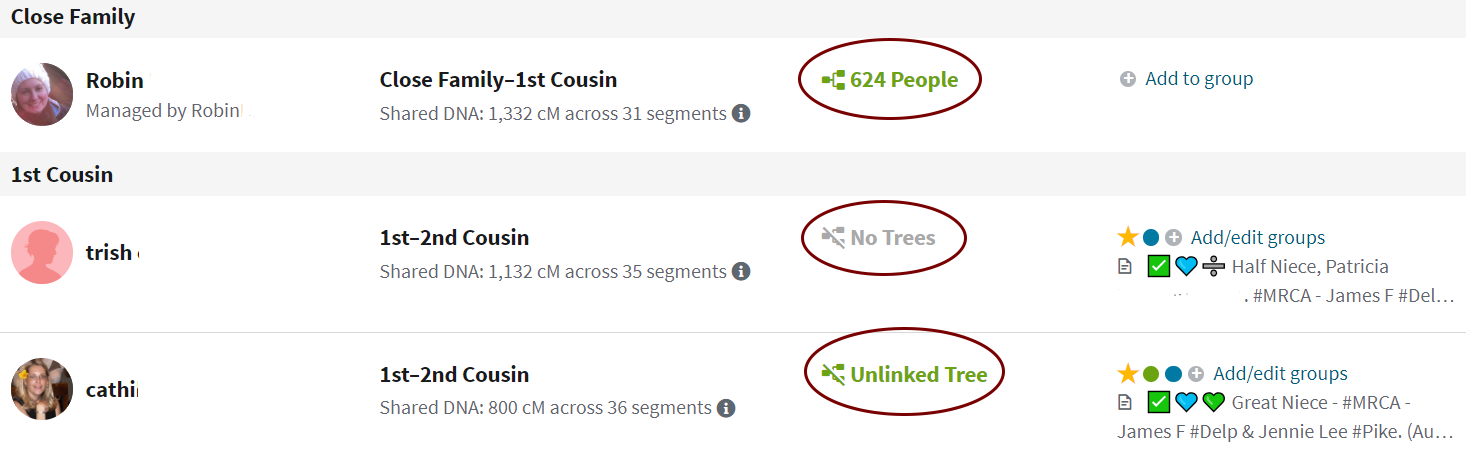
As you can see from the screenshot above, everything you need to make use of your matches (well, everything that AncestryDNA current offers) is on the single new page. You can add and edit notes, you can add the match to a group, you can see how much DNA you share without even having to click on anything, the pedigree preview is there (with the option to open their full tree), and Common Ancestors will show on the left if there are any. There's also the option to click on a built in tab to see your compared ethnicity and one for Shared Matches.
Where are the surname lists and location map? Don't worry, they're just a little further down the page (screenshot to the right). The only disappointing thing is that these no longer show all the way back to 10 generations, and the pedigree preview no longer shows back to 7 generations. They are now all limited to a mere 5 generations, which seems much too restrictive in my opinion. That means they only include back to your 3rd great grandparents, which means they will only apply to as distant as 4th cousins! I think we can all agree that there are many, many more distant yet legitimately identical by descent matches than that. Even ThruLines/Common Ancestors goes back further than that (5th great grandparents, or 7 generations). What this means is if there's no ThruLines/Common Ancestor found for a match, we're going to have to open up more pages to explore most matches deeper for a common ancestor, and that seems counter-productive to an efficient workflow. It almost feels as though AncestryDNA is trying to force us to be more reliant on ThruLines than anything else, which would be a big mistake considering ThruLines will only ever be as reliable as the trees it's using.
If you agree with these complaints and/or have any others of your own, remember to keep sending feedback to AncestryDNA through the "Prodvide Feedback" option in the bottom right corner of your match list page!
Friday, April 26, 2019
Monday, March 4, 2019
New Tools from AncestryDNA
| ThruLines from the DNA homepage, you can still go back to DNA Circles |
ThruLines works by automating sort of what I've been advocating people do manually for years: build on your match's trees to find a connection. Instead of only looking at your tree and the trees of your matches (like Shared Ancestor Hints and DNA Circles did), ThruLines looks to other trees outside your DNA matches to make the connection between you and your matches by building on both trees (much like how the We're Related app worked). As with anything tree-related, be careful about the connections it makes - I noticed one potential ancestor showing up because the system decided my ancestor Kate White was the same as someone called Katherine Weiss, which is German for White, but my Kate White is Scots-Irish, not German. And of course even putting aside the system making connection errors, the research other users do on their trees may be wrong.
| ThruLines details/pathway |
If you've enabled the beta match list, you'll see some quite drastic changes (shown above). Your match list is now on an infinite scroll, color/custom groupings have been added, and you have several new sorting and filtering options. I don't love the infinite scroll - although the additional sorting and filtering options does make an infinite scroll less cumbersome, it is still cumbersome when you consider you have literally thousands of matches. That's a lot of data for an infinite scroll and basically assures you'll never reach the end of the list even when using most filtering options to narrow the numbers down. Additionally, if your browser crashes or you have to shut it down for any reason, you will lose your spot in the infinite scroll. With pagination, you can just note the page you were on and jump back to it, but that's not possible with infinite scrolling. While you may be able to find the spot you left, it's still going to take time to scroll, scroll, scroll down until you finally reach it. Infinite scrolling is not very functional and I really hope AncestryDNA's developers reconsider it.
Custom groups offer 24 different colors (shown above and right), so you can now group your matches however you want, such as a different group for each of your sixteen 2nd great grandparent's branches, and then a few more for other options (like maybe a group for a certain location, or an unknown cluster you've noticed, or matches you've identified a MRCA with, etc). You can add one match to as many different groups you'd like and each group gets a name that appears if you hover over the colored dot. This may eventually replace what I've been using the emojis for in the notes section (you can see they are still in my screenshot above), but not just yet since at the moment, groups are only available on the match list page, not the match detail page(s). So I still need emojis as a visual reference on the match detail page. I imagine this may change in time. The new match list is, after all, an opt-in beta mode and I'm sure there are tweaks and additions to come. If groups get added to the match detail page(s) then emojis might become unnecessary, unless you're using more than 24 of them (I am not). The benefit of groups over emojis is that you can filter by groups. And although Chrome extension MedBetterDNA allows you to filter by hashtags, it was cumbersome since it only hid matches without the selected hashtag and did not condense them - so a match with the selected hashtag on page 50 of your matches would still be on page 50. That is no longer a problem with AncestryDNA's groups (or infinite scroll, although that has it's own issues addressed above), however, since groups are limited to only 24 options, whereas hashtags are unlimited (there's a limit of how many you can search at a time in MedBetterDNA, but you can use as many as you'd like), don't get rid of those hashtags either. I still have all identified surnames hashtagged (and will continue to add them) because groups being limited means I can only use them to identify branches, not individual surnames, as there would be too many surnames to use with groups. So groups will likely replace emojis eventually, with added benefit of filtering groups, but it will not replace hashtags used with MedBetterDNA. Additionally, MedBetterDNA's essential feature of being able to always show notes means this extension isn't going to become obsolete. It's functionality has been influenced by the beta updates, but the extension's developer expects to update it to work with the new match list once the beta goes public (likely a few weeks after the new match list gets pushed out to everyone).
Under filtering, a separate drop down menu (shown left), you can view matches with a "Common Ancestor". This appears to be replacing Shared Ancestor Hints, and it will include speculative ThruLines, so it's basically just another way to view your ThruLines (viewing them by individual match rather than by ancestor, which is what you see when you click on ThruLines from your homepage). The major downside to this, and I have already sent feedback to AncestryDNA on it, is the fact that there is no way to view only matches which have an actual common ancestor in both our trees versus those which are much more speculative because it's finding connections through other trees. There should be a way to separate them, as there is a noteworthy distinction between them. If you find this problematic as well, please make sure to send them feedback in the lower right corner of your browser while in beta mode (shown below/right).
Additional filtering includes "matches you haven't viewed". In the past, there was a "new" button which showed all matches you hadn't viewed yet and you could sort them by relationship or date. This is now split up so you can view new matches by date (including ones you've viewed) from the "Groups" drop down menu, or view matches you haven't looked at yet which is sorted by relationship from the "filter by" drop down menu. Personally, I use the latter the most, because I've made a point of looking at each estimated 4th cousin or closer and trying to figure out how we're related, so now when new matches come in, I periodically just look at new estimated 4th cousins or closer and examine them to stay on top of it.
Among the new filtering options include viewing matches you've messaged, matches with notes (very useful!), and matches with private, public, or unlinked trees, the latter being something we've all been asking for for years! Finally!
Best of all, you can combine options between the "Group" dropdown and the "Filter by" drop down menu. So if you want to see matches who you've you've sent a message to and labelled on your Smith branch, for example, you can do that.
| Clicking the circled items opens the old "view match" page with the pedigree preview, etc |
All of these new features and tools could be hugely beneficial, but my main disappointment is in the organization of much of it. In the past, clicking on a match opened the "view match" page we were all used to, including all the most useful features: pedigree preview, surname list, shared matches, map/locations, notes, and the option to message, star, trash, or mark as new. Somewhat recently, there was also added a "compare" button that took us to a different page which showed the comparison of our ethnicity reports, which was very interesting, but typically not very useful. Now with the update, clicking on a match's username takes you to that "compare" page instead, which does include shared matches and potential common ancestors, but does not include the ability to add or edit notes! It also won't show notes of the shared matches listed. Fear not, the old "view match" page with the pedigree preview and other features is still available: from the "compare" page, you can click "pedigree tree" or you can go straight to it by clicking on the tree info in the third column of your match list (even if there's no tree or it's private) - see above (edit: this option has now been removed, in order to get to the pedigree preview page, you can now only do so from the "compare" page). The problem is, the old "view match" page no longer includes Shared Ancestor Hints - in order to view them (now called Common Ancestors, or Potential Ancestors as a part of ThruLines) you have to look at the "Compare" page. And in order to view the details of those potential ancestors (part of ThruLines), it will open a third page! On top of all that, groups can only be added from the match list page, meaning in order to use all useful features, you have to switch back and forth among FOUR different pages. I can understand ThruLines being on a separate page because it's very detailed, but I see no reason why they can't combine the "Compare" and "View Match" pages and/or add grouping to those pages. It's ridiculous that the features are split among them, it's going to make my workflow that much less efficient. If you feel the same, please use the feedback option to make sure AncestryDNA know!
If AncestryDNA could resolve the two bolded issues, it would be almost perfect - now all we need is a chromosome browser and we're all set, but apparently that's never going to happen due to "privacy" issues.
Coming soon, I'll detail the new features from MyHeritage.
Thursday, January 24, 2019
24genetics Review
| My European countries map from 24genetics |
Most of the reports from uploaded DNA say they accept data from 23andMe or AncestryDNA, except the ancestry report, which says it will accept DNA from 23andMe, FamilyTreeDNA, AncestryDNA, or MyHeritage. The ancestry test costs $49, and the rest cost $69. You can order a promo pack including ancestry, sport, nutrition, and skin for $99. These also seem expensive for what you get, considering they don't have to run your DNA through a lab, so I only purchased the ancestry report and uploaded my raw DNA data from 23andMe.
The report is sent in an email as a PDF, much like how DNATribes before they discontinued their upload offer. In the PDF, you get an ethnic break down of your DNA first on a continental level called "Global Vision", then a country level, and finally a regional level. Like most ethnicity reports, they say the results date back "hundreds and even thousands of years".
| My country results from 24genetics |
EUROPE 99.20%
ASIA 0.80%
Most likely, the Asian results are just noise. You'll see in the country and regional break down that my Asian results are in a part of Georgia, in the Caucasus area (just above the Middle East), so it's possible this is related to my southern Italian ancestry, but given the small percentage, it may just be noise and not mean anything.
Great Britain 33.80%
Italy 30.00%
Austria 17.10%
Greece 8.20%
Netherlands 5.60%
Switzerland 2.30%
Finland 2.20%
Georgia 0.80%
The top two results are very accurate, my family tree is indeed roughly 32% British, and I did in fact inherit about 32% of my DNA from my Italian grandmother. But rest of the results aren't very consistent with my known ancestry. The smaller results could just be noise, and I'm guessing the Austria result is coming from my Germanic ancestry. I'm not sure where the Greek is coming from, since the only Mediterranean ancestry I have is already fully accounted for in my Italy results.
![]() |
| AncestryDNA's PCA chart showing reference panel populations and their genetic distance to each other |
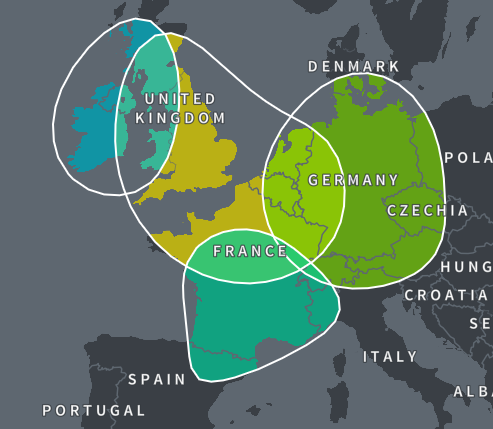
Maps are provided for the results, first showing the highlighted countries on a global scale (above right), and then zooming in on Europe (above left). I guess my one small result in West Asia didn't warrant a zoom in.
| My regional results |
Essex Medieval 32.30%
Tyrol 17.10%
Apulia 15.80%
Lombardy 13.60%
Utrecht 5.40%
Crete 3.20%
Kythera 3.00%
Romandy 2.30%
Finland Karelia 2.20%
Andros 2.00%
Cornwall 1.50%
Georgia Svaneti 0.80%
Treviso 0.60%
Groningen 0.20%
Essex Medieval is an interesting result because it specifies a time period as well as location. I wonder why the other results don't include a time period? I do indeed have ancestry from Essex, although there's a few branches from there, they are all from fairly far back on my tree, in the 1500s. I suppose that's consistent with the Medieval timeline, however, they seem to be attributing almost all my British ancestry to Medieval Essex, yet I have British ancestry from many other locations, some from much more recent time periods too (which should account for more of my DNA).
| My European regional map |
Apulia is an area of southeast Italy. I have no known ancestry from there, but my Italian ancestry is indeed southern/Sicilian, not northern, so I'll give it points for that. However, Lombardy and Treviso are a part of northern Italy, where I have no known ancestry.
Next is Utrecht, a city in the Netherlands. I don't know where in the Netherlands most of my Dutch branches come from, but one of them is actually from Utrecht, and another from Amsterdam. But let's face it, the Netherlands is a pretty small country (though it was once larger), so I'm not really sure how distinct DNA from different parts of it really are from one another - Amsterdam is really not that far from Utrecht (about 27 miles). Although this is a small percentage, my Dutch ancestry is from far back on my tree, so I would expect it to be a small percentage, if it would show up at all. I also get a very small hit (possibly noise) for Groningen in the Netherlands, where I don't have any known ancestry.
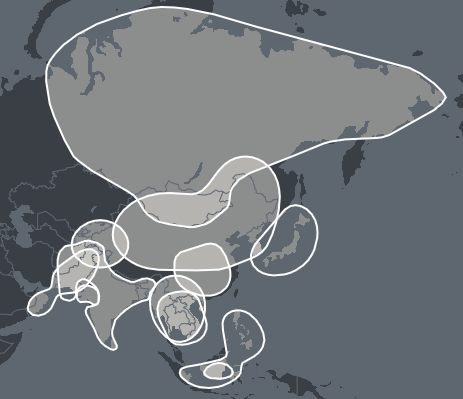
| My Asian regional map, probably noise |
Overall, I feel like my top most results from this company are accurate but it's missing significant locations and the smallest percentages are likely just noise. An interesting assessment, especially the more specific break down that you don't always get from other companies, but as with any ethnicity report, don't take it too literally. Worth the money? Probably not, maybe if it was cheaper.
Tuesday, January 22, 2019
Breaking Down Brick Walls with DNA
I'm going to detail one example of how DNA helped me break down a brick wall in my tree. This may be a somewhat unique case that might not always apply to every situation, but it's still worth detailing so people can get an understanding of how to work with your DNA matches in general.
My 4th great grandmother was Hope Gibbs, b. November 3, 1805 in Philadelphia. I knew from her baptism record that her parents names were Caleb and Isabella (maiden name unknown), but I didn't know anything else about them. My grandmother had left notes with the names and some details of Hope's sisters, and indeed, research of some of them not only confirmed those details but also listed Caleb and Isabella as their parents, but still no details on those parents. I even found some DNA matches who were descended from those sisters, but none of those matches knew more about their parents.
I then found a marriage record of a Caleb Gibbs and Isabella Brannin in 1799, in Mt Holly, Burlington, NJ (Ancestry.com wrongly transcribed the location as Philadelphia), but given the difference of location, how could I know it was the right couple I was looking for? Further research on the couple married in 1799 revealed they were Quakers, and Isabella was the daughter of Barzillai Brannin/Branin, and the granddaughter of Michael Brannin/Branin, but I still was unsure about the connection to Hope Gibbs. Were these really her parents?
It took me a while to think of this for some reason, but I eventually decided to look for the surname Brannin in my DNA matches (well, my mom's DNA matches, since she is one generation closer to the ancestors in question). Theoretically, I figured if my Isabella was a Brannin, I (or my mom) would have DNA matches with people descended from her father or grandfather, I just hoped Brannin wasn't so common of a name that I got unrelated hits for it among my matches. It would be much more difficult if the name was something like Smith, and indeed, I had previously tried to search my DNA matches for the Gibbs surname, hoping to find people who descended from a father or grandfather of Caleb, but Gibbs was too common of a name and I was getting results for DNA matches with obviously unrelated Gibbs ancestors due to their location or time period (my DNA relation to these matches obviously lies elsewhere and the Gibbs surname is just a coincidence).
But the results and conclusions of the Brannin surname search were almost instantaneous - I quickly found 10 DNA matches descended from either Barzillai or Michael Brannin (two shown above), which would only be likely if I was descended from or at least related to them genetically. Not all recurring ancestors among your DNA matches will be your ancestors, some may be related to you in other ways, but combined with the existing question of whether my Isabella was Barzillai's daughter, the DNA matches conclude that the two Isabella's were indeed the same. Worth noting is the fact that two of the ten matches shared a segment with my mom of over 14 cM, which has over a 99% chance of being identical by descent, so these are not false positive matches. Also worth noting is the fact that some of the ten matches I found I had to uncover myself because their trees didn't go back far enough, but with a little digging, I expanded on their tree and trace their Brannin line back to Barzillai or Michael. Sometimes, you have to do a little of the legwork yourself.
Quakers are good record keepers, so confirming Isabella's identity was a huge breakthrough for me, and I then spend the next few days building this new branch of my tree, going back several more generations on both her paternal and maternal sides, something I couldn't have been sure of if I hadn't found the DNA connection. Of course, this also confirmed Caleb's identity as the man who married her, but unfortunately the Quaker records didn't go back as far for his ancestry. It at least confirmed his parents as Samuel Gibbs and Mercy (maiden name unknown).
By the way, if you're wondering about the notes showing simultaneously with both DNA matches in the screenshot above, that is with the use of Chrome extension MedBetterDNA. It allows you to always display notes so you can refer to them quicker and easier. It also has a lot of other useful tools, like the the hashtag option, which you'll see I'm also making use of - it lets you search your matches by hashtags in the notes field, so you can more quickly find the matches you're looking for. You may also notice the emoji icons I'm using - the green check mark and the black heart. There's no hidden meaning to the black heart, I'm just using it as a quick visual reference for that particular branch of my tree. Every one of my 2nd great grandparents gets a unique icon for their branch and I was running out of heart colors - that may seem excessive with 16 second great grandparents but it's working for me. The green check mark denotes matches with whom I've identified our most recent common ancestor. As a visual person (I am a photographer, after all), I just find the icons help my brain sort my matches. For non-windows users, you can also make use of flag emojis (the flags don't work on Windows for some reason) to identify matches with a MRCA from a known country.
I hope this helps illustrate how you can use your DNA matches to confirm questionable branches like this. Keep in mind that the further back the ancestors you're looking for are on your tree, the less likely you'll be able to reliably use or find identical by descent DNA matches descended from those ancestors. In this case, we were looking at my mom's 5th or 6th great grandparents, meaning she'd be around 6th or 7th cousins with those DNA matches, which is still within the realms of identical by descent.
![]() |
| Hope's baptism confirming her parent's names, but not her mother's maiden name. |
I then found a marriage record of a Caleb Gibbs and Isabella Brannin in 1799, in Mt Holly, Burlington, NJ (Ancestry.com wrongly transcribed the location as Philadelphia), but given the difference of location, how could I know it was the right couple I was looking for? Further research on the couple married in 1799 revealed they were Quakers, and Isabella was the daughter of Barzillai Brannin/Branin, and the granddaughter of Michael Brannin/Branin, but I still was unsure about the connection to Hope Gibbs. Were these really her parents?
It took me a while to think of this for some reason, but I eventually decided to look for the surname Brannin in my DNA matches (well, my mom's DNA matches, since she is one generation closer to the ancestors in question). Theoretically, I figured if my Isabella was a Brannin, I (or my mom) would have DNA matches with people descended from her father or grandfather, I just hoped Brannin wasn't so common of a name that I got unrelated hits for it among my matches. It would be much more difficult if the name was something like Smith, and indeed, I had previously tried to search my DNA matches for the Gibbs surname, hoping to find people who descended from a father or grandfather of Caleb, but Gibbs was too common of a name and I was getting results for DNA matches with obviously unrelated Gibbs ancestors due to their location or time period (my DNA relation to these matches obviously lies elsewhere and the Gibbs surname is just a coincidence).
By the way, if you're wondering about the notes showing simultaneously with both DNA matches in the screenshot above, that is with the use of Chrome extension MedBetterDNA. It allows you to always display notes so you can refer to them quicker and easier. It also has a lot of other useful tools, like the the hashtag option, which you'll see I'm also making use of - it lets you search your matches by hashtags in the notes field, so you can more quickly find the matches you're looking for. You may also notice the emoji icons I'm using - the green check mark and the black heart. There's no hidden meaning to the black heart, I'm just using it as a quick visual reference for that particular branch of my tree. Every one of my 2nd great grandparents gets a unique icon for their branch and I was running out of heart colors - that may seem excessive with 16 second great grandparents but it's working for me. The green check mark denotes matches with whom I've identified our most recent common ancestor. As a visual person (I am a photographer, after all), I just find the icons help my brain sort my matches. For non-windows users, you can also make use of flag emojis (the flags don't work on Windows for some reason) to identify matches with a MRCA from a known country.
I hope this helps illustrate how you can use your DNA matches to confirm questionable branches like this. Keep in mind that the further back the ancestors you're looking for are on your tree, the less likely you'll be able to reliably use or find identical by descent DNA matches descended from those ancestors. In this case, we were looking at my mom's 5th or 6th great grandparents, meaning she'd be around 6th or 7th cousins with those DNA matches, which is still within the realms of identical by descent.
Wednesday, January 16, 2019
Genealogy Photos and Copyrights
![]() |
| Unknown women, possibly sisters. The backs of these are stamped with photog's info, J. Bronson of Philadelphia, who died 1914 |
Many people seem to be under the impression that because they inherited a photograph, particularly one of their ancestor, it means they own all rights to the image, and get upset when someone else, usually another descendant or relative of that ancestor, "steals" it and adds it to their own tree, or shares it in some other way, especially without "permission" or at least "giving credit" to them. Sure, it might be a little rude, but before you get outraged and indignant, first be sure that you really understand copyright ownership.
Most family photos are unpublished works, which means (unless otherwise agreed upon, which isn't typical) the copyright is retained by the photographer for the duration of their life plus 70 years after their death. How can a copyright be retained by someone deceased? Just like any property, their heirs inherit it. So unless you or your ancestor took the photograph, you do not own the copyright, and if the photo is still in copyright, you may actually be the one committing copyright infringement by publishing it online without the photographer's or their heir's permission. It isn't exactly fair to get angry at someone for "stealing" a photo you had no right/permission to publish online to begin with.
If the copyright has expired (so it's been 70+ years since the photographer's death), then no one owns it and no one is legally doing anything wrong by copying a photo you shared. Sure, it might be a little rude to do so without a thank you, but when you make an expired copyright image publicly available, you have to assume it's going to get copied, because people are going to assume you put it out there to share it, not just show it off. And as for "giving credit" - I can certainly see the value in identifying the source of who originally scanned and shared the photo, so that any questions about it can be redirected back to you, however, that is called citing a source, not giving credit. (While on the topic of giving credit, it is also worth noting that when an image is still in copyright, giving credit even to the rightful copyright holder does not absolve you from copyright infringement, only plagiarism. Copyright is the right to publish, distribute, alter, etc so if you do not own the copyright and did not get permission to do so, you do not have the right to publish it, even if you "give credit". A lot of photographers today will let it slide as long as you do give credit, because it's free advertising, but that's their prerogative, they still have the right to send you a cease and desist letter if they want to, so it's always better to get permission first.)
Maybe your ancestor did take the photograph. Maybe your ancestor was a professional photographer, or it's just a candid snapshot taken among family with a personal camera - they were available from 1900 onward, so it's very possible. Generally, professional shots are easily distinguishable from family snapshots, at least in history (today, there are lots of amateur hobbyists as good as professionals). Don't be fooled into thinking unprofessional photos aren't copyrighted, they are. The trouble with them is knowing who took it. If you can determine the photographer as your ancestor (pro or not), and that ancestor died less than 70 years ago, then congratulations, you probably do hold the copyright for that photograph. Only catch is, probably so do all the other descendants of that same ancestor, and if one of them was the person who copied the photo you shared, then technically, they are well within their rights to do so.
In conclusion, the only situation where you have any ground to stand on when accusing someone of "stealing" photos you shared of your ancestors is if your ancestor took the photograph, died less than 70 years ago, and the person copying the photo is not also a descendant of that photographer (pro or not) ancestor. I understand even if it's not a copyright violation, it still bothers people when someone doesn't say a simple "thank you", but all I can say to that is if it really bothers you that much, don't put photos online, or make your tree private (note: private trees are not available at FamilySearch or Wikitree). But if you do put them publicly online, and you're not the copyright holder, then you really have no one else to blame but yourself.
The photographs I've included above as examples were stamped on the back (shown right). J. Bronson turns out to be James (aka Jay) Bronson who was born May 23, 1862 and died April 13, 1914. Since this was well over 70 years ago, it means his photographs are assuredly in the public domain, which means I'm not only free to publish them without permission, I also really have no room to complain if someone wants to copy them. I would hope that anyone who does though could cite my blog as the source so anyone with questions about them, or seeking higher quality versions for printing, or anyone who knows who these women are can get in touch with me.
On another note, I have been unable to find Bronson at this particular address of 46 Main Street, Germantown, Philadelphia, Pennsylvania. Although there are many other listings of him on Main Street (aka Germantown Ave), none at number 46. That makes it difficult to narrow down the dates of the photos, but I believe they were taken at the same time, and that the similarity of their dresses suggests they may have been sisters. I'll go into more detail on this in another post.
The Legal Genealogist goes into more details about copyright laws in different situations, but I focused on the most common situation for most genealogists with photos of their ancestors, as it's the most applicable.
Sources:
Monday, January 14, 2019
Dating Old Photographs: Example #4
A cabinet card of an unknown woman. I have a lot of unknowns in my family's collection, and I think many of them were actually friends or distant relatives of my ancestors that my family simply held onto even though they weren't labelled. Given the location and time period of most of them, I think they were probably friends or relatives of my Rorer or Fallows ancestors in the Philadelphia area.
Estimated date: 1892-1893
The first thing I looked for was the photographer. It may not look like anything more than a decorative flourish at first, but that swirly thing in the middle of the bottom margin is the photographer's monogram and if you look closely it's the initials A.P.K.T. City directories tell me this was Albion K.P. Trask and that his photography studio was found at 1210 Chestnut Street in Philadelphia from 1879 to 1893. This narrows it down to almost a decade.
The curly/frizzy bangs (or fringe, if you're British) were popular throughout the 1880s and into the early 1890s as well, so her hairstyle is very consistent with the photographer's studio years.
The dark color of the cabinet card is also telling. These were used from about 1883 to 1895, although they were more expensive, so lighter cards were still dominant at the time. This helps narrow down my time frame, but can I narrow it down further?
The clothing she's wearing is very interesting. From time to time, I see this kind of beaded embroidery on the chest, especially on shiny, satin material like this. It seems to have been popular in the late 1880s and early 1890s. Given the lack of puffed shoulders or sleeves, I would normally think it's more likely to be late 1880s, but I can't completely rule out early 1890s. Just because a certain trend was fashionable during an era doesn't mean it was the only thing people wore.
Even more telling is the back of this cabinet card. The artwork covers nearly the entire back of it, which according to Phototree puts it in the range of 1888-1900. But most notably is the beveled edges. You might be able to see them in the image above, decorated in gold. Phototree tells us that beveled edges were used 1892-1900. We already know this particular photo is not later than 1893, due to the photographer's address, so the beveled edges narrows it down to 1892-1893.
The other elements, though they may not have narrowed it down this far, are still worth noting and knowing for other photographs, and understanding more about the subject. The extra expense of the dark card and the elaborate artwork on the back of the card suggests this photographer was on the pricier end of the scale, and that tells us something about the woman in the photograph too, she obviously wasn't exactly poor. This also helps me narrow down which branch of my tree she came from (even if she was only a friend of that branch).
On another note, the photographer Albion K.P. Trask was born about 1831, and died November 11, 1900, which was well over 70 years ago, meaning that the copyrights of all of his photographs are expired and now in the public domain. This leaves me (and anyone else) free to share and publish his photographs without permission.
Estimated date: 1892-1893
The first thing I looked for was the photographer. It may not look like anything more than a decorative flourish at first, but that swirly thing in the middle of the bottom margin is the photographer's monogram and if you look closely it's the initials A.P.K.T. City directories tell me this was Albion K.P. Trask and that his photography studio was found at 1210 Chestnut Street in Philadelphia from 1879 to 1893. This narrows it down to almost a decade.
The curly/frizzy bangs (or fringe, if you're British) were popular throughout the 1880s and into the early 1890s as well, so her hairstyle is very consistent with the photographer's studio years.
The dark color of the cabinet card is also telling. These were used from about 1883 to 1895, although they were more expensive, so lighter cards were still dominant at the time. This helps narrow down my time frame, but can I narrow it down further?
The clothing she's wearing is very interesting. From time to time, I see this kind of beaded embroidery on the chest, especially on shiny, satin material like this. It seems to have been popular in the late 1880s and early 1890s. Given the lack of puffed shoulders or sleeves, I would normally think it's more likely to be late 1880s, but I can't completely rule out early 1890s. Just because a certain trend was fashionable during an era doesn't mean it was the only thing people wore.
Even more telling is the back of this cabinet card. The artwork covers nearly the entire back of it, which according to Phototree puts it in the range of 1888-1900. But most notably is the beveled edges. You might be able to see them in the image above, decorated in gold. Phototree tells us that beveled edges were used 1892-1900. We already know this particular photo is not later than 1893, due to the photographer's address, so the beveled edges narrows it down to 1892-1893.
The other elements, though they may not have narrowed it down this far, are still worth noting and knowing for other photographs, and understanding more about the subject. The extra expense of the dark card and the elaborate artwork on the back of the card suggests this photographer was on the pricier end of the scale, and that tells us something about the woman in the photograph too, she obviously wasn't exactly poor. This also helps me narrow down which branch of my tree she came from (even if she was only a friend of that branch).
On another note, the photographer Albion K.P. Trask was born about 1831, and died November 11, 1900, which was well over 70 years ago, meaning that the copyrights of all of his photographs are expired and now in the public domain. This leaves me (and anyone else) free to share and publish his photographs without permission.
Friday, December 7, 2018
A Tip on Photo Dating
![]() |
| Emma Sarah Fallows, c. 1900-1910 |
Recently, I saw a group photo (shown below right, used with permission from owner Ashley McQuillen, who asks relatives to contact her by email) including several women wearing the popular light colored shirtwaists with darker skirts, which were popular around 1898-1910, apart from one woman who was wearing a darker colored blouse. An assumption was made by someone that because light shirts were popular at the time, the only exception to this would be if someone was in mourning and therefore wearing black.
Please, don't go down this path of tunnel vision.
In this historical clothing dating guide, you'll see if you scroll down all the way to the bottom of the 1900-1910 page, a group of women riding bicycles, all in light colored blouses except one. However, the one in a darker color is clearly not wearing a black shirt, as it's obviously a lighter color than her skirt. So she is not wearing black, which means she's probably not in mourning, but she is wearing a dark color, proving that not all women wore light colors all the time during this time period.
Consider also the impracticality of always wearing light colored shirts for a span of about ten years and trying to keep them clean in an era before the convenience of washing machines. In the same way that men of different stations in life would wear "blue collars" vs "white collars" depending on the type of work they did, so too would it have been impractical for certain women to always wear white or pastels. Even women of luxury probably still wore darker colors for certain activities, at least. In the cycling photo from the clothing dating guide (which I don't want to paste here because the copyright ownership is unclear), it seems that riding a bike would be one activity where it might be smart to wear a darker color.
Above (top left) is an image of my great grandmother, Emma Sarah Fallows (1888-1954). This was probably taken around 1900-1910, for a number of reasons. Her hair style, a typical Gibson girl style, was popular at this time, as was the bell shaped skirt she's wearing. It's a candid taken at her parent's home which was built in 1900, so it can't be before that year. The fact that it's a candid means it was probably taken with a Kodak Brownie, the first "snapshot" camera available/affordable to the general public, first released in 1900. But her clothing does not yet have the straighter waistlines that became popular for women in the 1910s, so it's probably pre-1910. As you can see, despite lighter blouses being more popular during this decade, she is wearing a darker shirt. Below are a couple more photos probably from the same day (she is wearing a cardigan but you can tell it's the same shirt, or in any case, it's a dark shirt). Note how her mother (Mary Ann Rorer) is wearing a lighter shirt. Same day/era, one woman wearing a light shirt, the other a dark shirt. There were no deaths in the family around this time, so no reason Emma would be wearing black for mourning, and even if she were, her mother likely would be as well. So don't get tripped up by thinking a popular trend meant no one wore anything else! That's not how fashion has ever really worked.
Tuesday, November 6, 2018
Dating Old Photographs: Example #3
A carte de visite from my own collection, featuring one of my ancestors. I am fortunate to know who these children are, from left to right are brothers John Henry "Harry" Fallows (b. 1862), George Fallows (b. 1867), and William Fallows (b. 1863).
Estimated Date: about 1868.
Many of you may already be familiar with the fact that boys under a certain age were typically clothed in dresses in history. They were usually "breeched" (began wearing breeches/trousers) anywhere from age 2 to 8. So the fact that George is in a dress here is not unusual and does not mean he must be a girl. Even the pink tinting of the skirt is not proof of gender. The main way to tell girls from boys when boys are still in skirts is the hair part. Girls parted their hair in the middle, boys on the side. Here, although George doesn't have much hair, you can see an attempt to part it on the side, certainly not in the middle. More importantly, the Fallows boys had no sisters.
The trouble with photos of children is that their clothing tends to be difficult to date. Men and children's clothing generally changed much less drastically and quickly than women's clothing did. The upside to photos of children is that because they grow so quickly, it's usually fairly easy to judge their approximate age. I'm estimating Harry is about 6 years old here, George is around a year, and William is about 5. That would be consistent with this photograph being taken approximately 1868. Certainly, it can't be before 1867, and most probably it isn't later than 1869.
In addition to the ages, there are other elements that tell us a lot about the time period, which may help when your photos aren't labelled. The tinting or coloring was most popular in the 1860s. Although that doesn't narrow it down much here, it may for other photos so it's worth mentioning. The borders are very noteworthy; the use of one thin inner line and one thick outer line was seen from 1864 to 1872. The lack of a tax stamp also suggests it's from after 1866 (from August 1864 until August 1866, photographs were taxed to help pay for the civil war - of course it could also be from before 1864, but given everything else, that's unlikely in this case). The plain background and square corners make it most likely pre-1870. All of that fits with this being from circa 1868.
Another dating aid is the size of the card and the image on the card. While the size of the card itself didn't change much (carte de visites are normally around 2 3/8" x 4 1/4" and only varied by about 1/4"), mine is 2 1/2" x 4" and in the book '19th Century Card Photos KwikGuide' it tells us this exact size came into use in the late 1860s. According to Phototree, image sizes started out small and continued to get larger over time until they filled the whole card and were finally superseded by larger cabinet cards. Phototree says the following:
Image Size: Less than 3/4" . . . . . . . . 1860-1864
Image Size: About 1" . . . . . . . . . . . . 1862-1867
Image Size: Between 1 1/2" - 1/3/4" 1865-1872
Image Size: Fills Complete Card . . . 1874-1910
The trouble with this is that my image size is about 2 1/4" x 3 5/8". I'm assuming Phototree is going by width, but even so there's no listing for 2 1/4", yet it does not completely fill the card. I don't know why Phototree doesn't have details on this size, but given that image sizes got larger as time went on, I'm guessing this size was found in the late 1860s or early 1870s.
The only thing perhaps not consistent with this being around 1868 is the fact that the back of it is blank. In '19th Century Card Photos' it says carte de visites with blank backs were typical of 1858-1861. There must have been some photographers who didn't imprint the backs of their cards later on too, because all the other elements suggest late 1860s. I would imagine that having your cards imprinted may have been more expensive for the photographer so some may have opted not to include it, regardless of the time period.
Estimated Date: about 1868.
Many of you may already be familiar with the fact that boys under a certain age were typically clothed in dresses in history. They were usually "breeched" (began wearing breeches/trousers) anywhere from age 2 to 8. So the fact that George is in a dress here is not unusual and does not mean he must be a girl. Even the pink tinting of the skirt is not proof of gender. The main way to tell girls from boys when boys are still in skirts is the hair part. Girls parted their hair in the middle, boys on the side. Here, although George doesn't have much hair, you can see an attempt to part it on the side, certainly not in the middle. More importantly, the Fallows boys had no sisters.
The trouble with photos of children is that their clothing tends to be difficult to date. Men and children's clothing generally changed much less drastically and quickly than women's clothing did. The upside to photos of children is that because they grow so quickly, it's usually fairly easy to judge their approximate age. I'm estimating Harry is about 6 years old here, George is around a year, and William is about 5. That would be consistent with this photograph being taken approximately 1868. Certainly, it can't be before 1867, and most probably it isn't later than 1869.
In addition to the ages, there are other elements that tell us a lot about the time period, which may help when your photos aren't labelled. The tinting or coloring was most popular in the 1860s. Although that doesn't narrow it down much here, it may for other photos so it's worth mentioning. The borders are very noteworthy; the use of one thin inner line and one thick outer line was seen from 1864 to 1872. The lack of a tax stamp also suggests it's from after 1866 (from August 1864 until August 1866, photographs were taxed to help pay for the civil war - of course it could also be from before 1864, but given everything else, that's unlikely in this case). The plain background and square corners make it most likely pre-1870. All of that fits with this being from circa 1868.
Another dating aid is the size of the card and the image on the card. While the size of the card itself didn't change much (carte de visites are normally around 2 3/8" x 4 1/4" and only varied by about 1/4"), mine is 2 1/2" x 4" and in the book '19th Century Card Photos KwikGuide' it tells us this exact size came into use in the late 1860s. According to Phototree, image sizes started out small and continued to get larger over time until they filled the whole card and were finally superseded by larger cabinet cards. Phototree says the following:
Image Size: Less than 3/4" . . . . . . . . 1860-1864
Image Size: About 1" . . . . . . . . . . . . 1862-1867
Image Size: Between 1 1/2" - 1/3/4" 1865-1872
Image Size: Fills Complete Card . . . 1874-1910
The trouble with this is that my image size is about 2 1/4" x 3 5/8". I'm assuming Phototree is going by width, but even so there's no listing for 2 1/4", yet it does not completely fill the card. I don't know why Phototree doesn't have details on this size, but given that image sizes got larger as time went on, I'm guessing this size was found in the late 1860s or early 1870s.
The only thing perhaps not consistent with this being around 1868 is the fact that the back of it is blank. In '19th Century Card Photos' it says carte de visites with blank backs were typical of 1858-1861. There must have been some photographers who didn't imprint the backs of their cards later on too, because all the other elements suggest late 1860s. I would imagine that having your cards imprinted may have been more expensive for the photographer so some may have opted not to include it, regardless of the time period.
Sunday, September 2, 2018
Review of AncestryDNA's New Ethnicity Estimate Update (Beta) - Continued
| My paternal grandfather's new AncestryDNA ethnicity map |
My theory is that the update seems to work best for people who are less mixed. Unfortunately, this doesn't bode well for most Americans since most of us are fairly mixed and come from multiple backgrounds. I believe this is why my report became less accurate with the update - I am a mixture of Italian, British, German, Norwegian, and a little bit Dutch and French. But my paternal grandfather, on the other hand, isn't very mixed at all. He's basically around 60% German and 40% Scottish or Scots-Irish, and although his results don't exactly match his tree, the new update is much more accurate than it was before.
| My paternal grandfather's original AncestryDNA ethnicity |
Great Britain 67% (range 43-87%)
Europe West 15% (range 0-35%)
Caucasus 10% (range 5-16%)
(Low Confidence Regions)
Italy/Greece 5% (range 0-14%)
Scandinavia 1% (range 0-7%)
European Jewish 1% (range 0-4%)
Iberian Peninsula < 1% (range 0-4%)
Europe East < 1% (range 0-3%)
With the update (also see map above):
England, Wales & Northwestern Europe 67% (range 62-100%)
Germanic Europe 23% (range 22-23%)
France 6% (range 0-9%)
Ireland and Scotland 4% (range 0-5%)
Remember, as I pointed out before, even though the category is now called "England, Wales, & Northwestern Europe, it covers the same area as before, including Scotland. The update is still leaning more towards his British background when his tree suggests he is more German, but the loss of all those low percentages in regions that didn't match his tree make it much more accurate than before. They also eliminated the unexpected 10% Caucasus, which wasn't even a low confidence estimate and so simply dropping that has made it much more consistent with his tree. Also, keep in mind that while we inherit 50% from each parent, we do not inherit exactly 25% from each grandparent, or 12.5% from each great grandparent, etc. So when I say my grandfather's tree suggests he's 60% German and 40% Scottish, that is very much an estimate because it's based on simply dividing each generation by half, which isn't actually how inheritance works. It's entirely possible he inherited more DNA from his Scottish ancestors than his German ones, even though he had more German ancestors than Scottish, and therefore the lean towards British over German in his ethnicity report could be entirely accurate.
| My paternal grandfather's new AncestryDNA ethnicity |
You may notice something weird about his new ranges though. As far as I know, they are still calculated by running 40 different analyses and than averaging out the results to get your final percentage, with the range showing the lowest and highest scores you got out of those 40 analyses. For England/Wales, my grandfather's range is as high as 100%, but that means every other category must have a range as low as 0%, and they don't. For Germanic, his range is 22-23%. It seems as though AncestryDNA are excluding the 0% in Germanic as an outlier - which I wouldn't have a problem with, but if they are going to do that, it means they should also be excluding the 100% England/Wales outlier too. Granted, it is still supposed to be in beta mode, so this could change as they continue to tweak things.
My husband is even less mixed than my grandfather. He is from England, born and raised, with a Catholic Irish father and Protestant English mother (which apparently caused quite the problem in their family when they married). On his mother's side, he actually has a Scottish branch and another Irish branch if you go back far enough, so he's about 60% Irish/Scottish and 40% English, and of course 100% British Isles.
Ireland/Scotland/Wales 67% (range 50% - 79%)
Scandinavia 12% (range 0% - 27%)
Europe South 9% (range 1% - 16%)
Europe West 6% (range 0% - 23%)
Low Confidence Regions:
Iberian Peninsula 5% (range 0% - 13%)
Great Britain 1% (range 0% - 8%)
And with the new update:
Ireland and Scotland 61% (range 45% - 76%)
England and Wales 38% (range 34% - 38%)
Benin Togo 1% (range 0% - 1%)
Wow! Apart from that weird 1% in Africa, which is obviously just noise, the new results are almost exactly what his tree says and support the idea that the less mixed you are, the more accurate the update may be for you.
Here again, were seeing inconsistencies with the ranges. How can one category range by 31% when the only other two categories only range by 1% and 4%? In order to have gotten 45% as the lowest score for Ireland/Scotland, the rest of his categories must have added up to 55% to make 100%, but neither of them have that high of a result as their maximum in the range. This again suggests that they are sometimes excluding outliers, but oddly aren't doing it consistently. I will be eager to see more details when they finally release them. Understandably, they have not given us much information (none at all, really) on their methods for the update because it's still in beta mode.
| Dad's update and comparison with old report |
Previously:
Italy/Greece 44% (range 31-55%)
Europe West 19% (range 0-43%)
Great Britain 15% (range 0-35%)
Ireland 7% (range 0-19%)
Low Confidence Regions:
Middle East 5% (range 0-10%)
Scandinavia 4% (range 0-16%)
Caucasus 4% (range 0-10%)
Finland/Northwest Russia 1% (range 0-5%)
Asia South < 1% (range 0-2%)
Updated:
Italy 44% (range 43-58%)
England and Wales 24% (range 23-24%)
France 12% (range 0-13%)
Ireland and Scotland 10% (range 0-10%)
Germanic Europe 3% (range 0-27%)
Greece and The Balkans 3% (range 0-3%)
Sweden 2% (range 0-2%)
Turkey and the Caucasus 2% (range 0-2%)
It's good to see his Italian/Southern Europe results didn't change, considering mine changed so drastically (and wrongly). His are still 44% and now narrowed down to Italy, not just Europe South. And the 24% England/Wales is fairly accurate too considering, again, that despite the name it does primarily include Scotland as well. But they did fail to identify much German and he's still getting several noise-level results. Noteworthy though is the fact that if they were still using the old low confidence regions, everything apart from Italy, England/Wales, and Germanic Europe would be in low confidence, which is consistent with his tree. The criteria for it is described as:
"When an ethnicity has a range that includes zero (meaning that in at least one of the 40 tests, that ethnicity didn’t appear) and doesn’t exceed 15%, or when the predicted percentage is less than 4.5%, the ethnicity is included in an estimate as a low confidence region." - Full article here
So despite his low average for Germanic, the range is as high as 27% and that would be above the criteria for the low confidence regions. Looking at it that way, his new results for mainly Italy, England/Wales, and Germanic are actually kind of accurate.
| My mom's previous AncestryDNA ethnicity report |
Lastly, we come to my mom's new results. Her background is more mixed than my dad's, so it's not surprising that her update isn't quite as accurate. She is approximately 50% British (English and Scots-Irish), 25% Norwegian, 20% German/Swiss, and possibly a tiny 2-3% Dutch and 2-3% French.
Her previous results (show left):
Great Britain 46% (range 10-81%)
Scandinavia 29% (range 2-57%)
Europe West 16% (range 0-44%)
Ireland 4% (range 0-14%)
Italy/Greece 3% (range 0-8%)
Iberian Peninsula 2% (range 0-7%)
With the update (shown below):
England, Wales & Northwestern Europe 45% (range 43-52%)
Norway 40% (range 38-40%)
Ireland and Scotland 11% (range 0-12%)
Sweden 4% (range 0-4%)
| My mom's new AncestryDNA ethnicity report |
Her British results haven't changed much, but her Norwegian/Scandinavian results are now much, much higher than before, a drastic deviation from the fact that she only had one Norwegian grandparent. While the amounts we inherit from a grandparent may vary, it's unlikely to be as high as 40%, much less 44% if you add in the Swedish results. But most importantly, where did her German ancestry go? The update definitely seem to be underestimating German results in general, at least for my family. At least my dad got small results in Germanic - but none at all for my mom?
The ranges are generally smaller than they used to be, which suggests better confidence or more consistency in the results, but is that because in some cases, they are excluding outliers? Hard to say until we get more information on their methodology.
Wednesday, August 22, 2018
Review of AncestryDNA's New Ethnicity Estimate Update (Beta)
| My new results |
| My old results |
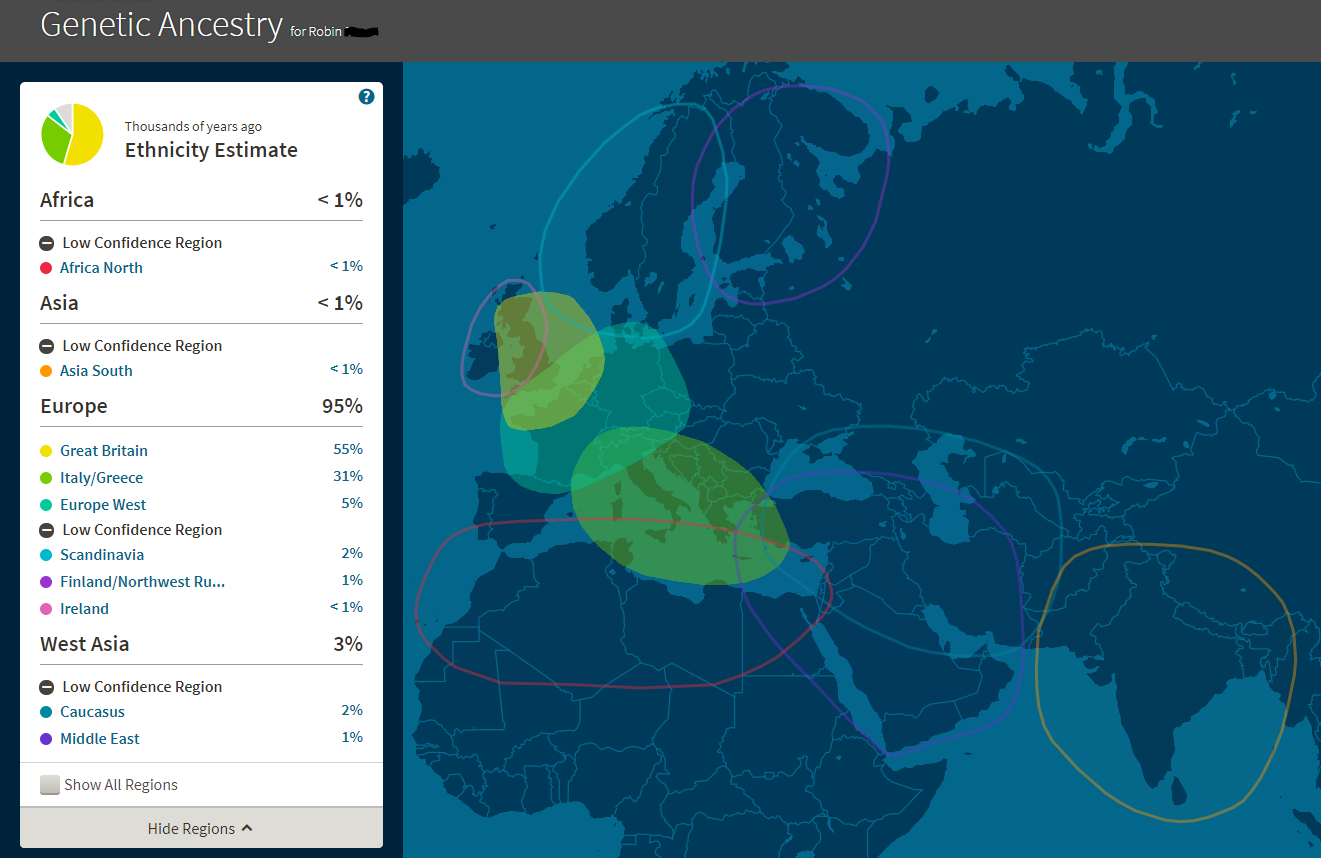
Granted, they do seem to have dropped most of the results from outside Europe I had before (see right), which is more consistent with my tree. I am now 99% European and only 1% Turkey/Caucasus, whereas before I only had 95% in Europe.
However, I'm still getting a lot of low percentages in areas surrounding where my ancestry comes from (2% Spain, 2% Greece/Balkans, etc), they are just now mostly in Europe instead of outside it. I also notice that AncestryDNA have done away with labeling "low confidence regions", which were previously defined as "when an ethnicity has a range that includes zero (meaning that in at least one of the 40 tests, that ethnicity didn’t appear) and doesn’t exceed 15%, or when the predicted percentage is less than 4.5%". Now, results which fall into this are no lower identified as such, suggesting that AncestryDNA are much more confident about even low percentage results/ranges. Sadly, I'm not convinced they have earned that confidence.
Due to the fact that my paternal grandfather tested, I know I share 18% of my DNA with him, rather than the "expected" 25% (this is normal), which means I inherited 32% from my Italian paternal grandmother. Before the update, AncestryDNA estimated my Europe South component at almost exactly what it should be: 31%, so I should have known that any deviation from this was going to be a step in the wrong direction, but the mere 12% Italian was still somewhat of a shock. Even if I add up the small amounts in surrounding areas for a Southern European total, I'm still only up to 17%. Not only was AncestryDNA's original prediction consistent with my tree, it was also very consistent with most other companies. FTDNA gave me 33% in Southern Europe, 23andMe had me at 29.5% Southern Europe, and LivingDNA at 30.2%. The only outlier was MyHeritage at 41.6%, which is partly why I felt MyHeritage's reports were less reliable than everyone else. But now, AncestryDNA must join the ranks of MyHeritage. My Northern vs Southern European ancestry has always been easy for most companies to tell apart so this seems like a big step in the wrong direction for me.
There are, of course, other discrepancies between the new report and my tree, but they are less severe. Although AncestryDNA is attempting to narrow regions down to more specific areas, it's not always reliable. I do not have as much French ancestry as they are suggesting at 18%, but if you add it together with Germanic, another 18%, you get 36%, which isn't that far off what I estimate from my known ancestry (about 21% German/Swiss/Dutch). So in some cases, I think we still need to look at broader areas and combine neighboring regions despite AncestryDNA's attempt to break them down.
| Great Britain - old ethnicity map |
This brings me to the point I want to make about the new regional names of the British Isles. Despite the name change, we're not actually seeing any difference in the areas these groups primarily cover.
Previously, Great Britain (map shown above/right) was defined as:
Primarily located in: England, Scotland, Wales
Also found in: Ireland, France, Germany, Denmark, Belgium, Netherlands, Switzerland, Austria, Italy
| England, Wales, and NW Europe new ethnicity map |
Primarily located in: England, Scotland, Wales
Also found in: Ireland, France, Germany, Denmark, Belgium, Netherlands, Switzerland, Luxembourg
So despite the name change, they both primarily cover England, Scotland, and Wales - the only change was to a couple of the secondary regions it might cover (no more Italy and Austria, but Luxembourg was added).
The same is true for what was previously called "Ireland/Scotland/Wales" (map shown below):
Primarily located in: Ireland, Wales, Scotland
Also found in: France, England
| Ireland/Scotland/Wales - old ethnicity map |
Primarily located in: Ireland, Wales, Scotland
Also found in: France, England
As you can see from the descriptions, it's exactly the same coverage.
So don't let the new names fool you, "England, Wales, and NW Europe" doesn't cover mainland Europe any more strongly than it did before, and it doesn't mean ancestry from Scotland (or even Ireland) can't still turn up under this category. I do not know why they are adding "Northwestern Europe" to the title of this group when it is not listed under the locations it's primarily found in. I expect this will undoubtedly be confusing to some people. Likewise, Wales may have been dropped from the now named "Ireland and Scotland" but you can see from the description and maps that it's still included in this group as a primary location. This is why it's so important to look at the details and not just go off the category title.
As you can see from the coverage maps I've also included, those haven't changed much either. They appear to have only changed the maps to better reflect the descriptions, not because the descriptions have changed. For example, previously Great Britain didn't list Norway in it's description of "also found in", yet the map did cover the southern tip of it, whereas now it does not. Previously, the map for Ireland, Scotland and Wales did not cover France even though it was included in the description, but now it does. So although the maps have changed slightly, it's not because the category is primarily covering any different areas.
It should be noted that although the regions these groups cover haven't changed, that doesn't mean your results in those categories won't. AncestryDNA have significantly updated their reference panel from 3,000 to 16,000, so we are seeing changes to the genetic make up of these groups in the reference panel, which will very likely reflect changes to the percentage you get in those categories.
Obviously, mainland Europe is seeing significant changes to the breakdown and coverage of different regions. Europe West, previously "primarily located in": Belgium, France, Germany, Netherlands, Switzerland, Luxembourg, Liechtenstein and "also found in": England, Denmark, Italy, Slovenia, Czech Republic is now broken down into "France" and "Germanic Europe", which respectively cover:
Primarily located in: France
Also found in: Andorra, Belgium, Italy, Luxembourg, Monaco, Spain, Switzerland
Primarily located in: Germany
Also found in: Netherlands, Belgium, Switzerland, Austria, Czech Republic, Denmark
Unfortunately I don't have the room or time to detail every new region, especially with maps, but you can see from the completely list how different the breakdown for Europe is now:
Europe
- Baltic States
- Basque
- Eastern Europe and Russia
- England, Wales & Northwestern Europe
- European Jewish
- Finland
- France
- Germanic Europe
- Greece and the Balkans
- Ireland and Scotland
- Italy
- Norway
- Portugal
- Sardinia
- Spain
- Sweden
And for the rest of the world:
- Africa South-Central Hunter-Gatherers
- Benin/Togo
- Cameroon, Congo, and Southern Bantu Peoples
- Eastern Africa
- Ivory Coast/Ghana
- Mali
- Nigeria
- Northern Africa
- Senegal
America
- Native American—Andean
- Native American—North, Central, South
Asia
- Balochistan
- Burusho
- Central and Northern Asia
- China
- Japan
- Korea and Northern China
- Philippines
- Southeast Asia—Dai (Tai)
- Southeast Asia—Vietnam
- Southern Asia
- Western and Central India
Pacific Islander
- Melanesia
- Polynesia
West Asia
- Iran/Persia
- Middle East
- Turkey and the Caucasus
Unfortunately, Africa and Pacific Islander don't see any further breakdown but that doesn't mean you won't see changes to your percentages or regions. America only see the addition or distinction of Andean, and West Asia sees a two part area now split into three. The biggest changes aside from Europe have happened in Asia, and it's about time. Ancestry's previous Asian groups only covered three very large regions: Asia Central, Asia East, and Asia South. Now there's 11 regions! I frequently used to recommend East Asians wanting to take a DNA ethnicity test to go with 23andMe, not AncestryDNA, but now I don't have to.
It should be noted that the update does not influence your Genetic Communities or Migrations. You might find some of them are now organized under a new parent region due to the new breakdown of the regions, but that's the most of it. The Genetic Communities/Migrations are determined through different methods using a different reference dataset (which is precisely why I still believe they shouldn't have been merged as sub-regions as though they are the same) so they aren't going to change with this update.
I think that covers enough for now. I will detail the changes to my other kits in another article.
Subscribe to:
Posts (Atom)