Friday, August 21, 2020

Major Breakthrough with DNA

I think I finally broke through the biggest brick wall on my tree. I had forever been stuck at my 3rd great grandmother, Emma Elizabeth Sherwood (left), who married William Henry Mills. Despite having found her maiden name, I could never find her parents or any record of her before her marriage. Born about 1838 in New York, there were a lot of girls with the same or similar name in New York around that time. I'd tried to research by elimination, but I was still left with too many options that could have been her. And DNA? I made some efforts but it was really difficult with a fairly common surname like Sherwood. I never got anywhere promising.

Until now. I decided to work on some closer DNA matches that I hadn't been able to identify before. I randomly picked one from my mom's side who had several shared matches with people confirmed from my Mills branch. This match, we'll call him 11B, had a small family tree added, enough that I could build on it. Although that is supposed to be ThruLines' job, it doesn't always catch everything. I started digging and before long, I found that 11B's 2nd great grandmother was Orannah Sherwood b. 1841 in New York.

I instantly thought she could be a sister of my Emma Elizabeth Sherwood. Right surname, born only about 3 years apart in the same state. Plus, I know this DNA match 11B is somehow connected to my Mills branch and Emma Sherwood married William Henry Mills. But I tried not to get my hopes up too high, because Sherwood is a common name, and lots of people lived in New York in the late 1830s/early 1840s. 11B could be connected to my Mills branch in some other undiscovered way entirely. More research was needed, so I researched the other branches of 11B's tree and found no other connection to my tree, let alone to my Mills branch.

I then found Orannah, fortunately not a super common given name, in NY in the 1850 census and guess what? She had a sister named Emily E Sherwood b. abt. 1837.

The 1850 census showing the Sherwood family with Emily/Emma


Things are looking much more promising. Granted, Emily was supposedly born in Indiana according to the 1850 census, not New York, but that could be wrong. Or it could be right and she never knew it. Her older sister Louisa also seems to have been born in Indiana in 1835, and then her younger brother Homer was born back in NY in 1839, so the family could have been in Indiana for only a few years and Emily/Emma may not have remembered it and just assumed since she grew up in NY that that's where she was born. It's strange for us today with all our documentation to think that someone didn't actually know where they were truly born, but it happened a lot in history.

Another smaller piece of evidence is the fact that the 1850 census tells us Emily's father, Nathan, was born in New York, which is consistent with later records of Emma saying her father was born in New York too. Unfortunately, it's not as consistent with her mother, which later records say she was born in either New York or New Jersey, while the 1850 census for Annis O, the presumed mother of Emily, says she was born in Vermont.

Here's the craziest bit, though, and is a real testament to why you shouldn't just outright dismiss family stories. Once upon a time, my grandmother was doing genealogy research and left behind a wealth of information, though rarely cited her sources. Much of what she wrote down was word-of-mouth info from cousins she tracked down and wrote to. In her handwritten info, she claimed that William Henry Mills (Emma Sherwood's husband) had a sister named Belinda who married a man with the surname Beals. Turns out, William did have a sister named Blendena, which was obviously misremembered as Belinda, but her only married name was Church, not Beals. None of William's other sisters or relatives married anyone named Beals either, so I was really scratching my head over where this name came from and considering that maybe it was totally fictitious, even though about 90% of my grandmother's info I've proven to be accurate, and the remaining 10% has turned out to hold some kernel of truth, with only some of the details being wrong.

Well, guess who did have a sister whose married name was Beals? Emily Sherwood! Her older sister Louisa married Silvanus Beals in 1855 in Indiana. And note how this is the same sister who was supposedly born in Indiana? The family probably had some kind of connection to Indiana.

I even managed to explain how Emma and Louisa wound up marrying in different states in the same year. Louisa's husband, Silvanus Beals, apparently was living in the same county that Emma married William Henry Mills in, Wyandot County, Ohio. That links Silvanus, and therefore potentially also Louisa, to the same place Emma was married. Additionally, Silvanus' obituary says he worked for a railroad company as a young men, the same industry that William Henry Mills spent his life in. Perhaps they worked together before they met their wives, maybe Louisa introduced Emma to William through her fiance or vice versa. There clearly appears to be a connection there.

The evidence is starting to really pile up, but is it all just a coincidence? How could I know for sure this was the right family, given the slight difference in the given name, Emma vs Emily, and the difference in her birth place as well as her mother's birth place? 

Firstly, I started researching Emily, not Emma, as though she was a different person. If I could find her on later records as having married someone else, not William Henry Mills, or never married at all, that would disprove the theory that they were the same person. I didn't find anything like that, but of course that doesn't confirm they were the same person, it only means that's still a possibility.

I also found Emily in the FamilySearch tree as Emma, which is apparently coming from a book "Descendants to the eight generation of Thomas Sherwood (1586-1655) of Fairfield, Connecticut Vol 2" which was published in 1985, so it's obviously very much a secondary source (and really doesn't contain much info), but it certainly suggests Emily's name could have actually been Emma. It's not a stretch.

But what I really wanted was to find more DNA matches descended from this family. I was hesitant to put this family into my tree because it meant putting a lot of speculative data in my tree, but I did it because I wanted to see if ThruLines would find more descendants. And after a few days, the matches came rolling in! 7 so far, and they will only continue to grow as my tree grows. Unfortunately, this family has been a little difficult to research, so it's been a struggle, but worth it. 

ThruLines showing 5 out of 7 DNA matches from the Sherwood family so far


It appears that Nathan probably died sometime in between 1853 and 1855, and Annis in either 1854 or 1855, because their last child was born 27 Mar 1854. As a result, the children were split up and scattered, sent to live with other families. In 1855, we know that Lousia got married in Indiana, and Emily/Emma, assuming they are the same person, was married in Wyandot County, Ohio. They may have been living with family in those areas. Also in 1855, Oreannah was sent to live with the family of her future husband, Charles C Baxter. Their brother, Homer, was an apprentice living with a seemingly unrelated family in a different part of NY on the 1855 NY State census. Another brother, Dwight, was adopted by another member of the Baxter family, who was fortunately neighbors with the ones who took Oreannah in, so at least these siblings got to be near one another. The youngest brother, Frank, was actually born in March 1854 and adopted as an infant by Franics Postel and Sarah Baxter (Sarah being the sister of Oreanna's husband, yet another connection to the Baxter family) before the 1855 NY census, supporting the theory that Nathan and Annis died around that time. 

I am still working on researching the other children, but I'm having difficulty and I think it's because they were all split up after their parent's deaths. If I'm having difficulty researching them, others probably are as well, and indeed, when I look for these people in other trees, there are usually dead ends. If no one has these people well researched in their trees, ThruLines doesn't have much to follow. So it's not necessarily because I'm on the wrong path, there's just no established path yet for ThruLines to pick up on, which is kind of exciting to be working on something no one else has done much work on yet. Of course, the downside to that is how difficult it is.

Additionally, when I look at my Shared Matches with the confirmed matches descended from Nathan and Annis, I find most of them don't have any tree added at all, and among those that do, most of them are tiny. Another hindrance of ThruLines. All I can do is build my own tree as much as possible down descendant lines and see if they eventually link up with more trees. For now, this is an excellent start, and I'm thrilled to finally have found Emma's family!

Thursday, August 13, 2020

MyHeritage's Photo Enhancements

Previously, I did an analysis of MyHeritage's photo colorizing tool. Since then, they have also added an enhancement tool, which identifies faces in photos and "enhances" them by making them sharper and clearer with more details. They also appear to have improved the colorizing. I noticed how the same photo I had colorized before, which left some areas like a hand here or there uncolored, are now magically colored (see bottom of article for example). It's still not perfect, but it's improving.

Normally, both tools are limited to 10 photos with a free account, so you have to subscribe with the Complete Plan (the most expensive one) to use unlimited photos with these tools. But right now, MyHeritage are trying to entice people to subscribe by making the tools unlimited for free for one month. They are obviously hoping people will be so impressed with the tools and get used to using them on unlimited photos that when the month is up, some will subscribe to continue having access to them. But personally, I'm not about to spend another $300 a year just for access to these fun little tools so I'm making the most of the free access while I can.

Much like the colorizing tool, the enhancement works best on images that don't have too much degradation or blurring. If you click the above photo of my Nan to enlarge it and see details, you'll see it had only some minimal blurring and the enhancement tool made it very sharp and clear, a much better picture of my Nan. You'll note that it does not remove scratches, spots, or other surface damage to the photo though, even when they appear on the face. And yes, you can enhance it and colorize it at the same time (see examples below), I just chose not to on this one of my Nan to show you the enhancement alone.

It also works best on faces that are closer to the camera - the smaller/further away the faces are, the less effective the enhancement is, and sometimes it's not effective at all. A few photos I've tested so far (see below), the faces were so far away and so blurry that the tool didn't even attempt to enhance it (though it did seem to identify it as a face since it colorized it correctly as skin colored). The ones that were enhanced were minimally done. 

The enhancement tool only worked on 3 out of 5 faces here, because they
were too small and blurry. The 3 enhancements were minimal too (see below).


A close up comparison of one of the small faces in the above photo with the minimal enhancements

Additionally, sometimes the enhancement leaves the face looking a little plastic and weird, like the person is wearing a mask (see below). This is more likely to happen the more blurring there is to the photo and faces, partly because it's difficult to enhance something so small and so unclear, but also because the tool only enhances faces and nothing else. A sharp, clear face next to blurry hair and clothing just looks weird. But in some cases, it's better than nothing, and it does give us somewhat of a better idea of what someone looked like.

Note how the one on the left looks fairly normal but the other two appear mask-like

Keep in mind though, that this tool is attempting to create data where it doesn't exist, so there comes a point on a heavily doctored photo where it may not be an accurate representation of someone's face. It's fun to explore, but for example, I would avoid using it while comparing people in two different photos to determine if they are the same person, or related. While it's tempting to use enhancements to do such comparisons because they seem clearer and sharper, making it easier to compare, it could actually be wrongly altering someone's appearance and leading you to the wrong conclusion about their identity.

So just like with the colorizing tool, the effectiveness of the enhancement tool can be a little hit and miss. It handles some images better than others, and there does come a point where certain photos and faces are too far gone to recover. Have fun with it, but don't expect too much from it with all your photos.

A comparison of the initial coloring of a photo (left) with the updated coloring of it (right), note
some of the hands that were previously uncolored are now a correct skin tone. There's also some
minor difference in the the darker skirts. Click to enlarge.


Wednesday, August 12, 2020

Changes at Ancestry.com

Recently in the news, there's been more than one announcement about changes happening at Ancestry.com and AncestryDNA. First, AncestryDNA announced they were raising the threshold for how much DNA you have to share with someone in order to match them, and then came the news that Ancestry's primary owner, Permira, are selling to another company called Blackstone.

Cue the freak outs.

But really, everyone, it's going to be okay. Here's why.

AncestryDNA are raising the threshold for matching from 6 cM segments to 8 cM. I know this seems extreme, but remember that the vast majority (thousands) of your matches under 8 cM are identical by state, which means they do not share a common ancestor, at least not within any kind of genealogical time frame. And even those matches which you can identify a most recent common ancestor with, at this level of DNA, it's so unreliable, you can't be sure the shared DNA is actually coming from that ancestor after all. Because of this, these low matches can actually be leading you astray, not breaking down the brick walls you thought they would. By raising the threshold to 8 cM, AncestryDNA are assuring that the majority of your matches will be identical by descent and therefore more likely to be most useful to your research.

In fact, in the past, AncestryDNA was often criticized for their threshold being as low as 6 cM, as at least 7 cM was considered more the standard. And if you think 8 cM is extreme, don't even bother testing at 23andMe, where rather than have the same cM cut off point for everyone, instead they cap your match list at 2,000 matches (or if you tested long enough ago, it may be 1,000). Whatever cM your matches share with you at that 2,000 cut off is where they draw the line. So, for example, let's say your 2,000th match shares 12 cM with you - they will include everyone that shares 12 cM with you even if it goes above 2,000, but that's it, that's your cut off point, you won't have any matches sharing less than 12 cM with you. Personally, I was unfortunate enough to test when the cut off was 1,000, and they didn't raise it. My cut off point at 23andMe? 20 cM. That would basically only be my estimated 4th cousins or closer at AncestryDNA. Imagine your match list being cut off at only estimated 4th cousins or closer.

Additionally, AncestryDNA have promised not to remove any matches that you have marked in any kind of way. If you starred them, put them in a group, left a note, or messaged the individual, those matches, even under 8 cM, will remain on your match list. So you're not going to lose any info that you've already established, only the ones that you haven't gotten anywhere with yet, which are the ones most likely to be identical by state anyway. 

So AncestryDNA are not being unreasonable by raising their cut off to 8 cM. It's more in line with what is considered standard, it's still way better than the crappy deal you get at 23andMe, and you won't lose any established data. What I recommend doing is going through all your ThruLines or matches under 8 cM with Common Ancestors and star or group them somehow, so you at least don't lose those. For me, at least, this is worthwhile because most of my ThruLines wind up being accurate. You may also want to star ones that have trees - the ones that don't, you probably wouldn't get very far with anyway. You can easily do all this by going to your match list, selecting "Common Ancestors" and then under "Shared DNA" select "custom centimorgan range" and put in 6 to 7. For those with trees, click "Trees" and alternately select each of the options. This will help prevent you from losing those low matches which have some chance of actually being useful.

Now let's look at the second news: a change in ownership. When the news first broke, there was a lot of shouting about how the company taking over is a private equity firm, as though this is some of dirty word that we should all be terrified of. Well, guess what? The main company that's selling, Permira, who have been the primary owners of Ancestry for the last 8 years, are a private equity company too. The company is merely changing hands from one private equity company to another. (For the record, there are a few other companies that also held shares in Ancestry. and two have also sold to Blackstone, one is retaining a minority ownership along with Blackstone. They are also private equity companies, but Permira was the primary share holder, as Blackstone will now be).

Of course, any time ownership changes, it could mean changes for the company. People mainly seem concerned with their DNA and who has access to it. Blackstone responded to this by making a statement reassuring users that they won't actually have access to DNA data:

"To be crystal clear, Blackstone will not have access to user data and we are deeply committed to ensuring strong consumer privacy protections at the company," a spokesperson for Blackstone told Motherboard in an email. "We will not be sharing user DNA and family tree records with our portfolio companies."

Of course, companies can lie or change their mind, but there's no reason to think that's going to be the case. Remember, Ancestry was in the hands of another private equity company for 8 years up to now and no one seemed to have a problem with that. 

But wait, I hear people saying, the concern is that Blackstone have their fingers in the health industry, which surely means they acquired AncestryDNA to mine genetic data for the health companies they own! Our DNA is going to be sold or given to other companies without our consent!

It's true that Blackstone also has investments in the healthcare industry, that's what private equity companies do - they invest in other companies and frequently have investments in multiple different industries. But guess what? So does Permira. Yep, Permira also has investments in healthcare, yet that was never a problem for the 8 years that Permira were the primary owners of Ancestry.com and their massive DNA database.

Look, I'm not going to say nothing could ever happen to the security and privacy of your genetic data. Hacks happen. Illegal deals happen. Companies can violate their own TOS. But that's always going to be a risk, no matter the company you tested with, and no matter who owns it. This particular sale doesn't mean it's anymore likely than before or with any other company. If it really, deeply concerns you, then you shouldn't ever have your DNA tested anywhere, and if you already have, you should delete it immediately. If you understood the potential risks (which are low, in my opinion) and were okay with them before, there's no reason to suddenly be concerned now.

So before you buy into all this fear mongering, just do what genealogists always do: research! Before you freak out, do some research about these companies buying and selling Ancestry. Do some research about the validity of low DNA matches. You might come to the same conclusion I did. And if you don't, fair enough, at least you did your research and came to an informed decision, which is more than I can say about most of the fear mongering going on.

Wednesday, July 22, 2020

Best Friends Forever? Not Quite. The Original Bride Wars.

The best of friends, for a time: May Ellis (left)
and Emma Fallows (right) sitting on the back
patio of Emma's parents house
In the early 20th century, two young ladies, Emma Sarah Fallows and May Melson Ellis, were the best of friends. They met at teaching school, attended as many social events together as possible, taught at the same elementary school, and even lived together during that time. They were inseparable. But in 1913, something suddenly happened to cause a split between them, and their friendship never recovered. What was it?

My great grandmother, Emma Sarah Godshall (nee Fallows), left a wealth of information and photos of herself behind. Her family was somewhat wealthy and could therefore easily afford what was probably a Kodak Brownie, which they used to take dozens of candid photos of their family and friends that survive today. They were also frequently mentioned in the society section of their local newspaper, the Ambler Gazette in Pennsylvania, for some of the most mundane sounding notices sometimes. I can't imagine who at the time would have been interested in knowing about every vacation they took, for example, but I'm glad they reported it because these are the little snippets of information that give me insight into my ancestor's lives in ways most people don't get. And it's these mentions that could explain why Emma and her best friend parted ways so abruptly.

In September of 1904, sixteen year old Emma and seventeen year old May arrived at Millersville Normal School in Pennsylvania, what was then a teaching school. Today, it's called Millersville University and offers degrees in many subjects. May being a year older than Emma may have been a second year student, but for Emma it would be her first time living apart from her parents in a place were she scarcely knew a soul. It must have been daunting, but Emma was an outgoing girl by all accounts, and probably made friends quickly. Although we don't know exactly when Emma and May met, we know they were good friends by the time Emma graduated in June of 1907. After this point, Emma is mentioned in the paper as spending time with May almost every month, and I suspect the lack of reports of Emma's friends before this only had to do with the graduation milestone (there are always fewer social reports of children with less details).

May Ellis (left) and Emma Fallows (right) sitting on front
porch of Emma's parent's house

Emma (left) and May (right) at the beach in Ocean City, MD

The girls quickly became practically inseparable. May was from Delmar, Delaware, and Emma was from Wyndmoor, Montgomery County, Pennsylvania, but that didn't stop them from regularly visiting each other and taking trips to the beach together. By 1910, they were living together with Emma's parents and working at the same elementary school in Wyndmoor. 

In December of 1911, Emma became engaged to Chester Harold Godshall, better known as Harold, or just C.H. They had been dating since 1908, when the first mention of them spending time together at a card game Emma hosted can be found in March, and when Harold began showing up in photos with Emma (clearly as a couple) sometime in spring or summer (they were on the beach at Ocean City, Maryland). Also featured in many of these photos are May and her beau, Boyd Morse Frymire. The four of them were tight, frequently taking trips together to places like Valley Forge and Ocean City, Maryland, and taking pictures of their memories along the way. Emma described them as "The Bunch" at one point. Boyd and Harold were both Civil Engineers and graduates of Bucknell University, so it's likely they were friends before meeting the girls. Maybe Emma and Harold introduced May to Boyd, or the other way around.


"The Bunch" at the beach in Ocean City, Maryland, 1908. Top photo: Emma (left), Boyd, and May (right). Bottom photo: Emma (left), Harold, and May (right).

On May 31, 1913, Emma took a break from planning her wedding, scheduled for November 11 of that year, to visit her best friend in Delmar for a house party May was hosting for several of her friends. She must have been excited to tell her friend all about her wedding plans, but Emma was about to receive a shock. Something changed in their friendship right around this time, and I believe it happened at this house party, because this is the last ever mention of the girls spending time together. They did not even attend each other's weddings, let alone stand by as each other's maid/matron of honor.

Coincidentally, only a few short days after the house party, May's parents announced her engagement to Boyd at a dinner party on June 3, probably attended by May's parent's friends this time. The next day, the announcement appeared in a Wilmington, Delaware newspaper. It seems likely that the house party May hosted for her friends was to announce to them her engagement to Boyd, and it seems significant that it coincided with the termination of her friendship with Emma.


Emma and May (with friends) "At Fretz's" place (Florence Fretz, Emma's Maid of Honor). Top: May (far left), Emma (second from left). Bottom: Emma (far left), and May (middle). Florence may be the other woman in the photos, or may be taking the photo.

But why would May announcing her engagement to Boyd cause the end of her friendship with Emma? It's unlikely Emma didn't approve of May's choice in Boyd because there are many photos of them all together looking happy and having a good time. And after all, Emma may have been the one to introduce May to Boyd. Could it be that Emma, after being engaged and planning a wedding for a lengthy two years, was offended that May would not only get engaged just a few months before her wedding, but also plan to marry before Emma? May and Boyd quickly married on September 17, 1913, less than four months after their announcement, and a mere two months before Emma was married to Harold on November 11. If you're thinking that May and Boyd married so quickly because maybe she was pregnant, there's no evidence of that. Their first recorded child wasn't born until August 3, 1914, nearly 11 months after their wedding night. Although it's possible May had a miscarriage not long after the wedding, and then quickly conceived again in what would have to be November, we can't assume that's what happened.

Whatever the reason for May fast-tracking her wedding, Emma absolutely might have felt that May was stealing her limelight by marrying so soon before her own wedding. Even today, there are women who would be upset about that, but particularly during a time of such formality and propriety, it could have been viewed as May upstaging her friend. There were social rules to be followed and this was definitely a bit of a slap in the face of etiquette. 

"The Bunch" - Emma taking a photo of Harold (second from
left), May, and Boyd (right) with unknown man (far left)

Emma's name is notably absent from May's wedding announcement in September. Although it doesn't mention the wedding party by name, it does name some of the guests who attended, and Emma is not among them. A week before Emma's wedding, she spent the weekend at the house of Florence Fretz in Bucks County, another long-time friend who also happened to be Harold's cousin. I imagine this was likely Emma's bridal shower since Florence was the one to serve as Emma's Maid of Honor. By the time Emma's wedding is announced in the paper, there is no mention of May among any of the guests or bridal party.

To my knowledge, the two never reconciled. May would go on to have two children with Boyd and moved all around Pennsylvania over the years. Emma and Harold also had two children and stayed in the Philadelphia suburbs. Maybe starting their own families and living in different places, they might have gradually drifted apart anyway, but it seems like such a shame that they never even kept in touch by letter, or introduced their children. While I can understand Emma feeling upstaged by her friend, it feels like a forgivable offense to me, and I would never begrudge a friend the happiness of her wedding, whatever the timing.

Emma (third from left) with friends during one of her visits
to May's home in Delmar, DE. May is probably taking
the picture.

Emma (left) and May (second from right) with friends
(looks like Boyd is on the far right)

Emma quit teaching full time after her marriage, as was typical of the times, but she did periodically substitute, and was active in her community and even politics. In 1938, she was the Secretary of Springfield-Whitemarsh League of Women Voters, and throughout the 1940s, she was first the Corresponding Secretary and eventually President of Eastern Montgomery County Council of Republican Women, as well as a representative of Wyndmoor Service Organization (a group that supported their local soldiers in the WWII armed forces, such as by sending care packages). She died December 18, 1954.

May's married life is less detailed, and it's unclear how her split with Emma effected their husbands, who were equally good friends with each other. Did they keep in touch, or did they side with their wives and never speak to each other again? The glimpses we get of our ancestor's lives are never enough, and always leave me with more questions that will probably never be answered.


"The Bunch" goofing off at an unknown location. Top photo, from left to right: Boyd, May, Emma, Harold. Bottom photo, from left to right: Emma, Harold, May, Boyd.

Thursday, February 27, 2020

9 Reasons Indentured Servitude Was NOT "White Slavery"

Now and again I see people who bring up "white slavery" in US history when what they really mean is indentured servitude. Indentured servants were mostly uneducated Europeans who were contracted into the sometimes lengthy and harsh service of an American employer to pay off the debt of their ship passage to the US. It's true they were frequently taken advantage of, had few rights, and often treated poorly, but there were fundamental legal differences between indentured servitude and chattel slavery in the US. A lot of racists and white supremacists have put out propaganda memes about "white slavery" or "Irish slavery" (see example left) in attempts to undermine the fact that slavery in the US was race based. There's other good articles on this topic from The New York Times, the Southern Poverty Law Center, and History.com but I want to detail point by point how legally, indentured servitude was not the same thing as chattel slavery in the US.

1. Most indentured servants went willingly. While the terms of their service were often misrepresented, these were primarily people who wanted to immigrate but couldn't afford the ship passage, so they agreed to let an American employer pay their passage fee in return for their service to pay off the debt. Granted, some of them only wanted to go to America because it was the only way to escape religious persecution in Europe. Others were criminals who were sent to indentured servitude in the colonies instead of being sent to jail. There have also been some recorded cases of Europeans being kidnapped and involuntarily indentured to the Americas, but that was rare and more importantly, illegal.[2] Most indentured servants chose the path they did, even if that path was misrepresented or their alternate choices were worse, it is not the same thing as being physically forced or born into legal slavery on a mass scale.

2. The duration of their service was finite and once complete, they were even given a payment of "freedom dues" to start them off in their new, free life. This may have been cash, new clothing, or even a parcel of land, and therefore some historians argue that at this point, these servants would have been better off than those who came to America on their own dime. It's true that many indentured servants had years tacked onto their contract if they tried to escape or otherwise broke their contract, and others were so maltreated that they did not survive to the end of their contract. But many also not only lived out their contract, but prospered afterwards because of it. The typical length of indentured servitude was 4-7 years, which is nothing like a lifetime of slavery.[1][3]

3. Indentured servitude could not be inherited like hereditary slavery. An indentured servant's child was not automatically indentured too. In fact, indentured servants were not allowed to marry without their employer's permission[2], which was typically not granted[8] (because this would mean more expense for the employer, without an extra laborer) so most of them did not even have children until released from their service. An employer could tack more time onto the service of a female servant if she became pregnant (usually extended by 18-24 months)[8], but her child could not be indentured to the employer.[1][3] Theoretically, a cruel employer could have raped a female indenture and then used her pregnancy to extend her contract so he could continue raping her. But the child was still free and more importantly, this was an illegal abuse of the system, compared to the hereditary slavery that blacks endured, generation after generation, on top of the legally sanctioned and encouraged "breeding" they were forced into to perpetuate their hereditary slavery.

4. There were several acts passed by the British and US government which deterred and reduced indentured servitude and had no impact on slavery. These included the Passenger Vessels Act 1803 and the abolition of Debtor's Prison in 1833.[2] If indentured servitude and chattel slavery were the same thing, why would laws influence one but not the other?

5. While the rights of indentured servants were limited (they could not vote, for example), they did have certain rights that slaves did not. Indentures had the right to medical care (and the time of service lost to illness or injury could not be held against them)[8], food, shelter, and clothing, as well as the right to take abusive employers to court, and they could not be cheated out of their freedom dues[8], none of which were rights afforded to slaves.[3][4][7] Of course, these rights may not have always been well met, and suing an employer was not always realistic since indentures may not have had the money to hire a lawyer or file a law suit, but there were cases that did occasionally appear in court.[8] And the legal distinction is still important in terms of how the law viewed indentured servants versus slaves. Slaves did not have the legal right to sue anyone, and slave owners had the legal right to treat their slaves however they wished, including abuse. If a slave owner wanted to starve a slave to death, he had the legal right to do that, whereas this would have been consider murder if done to an indentured servant. Legally, indentured servants were given a status similar to children, not slaves.[8]

6. As African slavery grew in the US, indentured servitude declined and their work load became different from those of slaves; they were given lighter and more skilled work. This meant the working conditions of indentures improved and they may have even gained skills they could use to prosper once their contract was finished. The very reason slavery grew and indenturing declined was because slavery was absolute in its lack of freedom, whereas indenturing was not, meaning plantation owners got perpetual free labor out of slavery, whereas they didn't with indentured servants, once again highlighting the difference between them.[1][5] In 1756, a Philadelphia merchant said “All importations of white Servants is ruined … and we must make more general use of Slaves.”[5] This shows how they were considered different, and as servitude declined, slavery increased.

7. The first Africans brought to America were actually indentured servants, not slaves. Before 1641, there were no slave laws in the US, so when Africans were first brought her in 1619, they were indentured servants with the same contracts and rights as white indentured servants. That obviously changed and they or their descendants were eventually sold into the slavery system that developed later.[1] But it illustrates a distinction.

8. An indentured servant's contract could be sold to a new employer, but the servant themselves could not be sold or owned as property as slaves were.[5] This may have only been a legal distinction which made no difference to the servant in reality, but it shows how the law viewed indentured servants as human beings, but slaves as property.

9. Indentured servants were recorded as free on the US census. On the early US censuses, "free white" people were grouped by gender and age, then there was a category for slaves, and then one for "all other free persons". The enumerator's instructions were to record indentured servants as free: "free persons, including those bound to service for a term of years, from all others".[6] So, white indentured servants were recorded as "free whites" and indentured servants of other races would be classed under "all other free persons" (or "free colored persons" depending on the census year). The very definition of slavery is not having the legal status of freedom, so the fact that indentured servants were considered free by law makes it impossible to call them slaves.

I am not saying indentured servants weren't exploited or didn't suffer at the hands of their employers, many of them did and that was a great injustice. But for the poor, life was always hard, and many people suffered at the hands of their employers even if they weren't indentured. Before labor laws and unions protected the rights of employees, even paid servants (not indentured) were often exploited, beaten, received wages too low to feed them, suffered long, grueling hours of hard labor, were sexually assaulted by their employers, etc. It didn't make them slaves. What made someone a slave was not the conditions they lived or worked in, but their legal status, and I hope I've illustrated how the legal status of slaves (ie, not free) in the US was very different from those of indentured servants (ie, free) and therefore they should not be lumped together. 

And of course, throughout all of history, people of all kinds were enslaved at some point. I am not saying no white person was ever enslaved in history - the Romans, for example, enslaved lots of white people. But the topic of "white slavery" is normally brought up in relation to US history and it's hereditary, chattel slavery as though they were the same thing when clearly, they were not.

So the next time someone tries to tell you about "white slavery" or "Irish slaves" when they actually mean indentured servitude, remember these facts and take whatever agenda they may have with a grain of salt.

Sources:

Tuesday, February 18, 2020

FamilySearch's Unindexed Images

Recently, FamilySearch made an update to their website in attempts to draw more attention to the wealth of unindexed records in their catalog, all available for free. The records available by using the search or even the collections list are a drop in the water compared to their vast catalog. You have always been able to access the catalog by click on "Search" and then "Catalog" from the drop down menu. Although it's readily available, it generally does not get used by people who don't know what it is or how to use it. Due to the fact that the images are not indexed, you can't search them by name or other details, you have to manually browse the images. To find the right collection, you have to search by location, collection title or author, keyword, subject, or, if you know it, film number (because the catalog used to be for looking up film rolls you could order). It's usually best to search by location, but this also requires knowing what jurisdictional "level" records are held at. For example, probate records are usually held at county level, so if you're searching for probates in Bucks County, Pennsylvania, you have to search the location field for Bucks County, Pennsylvania. Looking under just Pennsylvania will not find collections cataloged at lower levels, like county or city.

FamilySearch Catalog

FamilySearch's answer to this was to create a new option under the "Search" menu at the top of the site called "Images". Here, they have tried to simplify a way to find unindexed collections by making the location search field the only option unless you click on "more" and again on "advanced", which allows you to also search by time period, record/collection type, film number, etc. But unfortunately, the results seem to be lacking a lot of existing collections and the ones it does include are organized in a very convoluted way.

In the catalog, if I search for Philadelphia, Pennsylvania, I get a list of record/collection types, which I can click on to see the individual collections and select any of them. Fairly straightforward. In the new "Images" search, I get a huge list of over 8,000 results, many of which seem to be from the same collection but for some inexplicable reason, are broken down into multiple results (it appears they are broken down by individual film roll number, even though the film number isn't included in the results list). This means, for example, there's dozens of listings of probate collections, sometimes even multiple listings for probates from the same year! How am I supposed to know which one to use? In the screenshot below, it shows how if I'm looking for a Philadelphia probate record from 1913, there's multiple listings for it, and they aren't duplicates, they're different records. This is going to be far more confusing for people than the catalog ever was.


Of course, I can narrow down the results by using those more advanced search options, like adding a year and record type (1913, Probate), but that doesn't solve the problem of there being multiple results just for 1913 Philadelphia Probate records. In fact, there's 115 results! How on earth am I supposed to know which one to use? There is literally nothing distinguishing them from each other except sometimes the image count.

Maybe I just haven't gotten the hang of it yet, but so far, I haven't had any luck finding actual records or collections I know exist in the catalog with this new "Images" search option. As far as I can tell, it looks like they are not including collections that are only visible at a Family History Center or affiliate library, which is a huge portion of their catalog.

I do not understand the purpose or function of this new Images search. They now have 3 different ways to find records on their website (for some, it was confusing enough as it was to have 2 different ways), and none of them include their entire database of records. Honestly, I suggest you skip this and just use the catalog or search engine as usual.

Monday, February 17, 2020

More Colorizing

After trying MyHeritage's new colorizing tool and then giving colorizing myself a whirl in Photoshop, I finally managed to test out another automatic colorizing tool at ColouriseSG. At first, it didn't work, or maybe I just didn't wait long enough, but today it worked!

I used the same first image I did at MyHeritage, the one I then colored myself too. My first impression with just this one photo is that it's better than the one at MyHeritage, but the human touch is still best.


Although it still looks a little like they just added a sepia tone to it, I felt like the colors were a bit more realistic than MyHeritage's, and the eyes appeared less brown. They could arguably be gray.


They also made attempt to add a touch of redness to the lips, but I'm not sure I love the effect, they look a little purplish.


Overall, the colorizing is better than MyHeritage, but I was very disappointed by the fact that ColouriseSG made the photo I uploaded smaller and therefore lesser quality. So if you use this tool, be prepared to sacrifice quality for coloring! For this reason, I decided to not even bother testing it with other images.

As always, if you want something done right, do it yourself.


Friday, February 14, 2020

Happy Valentine's Day!

On this Valentine's Day, I'd like to point you in the direction of a previous blog post where I detailed the highly romantic love letters between my 3rd great grandparents, Robert Hawkins Smith and Octavia M Wood in 1837 Kentucky!

I once allowed MyHeritage to include them in a Valentine's Day promo and the staff member I spoke to thought they might have been the oldest surviving love letters in Kentucky. I thought maybe she was right, but that's a fairly specific location and a very specific topic too, so not a very difficult feat.

Wednesday, February 12, 2020

MyHeritage's New Colorizing Photos Tool

Ever wanted to have your old black and white family photos colorized, but don't know how to do it yourself, and don't want to pay a professional an arm and a leg for it? Well, MyHeritage just launched a new free feature from DeOldify that will instantly colorize black and white photos. But how well does it work? I was a little skeptical and couldn't wait to test it out.

The photo I tested was just a simple portrait from about the 1880s. I was surprised how quickly it colorized, and I was pleased with how nice it looked but I realized that it actually just looked like a sepia tone had been added to it. I don't think that was the intention, and the skin tones did have a more fleshy color, but everything else looked like it'd just been sepia toned. A little disappointing.


Additionally, you may not be able to see it very well but this man's eyes were clearly light colored - blue, grey, hazel, etc. Something like that. But zooming in on his eyes shows the sepia/fleshy colors of the skin seems to have just been overlaid on his eyes, making them look brown, as if there was no attempt whatsoever to even color the eyes at all.


And while we're on the subject, they are beautiful eyes, aren't they? I've always thought this guy looks a bit like Leonardi DiCaprio.

To show you the difference between what a computer can do and what a human can do, here is my colorization of the same photo (including spot cleaning/restoration):


Back to MyHeritage. I then tried it with a group photo, thinking the multiple faces, garments, etc would add some variation to the possible colors. This was much more impressive:


Not bad for an automated system! Granted, the photo's highlights are a little blown out in places and some of the faces are blurred from too much movement, but colorizing system handled it pretty well in spite of that.

What's even better is that this is a high resolution image I used. I was a little worried that such an advanced tool available for free would only accept low resolution images (maybe charging for high resolution), but this was a fairly high resolution image and it not only accepted it, it still only took a few seconds to generate a color version. Unfortunately, although it will accept high resolution images, there is a limit to how many photos you can colorize if you have a free account. They don't tell you this anywhere but choose your photos carefully because you only get 10 of them, and deleting previous ones doesn't allow you anymore.

And the colorization still isn't perfect.

You may notice how it doesn't exactly take much risk or leaps with the colors it chooses. The men are in black suits, the women all seem to be in black and dark navy dresses, and the kids are all in white or neutral colors. You can probably understand why - I suppose they don't want a man's suit turning up bright red or something equally unrealistic for the era and gender. That's the downside to using a computer instead of a human who can distinguish these things and safely choose a greater variety of colors to apply.

Additionally, when I zoom in, there are areas that look like something almost resembling purple fringing except not along high contrast edges. You can see these sort of random purple splotches in the zoom-in below, particularly in her hair (pretty sure purple wasn't a trending hair color in 1880 Wisconsin), and sleeves. This is just a small area of the photo but these purple spots turn up everywhere if you look closely enough.


There's also some areas of the image that the computer seems to have some difficulty coloring. You'll note above how her one shoulder does not appear colored, or at least seems to be a different color from the rest of her dress - more of a sepia tone again. You see it most prominently in the skirt behind this child below:


At first, I thought maybe it was due to a shading variation in the original that may have fooled the system into thinking the difference in the shading meant a difference in color, but that is not the case. You can see in the original, there is no shading variation.


I guess the tool just sometimes has difficulty identifying edges and items so when it's unsure, it seems to do this. It's understandable, I suppose - after all, what is required to accomplish this in mere seconds must be an incredibly complex algorithm and coding, and it's provided for free, so I can forgive it for not being perfect.

Lastly, you may have noticed MyHeritage put their logo in the bottom right corner of the colorized image, and a little paint palette icon in the lower left. To avoid these, I'd recommend adding a superficial border to your image where the logo and icon will show up, which you can then crop off later.


I decided to try another photo (above), this time with more elements in it - horses, a house, etc to see if the same problems occurred, and they did. Once again, you can see all the clothing colors are very neutral. And again, you can see some weird rainbow-like discoloration at the top of the house.


And again, there were obviously some spots where the computer had difficulty colorizing or distinguishing between items - as you can see below, the hand on the shoulder looks like it either hadn't been colorized at all or it's blending in with the color of the other boy's jacket. Conveniently for the computer, it chose to "color" this boy's jacket grey!


So if you don't want any creepy dead hands like this, or your ancestors had blue eyes instead of brown, it's best to hire someone to do this for you instead of relying on an automated system. There are also Facebook groups with generous people who will colorize your photos for free, but be aware that Facebook doesn't easily support high resolution images like this does. This option from MyHeritage is still pretty impressive for what it is though, and if you're not bothered by the small problems that you might not even see very well when zoomed out, this will be amazing tool for many people. At the very least, I enjoyed seeing some color in the faces of my ancestors and relatives, as it seems to make them come alive a little more.

I haven't checked it out yet but there's an alternate colorizing option found at ColouriseSG. It appears to be free.

Tuesday, January 14, 2020

How Copying Errors Can Really Screw Up ThruLines

I want to illustrate how ThruLines is only as reliable as the family trees it's using, and how even if you appear to have a few DNA matches linking you both to the same ancestor, that doesn't make it accurate. As we know, it's common for the inexperienced genealogist (of which there are many) to blindly copy data from other trees without verifying it. All it takes is a handful of people copying the same error for ThruLines to make a wrong connection that might seem accurate because there's more than one DNA match.

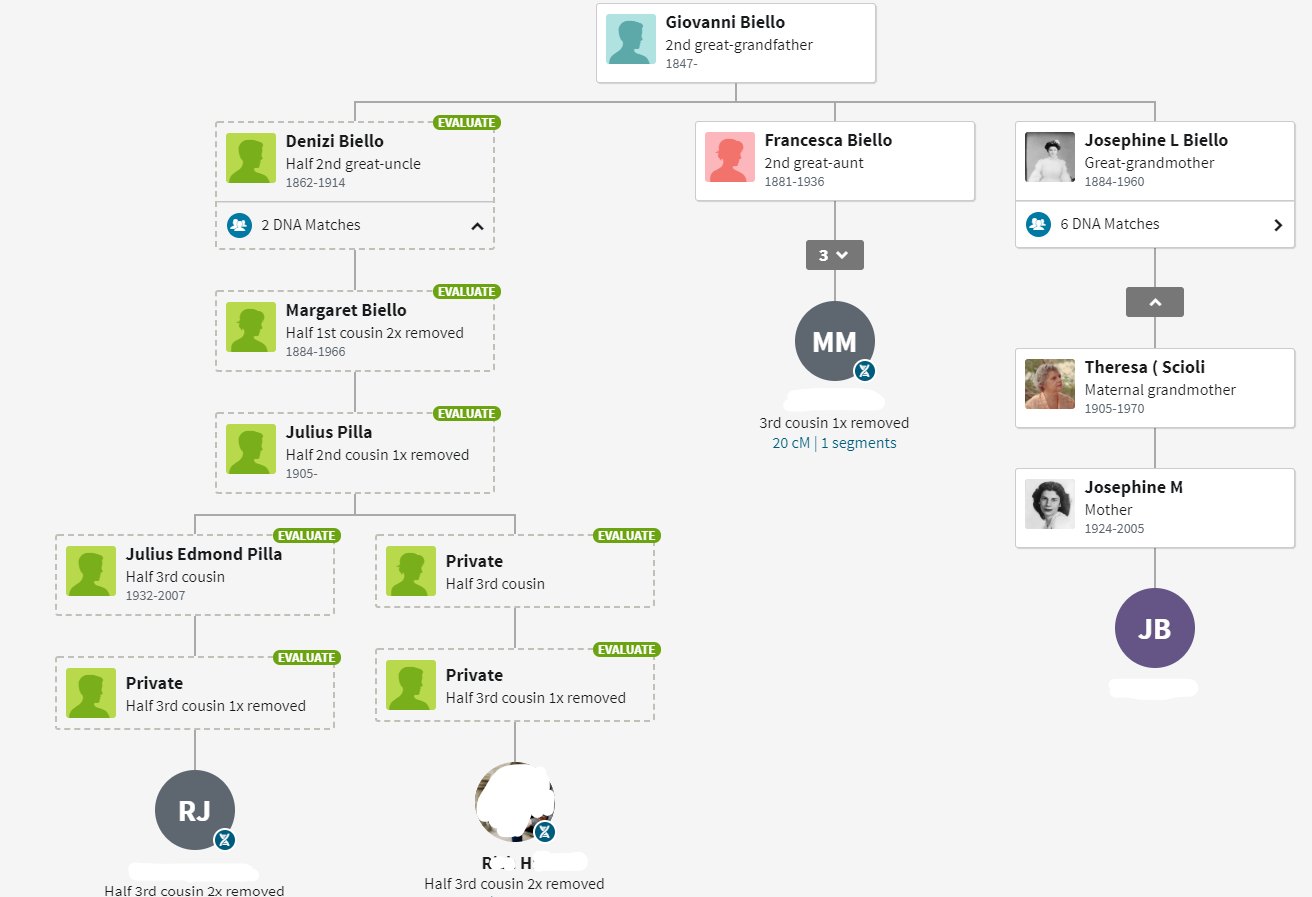
My dad (JB, shown above) is a DNA match with two people, RJ and RH (you can ignore MM in the screenshot above, that's a legitimate connection I've verified). ThruLines suggests that they are both connected to my dad via his ancestor, Giovanni Biello. It does not include Giovanni's wife, so these are allegedly half cousins, but to my knowledge, Giovanni was only married once. I was open minded to the idea I might have missed another marriage, but then I noticed something else.

RJ and RH both descend from someone named Denizi Biello, b. Feb 1862 (according to the 1900 US Census), supposedly the son of my ancestor Giovanni Biello, b. 13 Jul 1847. This would mean Giovanni was only 14 when Denizi was born, which might be biologically possible but it's extremely unlikely. Men didn't marry until they were old enough to support a family, which they would not be at 14, and if they had children out of wedlock, the child was often left at the church as a foundling (meaning the father not identified). So something about this just didn't sound right to me.

Yet, 4 people had added Denizi as the son of this Giovanni to their tree. And in their defense, Denizi's death certificate does indeed say his father was Giovanni Biello and his mother Domenica Scioli.

Denizi's, or Dionisio Biello's civil birth record
Digging through the civil records of Monteroduni, Italy where both men were born, I found Denizi's birth records which finally held the answer. For starters, his original name was Dionisio Biello, and he was actually born several years before 1862, on February 2, 1856. But his parents names were correct: Giovanni Biello and Domenica Scioli. Only, Giovanni was not born anywhere near 1847. He was recorded as aged 38, which would make him born about 1818. It also said Giovanni was the son of the late Dionisio, whereas "my" Giovanni Biello was the son of Lorenzo.

So, two completely different men, as I suspected. I do not know who originally made the wrong assumption that Denizi was the son of "my" Giovanni but then 3 other people copied the error, ThruLines picked up on it and then found two people descended from Denizi. Since there were only 4 tree with the same error, I contacted all of them to let them know - hopefully they'll make the change and the incorrect ThruLines will disappear, but imagine if this error had been copied by more than 3 people! It probably wouldn't have been worth sending a message to each one since many likely wouldn't get the message or make the correction.

Granted, I have to admit that Monteroduni is a small town in rural Italy where there is a ton of endogamy and cousin marriages. I'm pretty sure everyone with ancestry in Monteroduni is related to everyone else there in some way, but it's still important to figure out the correct relationships whenever possible. Biello is actually a very rare surname and given that and the same location, our Biello lines probably intersect at some point, it's just a question of whether it's before or after civil records began in 1809. I'll certainly keep looking.