Monday, June 26, 2017

Discontinuation of FamilySearch's Microfilm

So for those who haven't heard, FamilySearch is going to be discontinuing distributing of their microfilm come September 1, 2017. You can read their announcement of it here. This is because they are in the process of digitizing all their microfilm for online access and estimate they will be complete by the end of 2020. Of course, I hugely appreciate the massive undertaking of scanning so many records from microfilm and making them available for free, the contribution their organization has made to the genealogy community is outstanding, but it is still disappointing to know there is going to be an almost 3 year downtime in which many records won't be accessible at all. That's assuming their projection is correct and they complete everything by the end of 2020. Hopefully, it does not take longer than expected.

According to FamilySearch, they have 2.4 million microfilms at the Family History Library in Salt Lake City, and they have so far digitized 1.5 million of those. That means there is still almost a million more films (37.5%) which need to be scanned. Granted, they have prioritized those which are most frequently ordered and already digitized them, but there are probably thousands (millions?) of people out there who need access to those roughly 900,000 films still not scanned, who will no longer have it for the next 2-3 years. I am one of them, in the last 2 years I have order dozens of microfilm which not only was not digitized at the time, but remains still un-scanned today.

I am just surprised that they aren't waiting until everything, or at least close to everything is done before discontinuing it. They've only just passed the half way point of completion. I have seen arguments as to why they are discontinuing the microfilm service, and they all make sense for discontinuing it eventually, just not right now, before their scanning project is at least a little closer to being complete. It is certainly disappointing, but it's not like it's the first time I've been forced to wait years for access to certain records. Fingers crossed their timeline projection is accurate.

Tuesday, June 6, 2017

Newspaper Mentions of Incoming Ships

My ancestors were the few who stayed on board the Australia
in spite of the disabled engine
Here's a tip many people may not know about. Newspapers typically reported the arrivals of ships, so if you're looking for more information on your ancestor's immigration, check newspapers.

For example, I had the passenger list for my ancestors, Giovantomaso Scioli and Lorenza Palladino, arrival in New York City on March 10, 1880, but frustratingly, the passenger list didn't mention the departure port or date. Wanting to know when and where their ship left from to get the full picture of their journey, I found NYC newspaper articles on March 10th and 11th, 1880, which told me not told me the ships departure details, but also that the ship made the journey on a disabled engine and hit a storm just before arrival!

That's probably a unique situation, but at the very least you should find a listing of ship arrivals with the details of its departure (example below). Sometimes, passenger names are even listed so if you're struggling to find any passenger list to begin with, you might want to try newspapers too (example below.

Monday, June 5, 2017

How to get a Family Group Sheet on Ancestry.com

A couple years ago when Ancestry.com updated their website to the "new site design", the family group sheet feature disappeared. Staff promised it would return, but it never did. At least, not on the surface. There is a "backdoor" method to pull up a family group sheet of anyone in your tree. Here's how it works.

Use the following URL, replacing "TREEID" and "PERSONID" with the corresponding numbers from the URL of your tree/the profile of the person you want to make a family group sheet for: https://www.ancestry.com/family-tree/tree/TREEID/family/familygroup?fpid=PERSONID

How do you find the tree ID and person ID numbers from your tree? Just open the profile of the person you want, and they can be found in the URL. So, for example, this is the URL from someone my public tree: https://www.ancestry.com/family-tree/person/tree/110310542/person/340080162048/facts

The first number, 110310542 is the tree ID, and the second number, 340080162048 is this person's ID. So, taking the family group sheet URL and replacing the corresponding numbers, the URL is: https://www.ancestry.com/family-tree/tree/110310542/family/familygroup?fpid=340080162048

Here's a quick reference image, for future use:


Thursday, May 4, 2017

An Update on The Tragic Family of James Addison Smith

James Addison Smith with wife Margaret,
and children Olif (left) and Madge (right)
Previously, I talked about my 3rd great uncle James Addison Smith and how his family was plagued with tragedy. His wife, Margaret Catherine Peay, and his daughter Marjory both became morphine addicts, his daughter Mary was schizophrenic, his son Olif died in a train accident, and his daughter Madge (who was also in the same train accident but survived) eloped with a man who also later wound up in a mental institution. You may feel sorry for James, but family legend has it that he was very controlling of his daughters, forbidding them from having boyfriends or even leaving the house without their mother. When Madge eloped, he never spoke to or of her ever again.

But let's start with what information can be confirmed with records. I detailed Mary's schizophrenia in the previous post, so now I will detail the tragic and horrific train accident that took many loved ones from this family.

In the summer of 1894, five year old Olif and three year old Madge Smith had gone with their maternal aunts, Sallie and Daisy Peay, to visit their other maternal aunt, Nannie Maddox (nee Peay), and her husband, James P Maddox in Centertown, Kentucky. Back home in Russellville, a good 50 miles south, Olif and Madge's mother, Margaret, was caring for their 6 month old sister Marjory at the time. Caring for an infant with two young children constantly underfoot was likely stressful, so perhaps Margaret sent them off with her sisters to visit family for a brief break.

Headline from newspaper about the accident
On Saturday, the 23rd of June, they set off home with James P Maddox driving them in a two horse wagon to the nearest railroad station, which was likely in McHenry, Kentucky, about 7-8 miles from Centertown. At 12:30 PM, they came upon a railroad crossing just southwest of McHenry known as Frogtown Crossing. What happened next was the result of a combination of poor planning of the junction, and total disregard for public safety. The road leading up to the crossing was on a hill, making it hard to see the crossing until you were only a few feet from it. In addition, there was a sharp curve to the railroad just before the crossing, making it difficult to see if any train was coming. As if that weren't enough, the railroad tracks had no planks at the crossing of the dirt road, meaning wagon wheels had to be pulled up and over each rail. Perhaps the Chesapeake, Ohio, and Southwestern Railway Company felt the area was so rural, the road was unlikely to see much traffic, making an accident unlikely. In any case, the Smith, Peay, and Maddox families would suffer for that negligence.

Maddox seemed to be aware of the dangers of the junction, as he came to a stop just before reaching the top of the hill and the railroad. After a moment's pause, the wagon lurched forward, attempting to cross as quickly as possible, though other reports say the horses were spooked and this is why the wagon jumped forward. Regardless, the wagon suddenly halted on the tracks, the wheels stuck on the rails protruding from the ground, just as the eastbound train No. 6 came roaring around the corner so fast the passengers of the wagon didn't have time to jump out.

The collision was a horrific scene. The wagon was obliterated to pieces while the broken and bleeding bodies of both the horses and the wagon's passengers were thrown to either sides of the tracks. Olif had been thrown so high in the air, it's believed he died upon impact with the ground. The Peay sisters, thrown far from the tracks, were killed almost instantly and gasping their last breaths as help arrived. Maddox was unconscious but alive, barely, and suffered for 33 and a half hours before finally succumbing to his fatal wounds. Little Madge, the sole survivor (even the horses perished), had a broken arm and back, and her injuries were severe enough that many feared she would follow her relatives in death. In fact, one newspaper even falsely reported that she had already died. But she defied all the odds and pulled through, attended by the physicians of McHenry.

Settlement of case
The Maddox, Peay, and Smith families filed a law suit against the Chesapeake, Ohio, and Southwestern Railway Co., asking them for $5,000 for each of the passengers who died in the accident. Originally filed with the Circuit Court of Ohio County, the case was transferred to the Federal Court but dismissed in June of 1895 when the parties came to a settlement outside court. The Railway agreed to pay the families $2,500 for each of the deceased, and another $1,975 to the Smith family for the injured Madge. In 1895, $2,500 would have been the equivalent of about $72,800 today. Madge's share would have been worth about $57,500 today, and according to family legend, it was put into a trust which she didn't receive until she turned 21 in 1911. Assuming she gained interest on her trust fund, the amount she inherited might have been much greater.

In 1913, Madge eloped with Harry J Messmann, a 29 year old salesman from Manhattan, New York who came to her father's clothing store, taking her inheritance with her. According to family stories, her over-protective and controlling father was so infuriated by her elopement that he refused to ever speak to her again and the family was forbidden from even saying her name. She was dead to him, but she did write to her mother and sisters.

Married life was ultimately not to bring Madge any happiness though. Though she had at least one child with Harry, a daughter named after herself and her own mother, Margaret, family lore says that when her money from the accident ran out, her husband left her. However, census reports show that in 1930 and 1940, Harry was a resident in Middletown State Homeopathic Hospital - a mental institute. Just like her sister Mary, Madge's husband suffered from a mental illness severe enough to hospitalize him for the rest of his life. Whether he also left her because her money ran out, before he was hospitalized, is unclear. Maybe Madge, too embarrassed to admit the truth of where her husband disappeared to, put it about that he had left her instead. What became of Madge and her daughter after 1920 remains a mystery - I have not been able to find them in the 1930 or 1940 censuses.

I have also not been able to find any records that verify Madge's sister Marjory and mother Margaret were morphine addicts. It's certainly possible, knowing all that their family was put through (both this and not forgetting the story of Mary's schizophrenia), that they might have turned to a drug which would help them forget it all. However, Margaret's death certificate makes no mention of any drug addiction, and the censuses don't report that kind of thing. What the census does tell us is that Marjory was employed as a filing clerk during each census, and according to directory records, all through the 1940s as well. I am not sure how likely it is that one could hold a job with a morphine addiction, but perhaps she did not start until after 1950.

James Addison Smith's obituary notably does not name his
still living schizophrenic daughter, or the daughter who eloped
As for the rumor that James Addison Smith was so controlling that he never allowed his daughters to leave the house without their mother, it may be true. Madge had to elope, and Marjory, Ella, and Mona never married. While the legend goes that he didn't allow them to have boyfriends, it doesn't necessarily mean they weren't allowed to marry, but it does make marriage much more difficult. Only his youngest daughter, Laura Batsel Smith, was married with his approval in 1935 when she was 26. Her wedding announcement in the paper says her father walked her down the isle and gave her away, even hosting the wedding at his home. One wonders if this wasn't something of an arranged marriage, since when would Laura ever have had the freedom to get to know her groom, Edwin Chamberlin? Assuming the story is true, of course. It's a nugget of information my grandmother had collected during her own genealogy research. I know she reached out to a lot of relatives and gathered information from them. The Smith sisters would have been my grandmother's 1st cousins once removed, and several of them would have still been alive when my grandmother was researching, so this information could have come straight from the horses mouth. I know as genealogists we are taught to take family stories with a grain of salt, but we are also told to collect as much first-hand information as we can. So far, all the data and stories my grandmother left behind have turned out to be at least partly true.

On a last note, I noticed that James Addison Smith's obituary in 1941 does not mention his daughter Mary even though she outlived him. I guess in spite of all those years of caring for her, he was still embarrassed by his schizophrenic daughter. Madge is also noticeably not mentioned, and although we don't know for sure she was still alive at the time, her husband is listed in 1940 as still married, not widowed. That is suggestive that she was still alive, which lends credit to the story that her father had disowned her, for her to not be mentioned in his obituary. Whatever his reasons, he obviously disapproved of her marriage and never forgave her for it. What a shame, that with all the tragedies in his life, he would add to it by never forgiving the daughter he nearly lost as a child.

Tuesday, May 2, 2017

Quaker Gibbs of Burlington County, NJ

My Gibbs branch has always been a brick wall for me. My grandmother had fairly extensively researched her and my grandfather's genealogies and over the years, I went about confirming most of it with records and expanding on several branches. But not the Gibbs branch. Here's what I know.

Hope's baptism confirms her parent's names but not
mother's maiden name
Hope Gibbs was born November 3, 1805 in Philadelphia, Pennsylvania to Caleb and Isabella Gibbs. There is an adult Lutheran baptism record for her which confirms her birth date and parents names, and other records like her death record confirm her birth place. According to my grandmother, Isabella's maiden name was Peters but I haven't found any record of that and have only my grandmother's word to go on (and she is deceased so I can't ask her where she got it from). It's possible she got the name from her mother-in-law, or her grandmother-in-law and therefore the info is subject to the corruption of things being passed down the generations through word of mouth. Equally, I haven't been able to find any conclusive info on Caleb apart from the mention in Hope's baptism record.

What I did find was some Quaker records of a Caleb Gibbs in Upper Springfield, Burlington County, New Jersey and the timing is right that this could be my Caleb Gibbs, that he was originally in New Jersey and moved to Philadelphia before Hope was born. I can't find records of him in Upper Springfield after Hope's birth and to strengthen the ties between the two Calebs, I found a marriage record of Caleb Gibbs and Isabella Brannin (mis-transcribed as Browning) on April 29, 1799. Ancestry.com has the record of the marriage in Philadelphia, but this has been incorrectly indexed. Family Search has a copy of the record from the true location in Burlington, New Jersey.

Caleb Gibb's marriage without Quaker consent - lack of mention
of wife's name suggests she was not a Quaker

The trouble is I have no idea if my Caleb was a Quaker or whether he came from Burlington, New Jersey. The only links I have between them is that the Caleb from Burlington obviously married an Isabella, which matches with my info, and that there's no more Quaker records of him in Burlington County after 1800 (before Hope's birth), or seemingly any records at all of him in Upper Springfield after 1800 (though there are some Caleb Gibbs in neighboring townships). In fact, the reason for the lack of his mention in Quaker records after 1800 seems to be because there was a conflict with him and his marriage. It appears he married without the consent of the Quaker elders and he wasn't sorry for it. If this is my Caleb, this could be the reason he left Burlington (and perhaps even the Quakers) and went to Philadelphia.

Isabella's excommunication from the Quakers following
the birth of her illegitimate child
Interestingly, searching for Isabella Brannin in the Quaker records turned up a woman by that name who had a child out of wedlock in 1795 with Levi Webster. They were both excommunicated from the Quakers for it. This could be why Caleb's marriage to a disgraced woman and ex-Quaker was not approved. Isabella does not appear to have married Levi, which would have left her available to marry Caleb in 1799. Then all records of Caleb in Upper Springfield Township cease after 1800 - is it because they moved to Philadelphia, where their daughter Hope was born in 1805?

Quakers seem to be pretty well documented so I'm hoping someone who is researching Quaker Gibbs in the Burlington, NJ area might be able to help me link my Caleb Gibbs to them. It seems likely the two were one in the same, but I feel like I'm missing an affirmative link.

Friday, April 28, 2017

When it all comes together

Mary Cath. Brady, Martha Washington House, William Henry
McBride, and Daniel H McBride are all children of the John
McBride in my DNA match's tree, mentioned here as the heirs
of Catherine McBride, the mother of "my" John McBride.
This is a great example of how a combination of DNA and paper research can break down a brick wall. And it's why you should read all pages of a multipage document, even if it doesn't seem like it has any useful information at first. Additionally, probates often seem to get overlooked, but this is also a great example of how important they can be. When you're stuck, always look for a probate record, of all relatives involved. Even if they are female (women sometimes had wills and probates too!).

I had a suspicion that one of my DNA match's ancestor was my 5th great uncle, John McBride. The DNA match had the same name in her tree, but she knew nothing about him apart from his name (which she found from orphan court records), his wife, and his children. I had his birth and death data, and obviously his parents names (and records to back it all up), but no records confirming his wife's name or any children. The only thing they had in common was both location and time period, but there was no proof they were definitely the same man. It was like I had half the story, and she had the other half, but we had no way to link them together.

I finally read ALL the pages of John's mother's probate records. Initially I'd only read her will, thinking if she names her grandchildren by her son John, and they match the names of John's children in my DNA match's tree, that obviously proves they are the same man. The will doesn't name them (only says "my grandchildren by my son John")... but upon further inspection of the follow up documents, such as the distribution of her estate, it does list several people whose names match perfectly with the children in my DNA match's tree! Although it doesn't specify they are her grandchildren, given the context (i.e., her estate is being distributed to her heirs, as specified in her will as her grandchildren), it would be too much of a coincidence for so many of them to be listed on this woman's probate records if they weren't her grandchildren.

So when you're struggling to find a connection to a DNA match, it pays to do some digging around on a hunch, even if it seems like a long shot or there's not enough info to say for sure. The only connection I had was a name, and an extremely common first name at that, with a surname that isn't unheard of either. Even my DNA match in question was skeptical when I first proposed the idea to her, but a little digging proved my hunch was right!

Thursday, April 6, 2017

Finally! A Gedmatch Admixture Guide!

Update: I think perhaps I was not clear enough when originally writing this that ethnicity/admixture is only an estimate or interpretation of your DNA, it is NOT an exact science and different interpretations often yield wildly different results. It's usually accurate on a continental level, but sub-continental regions generally share too much DNA to always be able to reliably tell them apart. That is why most of Gedmatch's calculators often cover broad areas. The more specific an area is narrowed down too, the more speculative the results are. Plus, different sample groups and different algorithms will always produce different results and there is no one option that is always going to be more reliable than any other. While the ethnicity reports can be fun and interesting to explore, which is why I wrote this guide, they really should not be taken literally. You should not attempt to use them to definitively prove your ethnic origins (on a sub-continental level), or exact amounts of any given ethnic origin, or a specific geographic path your ancestors might have taken over time, or especially to confirm a specific ancestor's identity. If that is what you're looking to do (particularly the latter), you are better off working with you DNA matches (if you have not opted into matching, you should seriously consider it, since that is where the true value of the test lies). Additionally, be aware that Gedmatch's admixture calculators haven't been updated in years (though all of this still applies to other companies who have provided updates more recently). With all that in mind, I hope this guide is useful to helping people understand the different interpretations of their DNA available on Gedmatch. Have fun, but remember, don't take it too seriously.

For those unaware, Gedmatch.com is a website where you can upload your raw DNA data for further analysis and matching with people from other companies who have also upload their data.

Parts 3 and 4 on Admixture Proportions by Chromosome and Chromosome Painting now available.

Part 5 on Spreadsheets is now available.

Part 1 - Admixture Proportions

Introduction
Despite all the help articles available on Gedmatch.com, none of them really offer a comprehensive guide to understanding the admixture calculators for newbies. Most of them are guides on understanding DNA in general, or how to upload your data, or using the one-to-many or one-to-one tools. In fact, there is a very good beginners guide to the matching side of things found here. But the most common questions I see about Gedmatch are “which admixture calculator do I use?” and “what do the results mean?” There is a Gedmatch wiki page on admixture, and there is Kitty Cooper's slide presentation, but I don’t think they really answer all the questions most people are looking for, especially regarding Oracle. Even Googling the topic only turns up spotty results from forums and blogs, nothing that really lays it all out. Since no one else has done it, here is my attempt. Please keep in mind I am no expert and have no formal education in genetics, this is just the knowledge I’ve gathered over the years from various sources as a result of trying to understand my own DNA results.

Admixture is a scientific term for the ethnicity percentages you received from a DNA company like Ancestry.com, FamilyTreeDNA, 23andMe, or MyHeritage. It’s important to understand that each admixture project on Gedmatch is created by a different person, mostly academics. Note that most of the admixture results will include some basic info on the calculator, either on the results page, or through a link from the creator. However, the info provided may still be technical and difficult to understand for the average person, because they were primarily created for academic purposes. This is an attempt to translate some of that info into something more understandable to the average user. I apologize that this guide favors info on European backgrounds, but that is simply what I’m most familiar with, being a European descendant myself.

Be aware that it’s common practice in DNA admixtures to refer to populations from prehistoric times as “ancient”, even though this is a bit of a misnomer. In historical terms, ancient history marks the beginning of recorded history, but here, “ancient” generally refers to the time before written history, prehistory. Some time periods might be specified as “neolithic”, or “paleo/paleolithic” etc.

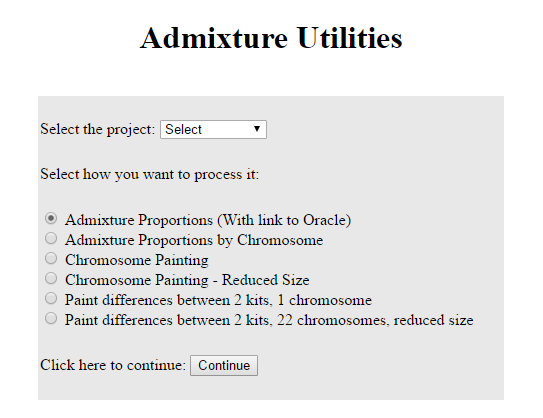
Select a project from the drop down menu, leaving the other
options as they are, then click "continue"
Step 1: Pick a project.
There are 7 projects to choose from in the Admixture (Heritage) tool (found under "Analyze your data" and "DNA raw data"), but what are they? What do they mean? Which one should you pick? Here’s a basic breakdown:

(Note: below the projects drop down menu there are options like "Admixture Proportions (with link to Oracle)" and "Chromosome Painting", etc. Don't mess with those for now, just stick with the top default option, Admixture Proportions (with link to Oracle), as that is what this guide will cover.)

  1. MDLP
This is a global calculator and attempts to break your results down into different parts of the world. It’s good as an overview, but if, for example, you already know you’re European, it’s probably unnecessary. It’s also heavy on ancient groups. The blog for this project is found here: http://magnusducatus.blogspot.com/

  1. Eurogenes
As the name suggests, this is primarily for people with European backgrounds. While it does have populations outside Europe, there are usually more sub-continental regions for Europe than any other continent. I highly recommend this as the go-to project for people with sole European ancestry. The blog for this project is found here: http://bga101.blogspot.com.au/

  1. Dodecad
This project says it focuses primarily on Eurasians, but most of the calculators are geared more towards Asian and African ancestry than European. It’s not ideal for Europeans, but may be useful for people with mixed ancestry. The blog for this project can be found here: http://dodecad.blogspot.com/

  1. HarappaWorld
This calculator is primarily for people with South Asian ancestry. The blog for this project can be found here: http://www.harappadna.org/

  1. Ethiohelix
This is an African based project, though it does have options for people with mixed backgrounds (but always including African). There is no Native American in this project at all. The blog for this project is found here: http://ethiohelix.blogspot.com/

  1. puntDNAL
This is primarily a project on ancient DNA. There is no website, but questions and comments about should be directed to Abdullahi Warsame at puntdnalking@gmail.com

  1. GedrosiaDNA
This project focuses primarily Eurasian (especially Indian and Asian) and ancient DNA. There is no website, but for further questions, please contact the creator at Dilawerkh4@gmail.com


Once you've selected a project, you need to enter your kit
number and then select a specific calculator.
Step 2: Pick a calculator.
You’ll find that for each project, there are often several calculators to choose from. How to choose? What do they mean? What are the differences? Well, for starters, the numbers following a ‘K’ indicate how many populations (or regions/categories) that calculator includes. So for example, Eurogenes EUtest V2 K15 has 15 populations. So choose one depending on how many regions you want to break your results down into. Keep in mind the more populations and therefore the more specific the regions are, the more speculative the results will be.

Don't forget to put in your kit number - if you've forgotten it, go back to the home page and copy it.

Certain other tests may be specific to deeper, more ancient (prehistoric) ancestry, like Hunter-Gatherer vs Farmer. Any abbreviation that starts with ‘A’ probably stands for ‘ancient’, but I will post a comprehensive terminology list at the end of this guide. These calculators for ancient DNA aren’t very useful if you’re just looking for an opinion on your more recent ethnicity results.

Other calculators might be specific to certain types of ancestry. For example, Eurogenes’ Jtest is specific to Ashkenazi Jewish ancestry. There’s no need to run this test if you don’t have any Jewish ancestry. In fact, you might get false results in Ashkenazi if you run this calculator and have no Jewish ancestry.

(Note: ignore the option below the calculator drop down menu, this is for data collection purposes. If all 4 of your grandparents are from the same ethnic group and you want your DNA to be a part of the sample groups they use to create these calculators and determine populations, then go ahead and fill it out. Otherwise, you can ignore it.)

Here’s a more detailed breakdown of each calculator. I've also created a spreadsheet listing the populations included for each calculator, along with my recommendations for good calculators to use based on your ancestry or what you're looking for.

MDLP
  • MDLP K11 Modern - 11 global populations including ancient
  • MDLP K16 Modern - 16 global populations including ancient and modern - results page includes full population descriptions
  • MDLP K23b - 23 global populations including ancient
  • MDLP World22 - 22 global populations including ancient, full details including maps of what areas each category covers are found here - there are several Native American categories so this may be ideal for Native American ancestry
  • MDLP World - 12 global populations, probably the original MDLP calculator

Some Population Maps
for Eurogenes ANE 
Eurogenes
  • Eurogenes K13 - 13 global populations, mostly European. Creator made this the default as it “seems to hit the spot for most people” with European background. Details here
  • Eurogenes EUtest V2 K15 - 15 global populations, mostly European, also a popular option. Details including regional maps for each category found here
  • Eurogenes ANE K7 - 7 populations, Ancient North Eurasian, meaning this looks at ancient DNA mostly in Europe, Western Asia, and Africa. Details found here and some maps available here
  • Eurogenes K9b - 9 global populations, approximates Geno 2.0 analysis
  • Eurogenes K9 - 9 global populations, map available here (population descriptions no longer available)
  • Eurogenes K10 - 10 global populations, map available here (population descriptions no longer available)
  • Eurogenes K11 - 11 global populations, map available here (population descriptions no longer available)
  • Some population maps
    for Eurogenes K36
    Eurogenes K12 - 12 global populations. North European ancestry is said to do well with this calculator. Map available here (population descriptions no longer available)
  • Eurogenes K12b - 12 global populations, excluding Native American (Amerindian), map available here (population descriptions no longer available)
  • Eurogenes K36 - 36 global populations, mostly European. This is the most detailed breakdown for Europeans, but that also makes it highly speculative. Details found here and maps available here - there's also an interesting application that will map out your personal K36 results
  • Eurogenes Hunter-Gatherer vs Farmer - 12 ancient Hunter-Gatherer vs Farmer populations. Map available here
  • Jtest - Jewish Ashkenazi, 14 global populations but mostly European, this is essentially the EUtest with an Ashkenazi category. Details including maps are here
  • EUtest - 13 global populations, mostly European minus Jewish Ashkenazi. Details including maps are here
Some Dodecad K12b
Population Maps

Dodecad
  • Dodecad V3 - 12 populations, mostly Asian and African, 2 European, no Native American. More info
  • Africa9 - 9 populations, all African except one European (no Asian, no Native American). More info
  • World9 - 9 global populations, not specific to any continent so good as an overview regardless of your ancestry. More info
  • Dodecad K7b - 7 populations, mostly Asian, 2 European, 1 African, no Native American. More info
  • Dodecad K12b - 12 populations, mostly Asian, 3 African, 2 Middle East, 2 European, no Native American. More info and population maps

HarappaWorld
  • HarappaWorld only has one calculator and as explained above, it’s primarily for South Asian ancestry. It does include some European, African, and Native American populations, but its focus is on South Asian: Indians, Pakistanis, Bangladeshis and Sri Lankans.

Ethiohelix
  • EthioHelix K10 + French - 10 populations, 9 African, one “French” which acts as a European population. This is really only useful/accurate for people with mixed African and European ancestry. Maps available here
  • EthioHelix K10 + Japanese - 10 populations, 9 African, one “Japanese” which acts as an Asian population. Only useful for people with a mix of African and Asian ancestry. Maps
  • EthioHelix K10 + Palestinian - 10 populations, 9 African, one “Palestinian” which acts as a Middle Eastern population. Only useful for people with a mix of African and Middle Eastern ancestry. Maps
  • EthioHelix K10 Africa Only - 10 strictly African populations, nothing else. Do not use if you have no African ancestry as results won’t be accurate. Maps

puntDNAL
  • puntDNAL K10 Ancient - 10 ancient populations, incorporates Caucasus HG as well as Early Neolithic Farmers and Western European HG.
  • puntDNAL K12 Ancient - 12 populations, utilizing ancient oracle, more info provided on results page
  • puntDNAL K12 Modern - 12 populations utilizing modern oracle, more info provided on results page
  • puntDNAL K13 Global - 13 modern populations, focuses primarily on Asia (6 Asian populations, 3 African, 2 European, 1 Oceania, 1 Native American). From the creator: "The impetus in creating this calculator was the release of the Southeast Asian study, which inspired me to create a calculator that included a Southeast Asian component and give my Southeast and Northeast asian people a more accurate calculator for their ancestry." Population details
  • puntDNAL K15 - 15 populations, focuses primarily on Africa (particularly East Africa), but also includes some West Asia, and Europe. More info
  • puntDNAL K8 African only - 8 populations, as the name suggest, it’s strictly an African calculator

GedrosiaDNA
  • (Removed) Eurasia K9 ASI - 9 populations, modeled around the ancient Ancestral South Indian component, no Native American. More info on population descriptions
  • (Removed) Eurasia K10 CHG - 10 ancient populations, modeled on Caucuses Hunter Gatherers, more info on population descriptions
  • (Removed) Eurasia K11 CHG-NAF - 11 ancient populations, modeled on Caucuses Hunter Gatherers and Neolithic Anatolian Farmers, more info on population descriptions
  • Gedrosia K3 - 3 populations, Eastern Eurasian, Western Eurasian, and Sub-Saharan African. More details
  • (Removed) Gedrosia K15 - 15 populations with a focus on the Indian subcontinent. Population descriptions
  • (Removed) Eurasia K14 - 14 populations, using the same Neolithic and Bronze Age source data as the K14 Neolithic calculator, plus some modern populations
  • (Removed) Eurasia K14 Neolithic - 14 global populations, focus is on ancient Neolithic and Bronze Age genomes from across Eurasia. Population descriptions
  • Gedrosia K12 - 12 populations, designed for individuals of predominantly South Asian and West Asian ancestry for inferring gedrosian Balochi admixture. No Native American. More info
  • (Removed) Gedrosia K11 - 11 populations with a focus on Kalash Indo European peoples of Pakistan. Population descriptions
  • Ancient Eurasia K6 - 6 ancient populations, primarily Europe, Asia, and in between, 1 African, no Native American. Further descriptions are available on results page.
  • (Removed) Near East Neolithic K13 - 13 ancient populations, with a focus on the Near East. Details provided on results page.


Step 3: Understanding the results: A Terminology Guide
A list of populations you might see and a brief description. I did not include some of the most self-explanatory ones. Some that I have listed might still be obvious to some people, but I’ve seen others ask about them on occasion. If there isn’t one listed here, you might learn a lot by just googling it. There is also a good abbreviation guide here: https://isogg.org/wiki/Abbreviations
Keep in mind different calculators may use different terms to refer to the same region or population.

  • Amerindian or Amerind - Native American (ie, American Indian meshed into one word)
  • Anatolian - mostly Turkey
  • Ancestral Altaic - Asia (excluding South), and Eastern Europe
  • ANE - Ancient North Eurasian
  • Archaic African - broad category for prehistoric Africans
  • Archaic Human - broad category for prehistoric humans around 500,000 years ago
  • ASE - Ancient/Ancestral South Eurasian
  • Ashkenazi - Ashkenazi Jewish of central/eastern Europe (not the same as Sephardic Jewish)
  • ASI - Ancient/Ancestral South Indian
  • Australian - aboriginals of Australia
  • Australoid - “people indigenous to Southeast Asia, South Asia, Australia, Melanesia, Polynesia, Micronesia, and historically parts of East Asia.” (Wikipedia)
  • Austronesian - “relating to or denoting a family of languages spoken in an area extending from Madagascar in the west to the Pacific islands in the east.” (Google)
  • Baloch - people of Iranian Plateau and Arabian Peninsula (primarily the Middle East)
  • Baltic - regions surrounding the Baltic sea
  • Bantu - Central and south Africa
  • Basal - Basal Eurasian?
  • Beringian - areas surround the Bering Strait (Eastern Russia and Alaska)
  • Biaka - aka Aka, “nomadic Mbenga pygmy people who live in southwestern Central African Republic and the Brazzaville region of the Republic of the Congo” (Wikipedia)
  • Caucasian/Caucasus - people of the Caucasus region, the border between Europe and Asia in between the Black sea and the Caspian Sea
  • CHG - Caucasus Hunter Gatherers
  • EHG - Eastern Hunter-Gatherer
  • ENF - Early Neolithic Farmer
  • Fennoscandian - Scandinavia and Finland
  • Gedrosia - Modern day Makran (semi-desert coastal strip in Balochistan, in Pakistan and Iran, along the coast of the Persian Gulf and the Gulf of Oman)
  • Khoisan - Southern Africa
  • Mbuti - “one of several indigenous pygmy groups in the Congo region of Africa” (Wikipedia)
  • Melanesian - “a subregion of Oceania (and occasionally Australasia) extending from the western end of the Pacific Ocean to the Arafura Sea, and eastward to Fiji.” (Wikipedia)
  • Mesoamerican - Native American in Mexico, Central and South America
  • NAF - Neolithic Anatolian Farmer
  • Oceanian - Aboriginals of the Pacific Ocean islands (may include Australia depending on calculator)
  • Omotic - Southwest Ethiopia
  • Papuan - New Guinea and surrounding islands
  • Pastoralist - Sheep or cattle farmer
  • Pygmy - “certain peoples of very short stature in equatorial Africa and parts of Southeast Asia.” (Google)
  • San - Bushmen of southern Africa
  • SEA - South East Asian
  • SSA - Sub-Saharan African
  • Steppe - “ancient North Eurasian hunter-gatherers' heritage, which was subsequently shown to have an influence in later eastern hunter-gatherers and to have spread into Europe via an incursion of Steppe herders” (MDLP K16)
  • Tungus-Altaic - Northeast China and Siberia
  • WHG - Western Hunter-Gatherer
  • WHG-UHG - Western Hunter-Gatherer/Unknown Hunter-Gatherer
  • Volga-Ural - Part of Russia (central)


Conclusion
Which project and calculator you go with greatly depends on your known ancestry. I know all this info is probably still a little overwhelming even with (or perhaps because of!) this guide. If you’re of European descent, and a newcomer to Gedmatch, and you just want a second opinion on your ethnicity results from any of the Big 3 companies (Big 4 now maybe, with MyHeritage joining the bandwagon), I’d recommend Eurogenes K13 or K15. Personally, I tend to prefer K15, because there are maps available showing specifically what regions are covered by which populations. Certainly, you can play around with any of the other Eurogenes calculators too (except Jtest if you’re not Jewish). Most of the other projects and calculators are either geared more towards ancient DNA, other continents, or a mixed ancestry. You may find a non-bias global calculator in some of the other projects, but it’s probably not going to provide the breakdown of Europe you’re looking for.

If you’re looking for an ancient calculator, I again tend to stick to one of Eurogenes’ (HG vs F, or ANE), but MDLP have some good options too. There’s also a couple in puntDNAL which I don’t think have a bias towards any one type of ancestry.

If you’re African, Asian, or of mixed heritage, there are a number of options to choose from, but I unfortunately can’t recommend any over any others. Most global calculators will include Amerindian (I have noted when one doesn’t), but MDLP World22 seems to have the most categories for Native Americans and may be ideal for that.

I was surprised to realize Eurogene's Jtest is the only one that offers an Ashkenazi (or other Jewish) category, so if you're Jewish, it looks like this is your only option. However, it should be noted that there are many Jewish populations typically included in Oracle/Oracle 4 (see below for more details), not just for Jtest but any other given calculator too. For your reference, I created a spreadsheet that shows which calculators have what Jewish populations available in Oracle/Oracle4.

If you're adopted and don't know what your ethnic background is, is important to remember that there's never going to be one defining ethnicity or admixture report that tells you "this is your ancestry" with any total accuracy. However, I understand the desire to know where you came from, so what I'd recommend is gathering as many reports as you can (within reason - if you're obviously white, there's no sense running an African-only calculator) and compare them in a spreadsheet like I've done here. It will help you spot any consistencies, or see what populations show up most frequently in the highest numbers.

It is frustrating that maps, or at least population descriptions, aren’t available for every calculator, but this is a free service, after all. It’s actually pretty amazing all the work the project creators do to provide this for free.


Part 2 - Oracle
Say what now?

Introduction
The second most common questions I see about Gedmatch are about Oracle. What is it? What do the results means? Oracle is an attempt to pinpoint your origins to a more specific population or region. You'll find many are narrowed down as specifically as regions within countries, or specific religious groups. There are two options: Oracle and Oracle 4. You will find buttons for them listed under your admixture results. Note that not all admixture calculators have Oracle available so pick a calculator that both suits your background and offers Oracle. There is a third button which just says "Spreadsheet" but this is covered this later. There is a also good explanation for this from Roots & Recombinant DNA.

Oracle
Oracle will list your admixture results, then something called Single Population sharing, and finally Mixed Mode Population Sharing.

  • Single Population Sharing attempts to pinpoint a specific, single population that your DNA most closely matches, with a list of the top 20. The distance will tell you how closely you match each group, so the smaller the distance number is, the more closely you match. It is assuming your ancestors all came from the same area/population (so if they didn't, this is probably not ideal for you and the results may not make sense).
  • Mixed Mode Population Sharing will show you your top 20 of two specific, combined populations in order of how closely you match those populations. It is assuming your ancestors came from only two locations/populations (though not necessarily split 50/50). Again, the distance will tell you how closely you match this combo of populations, while the percentage will tell you how much of your DNA matched which population.

Oracle 4
Oracle 4 is essentially the same as Oracle, except it expands on it by providing combinations of 3 and 4 specific populations. The single and double combinations can be different from original Oracle though, so don’t bypass Oracle thinking you’ll get that and more with Oracle 4, it may be best to examine both depending on your ancestry.

  • Using 1 population approximation works the same as Single Population Sharing in Oracle, but I’ve noticed the results are sometimes different, so they’re obviously using a slightly different calculation. Reading the results works the same though: they are showing you a list of specific populations you most closely match, with the distant showing you just how closely you match. Again, this is intended for people whose ancestors all come from the same population.
  • Using 2 population approximation also works similarly to Mixed Mode Population Sharing but you'll notice that the percentages are always 50/50. That's because it's assuming that you have one parent from one population, and the other from another, so you would be 50/50. If that's not the case, this is not ideal for you. For some reason this only lists your top 1 result instead of the top 20. Again, the distance tells you how closely you matched this combo of populations.
  • Using 3 population approximation works the same as 2, but with a combination of 3 populations instead. So it's assuming you have one parent from one population and on your other side, you have a grandparent from a different population, and the other grandparent from a third population. This is why one population will be 50%, and the other two are 25%. It only lists one result. You know what the distance means by now.
  • Using 4 population approximation uses a combination of 4 specific populations you most closely match and lists your top 20 combos. This was designed for people who have 4 grandparents from 4 different places but it can sometimes also work well if most of your ancestry is mainly from 4 different places/populations (because it does not include percentages).

Conclusion
Be aware that the results from Oracle and Oracle 4 will vary depending on what admixture calculator you used, which is why they are found on the admixture results page, and not as a separate calculator. Also keep in mind the results are speculative, but I have found they do often make some sense, and in some cases, can be remarkably accurate. Check out my blog post on a deeper analysis of my Oracle results here. However, if you do not fit the scenarios described of having parents or grandparents from one location, the results may not be reliable for you.

A lot of ancient populations in Oracle will likely have unfamiliar names but there's a good a map showing where many of the samples for the ancient populations came from available here.

If you feel like you've got a good handle on this, continue onto Parts 3 and 4, Admixture Proportions by Chromsome and Chromosome Painting.