Showing posts with label national events. Show all posts

Wednesday, January 20, 2021

Augusta's Confederate Monument and My Family History

Sometimes, genealogy and modern politics have some overlap. 

In Augusta, Georgia, a giant, imposing obelisk stands as a memorial to Confederate soldiers. In particular, it hosts four life-sized statues of infamous Confederate military leaders, Robert E. Lee, Stonewall Jackson, William H.T. Walker, and Thomas R.R. Cobb (shown left), the latter of which is my 2nd cousin 6 times removed. It's a distant relation, for sure, but a significant one, given why this monument was erected in 1878 by the Ladies Memorial Association of Augusta.

Let's be clear about one thing - statues, monuments, and memorials are built in honor, respect, and celebration of the people, places, or events they represent. Monuments like this one are made in memory and respect of men whose only or primary contribution to history was to lead armies in the name of slavery. And when monuments like this are inscribed with quotes like the following, that fact becomes impossible to deny:

"No nation rose so white and fair 

None fell so pure of crime."

I'm not sure how anyone could say this is anything but blatantly racist, and this is the inscription found emblazoned under the feet of my cousin. That makes this a little bit personal for me - southerners like to shout about how this is their history, and their heritage. But for me, it literally is. 

And I say, tear it down.

The removal of statues like this isn't the removal of history. History belongs in museums and history books, which there is no lack of. There are plenty of Civil War and Confederate artifacts and memorials to be found in museums, where people can study and learn from them, and this monument could be one of them instead of being revered in the middle of town. When a memorial is erected in honor and celebration of Confederate leaders, it's honoring and celebrating slavery and racism. By not only leaving such a monument standing, but actively refusing to remove it, the government is not-so-subtly condoning a symbol of racism. We would never tolerate a statue of Hitler standing proudly in the middle of a city, paying homage and reverence to him, so why do we allow it for Confederate leaders?

Even if we remove all the slavery and racism from such symbolism (which isn't really possible, but just for the sake of argument), you're still left with a monument honoring men who tried to tear our nation apart with war and violence. Are we now going to see statues of the leading faces among the rioters who broke into the Capitol Building? Because they too are talking about civil war, they too are waving the Confederate flag, and they too believe their violence to be "fair" and "pure of crime". In reality, they are traitors, and so were Confederate leaders. And actually, many (if not all) of the rioters are also proud racists, just like Confederate leaders, as proven by the presence of white supremacy groups and Neo Nazi symbolism during the Capitol riot. Confederate leaders were also unabashed racists. This direct quote from my own cousin, Thomas R.R. Cobb, a Confederate General, proves it:

"This inquiry into the physical, mental, and moral development of the negro [sic] race seems to point them clearly, as peculiarly fitted for a laborious class. The physical frame is capable of great and long-continued exertion. Their mental capacity renders them incapable of successful self-development, and yet adapts them for the direction of the wiser race. Their moral character renders them happy, peaceful, contented and cheerful in a status that would break the spirit and destroy the energies of the Caucasian or the native American."

None of this means that every statue of every historical figure who ever did anything unethical should be removed. Yes, I am aware of the fact that most of our founding fathers were slaveholders, and that's certainly something I don't think we should hide from - we should talk about it, and we should teach it in schools. Our founding fathers were flawed, and that's something we have to accept. But the difference is, statues of founding fathers were not constructed in honor of them being slaveholders, they were erected in honor of all their positive achievements. Statues of Confederate leaders are produced in honor of their fight for slavery, and supporting that in the name of "history" or "heritage" is, frankly, bullshit. It's not in the name of history, it's in the name of racism and hatred. 

And if your heritage is racist, it's not something you should celebrate. Read about it in a history book, or visit a museum, or find something else about your heritage to celebrate that's not based on slavery, but do not protect a symbol of hate standing proudly in the middle of a city. 

Shame on the Augusta, Georgia government, and shame on everyone who enables them.

Wednesday, February 12, 2014

The Patriotic Society of the City and County of Philadelphia

Never heard of this? Neither had I, but it played a noteworthy role in our state's and even our nation's history. Anyone with German ancestry in Pennsylvania might find this interesting.

In colonial times, the German population was strong, particular in Pennsylvania where by 1790, they made up about a third of the total population. It is not surprising therefore that the English were wary of their influence in the colonies, which was particularly strong in elections such as for the Colonial Assembly (the colonial governing body), because the Germans tended to all vote for the same candidate. The Germans themselves were largely influenced by their German newspapers in the colonies, particularly Christoph Sauer's newspaper in Philadelphia, which was known for having anti-English sentiments. In fact, it seemed to have made use of a little bit of propaganda by impressing upon the Germans that the English intended to enslave them and enforce compulsory military service among their young men, much like the circumstances from which they had fled their homeland. As a result, the Germans frequently refused to serve in the army for Britain's fight against the French over Canadian territory. In turn, the English feared that the Germans were strong enough in numbers to rise up and turn Pennsylvania into a German nation, thus there was a lot of prejudice among the English against the Germans. Proposals were put forward to bar the German's from having a vote in the Assembly, during which time they would also be forced to learn English. It never happened though, and as a result, the German language prevailed in America all the way up to World War I.

Benjamin Franklin, unfairly critical of Germans
in Pennsylvania
But in colonial times, the prejudice against the Germans was so strong that even our beloved Founding Father Benjamin Franklin shared harsh, negative views of them. In a letter from him to Peter Collinson in 1753, he wrote the following:
"I am perfectly of your mind, that measures of great temper are necessary touching the Germans, and am not without apprehensions that, through their indiscretion, or ours, or both, great disorders may one day arise among us. Those who come hither are generally the most stupid of their own nation, and as ignorance is often attended with great credulity, when knavery would mislead it, and with suspicion when honesty would set it right; and few of the English understand the German language, so that they cannot address them either from the press or pulpit, it is almost impossible to remove any prejudice they may entertain. The clergy have very little influence on the people, who seem to take pleasure in abusing and discharging the minister on every trivial occasion. Not being used to liberty, they know not how to make modest use of it. They are under no restraint from ecclesiastical government; they behave however, submissively enough at present to the civil government, which I wish they may continue to do, for I remember when they modestly declined intermeddling with our elections ; but now they come in droves and carry all before them, except in one or two counties. Few of their children in the country know English. They import many books from Germany, and, of the six printing houses in the province, two are entirely German, two half German, half English, and but two are entirely English. They have one German newspaper, and one half German. Advertisements intended to be general, are now printed in Dutch, (German) and English. The signs in our streets, (Phila.,) have inscriptions in both languages, and some places only in German. They begin of late, to make all their bonds and other legal instruments in their own language, (though I think it ought not to be), are allowed good in courts, where the German business so increases, that there is continued need of interpreters, and I suppose in a few years, they will also be necessary in the Assembly, to tell one-half of our legislators, what the other half says. In short, unless the stream of importation could be turned from this to other colonies, as you very judiciously propose, they will soon outnumber us, that all the advantages we have, will, in my opinion, be not able to preserve our language, and even our government will become precarious."
It is therefore rather ironic that not long later, many of the "English" of the colonies, who previously feared the loss of British rule to the German settlers, were now unified with them against the British in the American Revolution. With the exception of many of the pacifist Mennonites who held an indifferent stance in the conflict, the Germans were firmly on the side of the Patriots. In 1772, the German residents of Philadelphia held a significant amount of influence in business and civic matters and created an organization called The Patriotic Society of the City and County of Philadelphia. Its intent was to prepare and support what they correctly viewed to be the inevitable struggle for the colony against the British. Though it gets little mention these days and does not even have a Wikipedia page about it, its existence shows the support of the German faction of Pennsylvania in the Revolution, despite the harsh prejudice previously against them. Understanding their vast numbers in the colony proves just how important their support was for the success of the Revolution and the creation of our nation.

Sources: 

Sunday, October 6, 2013

Happy German-American Day!

Germantown Seal
Today is officially German-American Day. I love this day because I have so many German ancestors, just as many other Americans do. One only needs to stop and consider the surnames of the people around them to see how many are German in origin. Even those that may not sound German have often been Anglicized from a German name. The day is used to observe and celebrate the date that the first significant group of Germans arrived in Philadelphia in 1683 and founded Germantown, 330 years ago today. Conveniently, it also usually coincides with Oktoberfest, often falling in it's final days or just after.

German heritage is so strong in America that myths have been created about it, such as the one that our official language was nearly German. This is false because for starters, America has no official language to begin with. What actually inspired this myth was when the U.S. Government considered making it a requirement that all government documents be translated into German. It didn't happen but if it had, it would have just meant that all government documents would be available in German as well as English, not that German would replace English. However, even the truth of the matter shows just how prominent the German language was in our culture.

Old Germantown, Philadelphia
When did this change? Mostly during World War I when there was a lot of anti-Germany sentiment in America. Germany were our enemies and speaking German was felt to be unpatriotic so there was a drastic decline in the language at this point. And if that wasn't enough, certainly the second world war put the nail in the coffin for the language. During this time, posters discouraging the use of languages like German and also Italian and Japanese were distributed. Only communities like the Amish and Mennonites retrained the language, further isolating them from the rest of society. For a long time after WWI and particularly WWII, we were unable to take much pride in our German heritage, even if our ancestors had come to the country well before the first world war, it was felt to be in bad taste to celebrate German culture or history at all. German-American Day had been informally observed up until WWI and it wasn't until 1983, on the 300 year anniversary of the first group of German's arrival in Pennsylvania, that it was revived by law as an official day of observance. Unfortunately, it's not enough to get a day off work/school though and even today, after 30 years as an official, national day of observance, it goes significantly overlooked. Though many cities across the U.S. host a Steuben Parade, it usually takes place in September, well before German-American Day.

German-American Day is significant to me not only because I have many German ancestors but because some of them were a part of the early Germantown community. My ancestor Jacob C. Gottschalk, arrived in Philadelphia in 1701 or 1702 and became a preacher in the Germantown Mennonite community alongside William Rittenhouse. After Rittenhouse's death, Jacob became the first Mennonite Bishop in America.

Why is German-American Day important to you? Should it receive more attention? Who were your German ancestors?

Eat a pretzel today, they're German!
Here's some good reasons to celebrate German-American Day:

  • The Christmas tree originated in Germany.
  • Food! Hot dogs (Frankfurters), hamburgers, bratwurst, sauerkraut, strudels, pretzels - all German influences. And foods like shoofly pie and funnel cake have their origins with the Pennsylvania "Dutch".
  • Beer! German-Americans played a large role in beer production in America.
  • Religion. Most Lutheran and Anabaptist churches in America were founded by Germans and let's not forget the leader of the Reformation was Martin Luther, a German.
  • Farming and craftsmanship. Palatines in particular were revered as the among the best farmers in the world and helped make Pennsylvania's agricultural history as important as it was.
  • Classical music. Beethoven, Mozart, Bach, etc. It may not be your favorite style but they undoubtedly created iconic music that will last forever.
  • The public school system in America was heavily influenced by the German concept of free common schools.
  • Folklore and fairy tales. Cinderella, Snow White, Sleeping Beauty, etc... Disney got them all from the Brother's Grimm, who had collected them from oral story telling in Germany.
  • The first anti-slavery protest was published in Germantown, PA in 1688, a mere 5 years after the area was founded, and some, if not all of the signees were German. Quakers and Mennonites of the area strongly opposed slavery and wasted no time making that clear to the world. Though the Quaker movement began in England, many German Mennonites had converted to the Quaker faith when William Penn and others preached their beliefs in the Rhine valley.
Have I missed anything obvious? Feel free to comment below.

Images thanks to Wikipedia.

Thursday, July 4, 2013

July 4, On This Day in My Family Tree

Happy Independence Day! What were your ancestors doing during the Revolutionary War? My Godshall and allied families branch were Mennonites who, as pacifists, did not support the war and took a nonresistant stance, which basically meant they did not support either side. When states began mandating “militia duty”, numerous nonresistant Christians, including Mennonites, Quakers, Moravians and German Baptists, refused involvement and so Pennsylvania applied a war tax on them. Many still refused to pay stating that they “find no freedom in giving, or doing, or assisting in anything by which men's lives are destroyed or hurt.” In some cases their property was confiscated to pay the tax.

However, not all Mennonites took this position and some who supported the cause in one way or another were excommunicated, such as Christian Funk and his followers. Funk was a Reverend who preached that Mennonites should be donating to the cause because he felt independence from British rule would allow them more religious freedom. He is my 1st cousin, 7 times removed so I am not descended from him but I am descended from his uncle, Christian Moyer (or Meyer) II. Christian was one of the founders of the Salford Mennonite Meetinghouse in Harleysville, PA and served there as a Deacon. He was involved in the decision to excommunicate his nephew and it must have put great strain on the Moyer and Funk families, who had formerly been very close.

My grandparents sharing a
romantic kiss for the camera
To read more on this (and view citations), see my history of Moyer/Meyer family.

I told this all to my husband but he burst out laughing when he heard "Christian Funk" because it sounded like a genre of music to him. His exact words were "All I heard in that was WW FM 103, home of the Christian Funk." Har har.

And more specifically to the date, happy anniversary to my late maternal grandparents, who were married on this day 68 years ago at Grace Lutheran Church in Wyndmoor, Pennsylvania. My grandfather was 29 years old and my grandmother was 27, although it was a first marriage for both.

I thought the photograph of them to the left was an appropriate one for their wedding anniversary.

Sunday, June 16, 2013

Happy Father's Day

I want to say a few things about my dad on Father's Day, much like I did for my mom on Mother's Day.

I never considered myself a "daddy's girl". When other women talk about how they had their dad wrapped around their little finger, this is like a foreign concept to me. Out of my two parents, my dad was always the stricter one, the disciplinarian. He could also have been considered a workaholic during a certain period of my childhood when he was frequently away on business and working what seemed like 12 hour days so there were times when he felt somewhat absent. But perhaps because of this he was also sure to make quality time for his family and we always had a lot of fun together. In fact, just like my mom was the reason we did creative stuff like make jewelry out of puzzle pieces, my dad was the reason we did stuff like buy a go-kart and drive it around his office parking lot after hours. Just like my mom, my dad never does things by halves. Some of my favorite family memories are a result my dad throwing himself into his hobbies and interests, such as when he got his pilot's license and leased a private plane. For a time, it felt like every weekend we would go for a leisurely fly in the Cessna, and perhaps practice some touch-and-go's (landing and quickly taking off again), sometimes all four of us, sometimes just me and my dad. Apparently, I used to critique and rate my dad's landings and much to my dad's amusement, I could be quite harsh on a particularly bumpy landing!

My dad and me.
One of the activities that I never took to was camping. Both my parents have always been the outdoorsy type but I obviously didn't inherit this from them. After taking me camping for the first time, my dad asked me what I thought of it and I firmly gave him a negative response, which amused him because I apparently reminded him of his sister. He still marvels that someone so young could have been so decisive and felt so strongly about camping.

We also played a lot of card and board games as a family but the two which are sentimental to me and my dad were Uno and Backgammon. Uno, for some reason, became a never ending game for me and my dad. We would play round after round, a tablet of scores getting longer and longer, keeping tabs so we could leave it for days and return to it whenever we could. We didn't play Backgammon very often and to be honest, I'm not even entirely sure I remember how to play it. But I remember my dad teaching me how to play it and I think the reason that sticks out in my memory is because it was the first "grown up" game I learned (as opposed to kiddie games like Connect-Four) and yet my dad never second guessed that I would be able to understand it.

That's how I always remember my dad from my childhood, he was always encouraging me to pursue the things the interested me, regardless of whether I was good at it or not. I had always had an interest in art but sadly, I never developed a talent for it. However, that didn't stop my dad from taking me to art museums, hanging Monet posters on my wall, introducing me to pastels, buying me a huge art supply box and filling it with colored pencils, brushes and paints, etc. I may have never become a painter but as I got older, my interest in art developed into an interest in photography, a medium that I did seem to have an aptitude for, and thanks again to my dad's encouragement, I am now a professional photographer. Both my parents have always been incredibly supportive but unsurprisingly (with all his hobbies over the years) my dad had a pre-existing interest in photography and was more than willing to hand over all his photography equipment for my use.

Life with my dad was also fun because of his great sense of humor. It may come as a surprise to him that I have fond memories of our family dinners, sitting around the table as my dad told us jokes or funny stories from his past. I say it may come as a surprise to him because as a child, I was a "picky eater" and the dinner table often became a battlefield, the scene of a battle of wills. So it's a true testament to his sense of humor that I have good memories at the dinner table.

He was also always good-natured about an on-going prank that I used to pull on him. This is unusual because I'm not normally a big fan of pranks but in fairness, my dad would pull the same prank on me in return. I don't know how it got started but it became a game of stealth, attempting to slap a sticker (usually from a banana or apple) on the other's back without them noticing. I think my mom typically intervened before either one of us went off to work or school with a sticker on our back, which would have been like a step away from a "kick me" sign. However, one day when I was obviously getting a little older and a little more deceptive, I managed to elude both of them. Apparently my dad got half way through the day before someone at work asked him "Why do you have a Dole sticker on your back?" But he came home in smiles, looking almost proud of me that I had bested both him and my mom.

There is so much more I could have written about both my parents, we just did so much together as a family and I have so many good memories; what's amazing is that my dad managed to do so much with us despite how demanding his job was for most of my childhood. He would go on so many business trips that we had a rule - if he was gone for a week or longer, he had to come back with a gift for me and my brother each. And given that many of his trips were to Europe and Asia, that meant we had many exotic gifts brought back from far-flung parts of the world. My favorites were the ones from Asia, particularly the silver jingle bell anklets which I was devastated when I grew out of.

Father's Day has always been rather special as well because it tends to fall on or around my birthday. This is one of the years that it landed on my birthday but sadly, we can't spend this day together like we used to (which was often at the airshow) because I'm living in another country. Hopefully that won't be a problem in the future since my husband and I have plans to move back soon but for now, I want to say thanks, Dad, for all the hard work you did so that our family had the means to do all the fun stuff we did. Thanks for always thinking of us even when we were so far away, for always making the time for us despite how stressed and tired you were from work. Thanks for always supporting my interests and hobbies as much as your own, for never complaining when I was sick and accidentally threw up on you, and for always holding me tightly when mom was digging a splinter out of my foot with a needle. I am so lucky to have both the parents I do.

Sunday, May 12, 2013

Happy Mother's Day

I had originally written this for Women's History Month but decided it would be more appropriate for Mother's Day.

I consider my relationship with my mom to be somewhat unique. We have always been close, even through those "difficult teen years" we did not have major difficulties communicating and all my friends were always jealous of my "cool mom". When they said she was cool, it did not mean my mom never disciplined me in attempt to win my friendship, just that she was fun but also understanding, reasonable, patient, and fair. She never took the "because I said so" approach and instead always listened to me and explained things to me. In all my years growing up, all the times I'm sure I tried and tested her patience, I can only ever remember her raising her voice to me once. We were making applesauce and I must have been very young because my role was limited to stirring some cold applesauce that I'm now pretty sure didn't actually need to be stirred. Even so, after a while, my arm got tired so I announced, "I'm done stirring, mommy. Can you do it now?" She was busy at the stove so she told me to just leave the bowl on the counter and she'd get to it in a minute. I obviously decided it couldn't wait so I began pushing the bowl towards her and towards the opposite edge of the counter. She noticed this and warned me to stop or the bowl would fall off the counter but I must have thought there was more room and kept pushing. Next thing I know, there is applesauce all over the floor and anyone who knows anything about the laborious process of making applesauce knows how frustrating it would be to watch all that effort in ruins on the floor. So quite literally, for once in my whole life, she blew her top and began yelling at me. Shocked, I burst into tears and I can't remember if she sent me to my room or I fled there willingly. In either case, it was of mutual consent that I'd go to my room. Don't get me wrong, as soon as the bowl tipped over the edge, I knew I was in trouble. But yelling was not her discipline style and so it alarmed me greatly. Later, after she'd cleaned everything up, she came to my room and this is a testament to her patience and forgiveness when she apologized to me for yelling at me. But she also explained why she lost her temper and reminded me why it was important that I listen to her when she tells me not to do something.

I am certainly not trying to preach about parenting styles. The point is, because of her understanding, patience, and communication, I felt I could talk to my mom about anything - and I attribute this entirely to my mom's doing, I was just along for the ride. Her relationship with her own mother when she was growing up was not as good as ours and so she resolved that when she had kids, she would do everything in her power to make sure it would be different. And my mom never does things by halves.

Mom and me.
I adored (and still do) both my parents but my mom was a stay-at-home mom and therefore my primary care taker growing up. The influences she has had on me are remarkably blatant sometimes. Frequently, my dad will fondly laugh and say to me, "Sometimes, you are so like your mother I can't believe it". Even people who hardly know me, like my mom's coworkers (she is now a nurse), refer to me as "Rachael's mini-me" because not only have I inherited much of her character, I also apparently look exactly like her. I say apparently because this is what everyone says but when my mom and I look at each other, we both agree "I don't see it." I suppose when you know someone so well, no matter how similar they are, you also know and see all the things that make them unique and individual. However, I am flattered when people say I look like my mom since she is one of the most beautiful women I've ever known. Even now that she's in her 50's, she still gets compliments on her appearance - it helps that she has always looked a good 10 years younger than she is. My mom once asked me "Does it bother you when people say you're just like me? You don't feel like you're not an individual, do you?" and I almost laughed because that couldn't be farther from the truth. If I have inherited even half of the charm, rationale, devotion, talent, independence, determination, thoughtfulness, selflessness, forgiveness and understanding that my mom has, I will count myself lucky.

As I said, my mom was a stay-at-home mom for most of my childhood but when I was in high school she went back to school and became a nurse, such is her desire to help and care for others. She had always wanted to be a nurse, from the time she was at least a teenager, I think. But her mother always told her that nursing wasn't an ideal profession for her because she "cared too much" about people. My grandmother was afraid she'd grow too attached to patients and have her heart broken if something tragic happened to them. My grandmother's reasoning stemmed from her own life experiences which I'm sure I'll go into another time but suffice to say for now, she was trying to protect my mom. Fortunately, there are plenty of nursing jobs which don't see life-or-death cases and my mom is now a surgical nurse, mostly doing ENT cases (ears, nose, throat) which are usually routine. But she does see some heartbreaking and inspiring cases when she goes on a two week "surgical mission trip" every year (or nearly every year) - which is basically like Doctor's Without Boarders but specializes in providing surgeries for people in third world countries - typically Peru. The work they do there can be amazing and it changes people's lives. I remember she told me about one case of a child who had been severely burnt by an open cooking fire in the past and the scars were limiting the child's mobility so the surgery helped loosen and reduce the scarring. They also fix a lot of cleft lips and palates. I am so proud of her for being a part of this kind of work and it just shows how incredibly selfless and caring she is.

Even before she became a nurse, as a stay-at-home mom, she was always involved in something. One of her characteristics I definitely did not inherit is her inability to sit still and relax. For as long as I have known her, she has always been on the go, always doing something, even as a stay-at-home mom. She was always involved in or supportive of the activities my brother and I were involved in, she had numerous craft hobbies, she volunteered at places like the school library, she was always donating our old stuff to charity, she even started a part time cleaning business with her best friend. I don't think we would have done half the fun and cool stuff we did as kids if it hadn't been for my mom's energy and enthusiasm; like the time she had us painting and decorating puzzle pieces to make into jewelry and sell at the Children's Arts Festival in State College. Even at the end of the day, when she relaxes in front of the TV, she often folds laundry or knits because she just never sits still.

You would think with this kind of drive, she would also be one of those clean freaks but she frequently quoted her mother's motto which was "if you can write your name in it, it's time to clean". It's a good motto, I think. One day, my brother and I came home from school and my mom was cleaning so we excitedly asked "Who's coming to visit?!" because we typically only did a full house clean when we were having guests stay over. We were very disappointed to learn no one was visiting and I think my mom resolved to start cleaning a little more often from then on. In her defense, my dad is a slob (as most men are), and it must have been difficult cleaning up after him and two kids, even when she did recruit us kids to help and give us chores.

She did apply this drive to her parenting though and was always utterly devoted to her children's happiness, though not to the extent of spoiling us. She was a stickler for certain things and I learned from a very early age never to interrupt her while she was speaking to someone else unless it was an emergency (which was defined by "if someone is hurt"). But when we were sad and upset or having difficulties with something, she would gladly turn the world upside down to make it right if she could. And she always did seem to have the answer to everything (except math problems!) - she could fix anything and always had what I needed. I remember when I got my ears pierced and I was having difficulty sleeping because when I put my head down on the pillow, it hurt my ears. She laid in bed with me for what felt like hours trying to sooth me until I finally fell asleep and when I woke up in the middle of the night, I discovered a very strange looking pillow with a hole in the middle of it which was obviously meant for my ear to go in. It didn't quite work out because it was kind of lumpy but I wondered where such a thing came from and in the morning, I asked my mom if she'd made it, knowing that she sews. She confirmed that she had, in the middle of the night, sewn it for me. I was astonished that she would stay up so late to make something for me right on the spot just because I was experiencing some discomfort or pain. I don't know if I thanked her for it at the time but if not, I will now. Mom, thank you for always being there for me, for always listening to me, for always going so far out of your way to make me happy and to make me feel loved and safe.

And if it hadn't been for my mom, I also probably wouldn't have gotten into genealogy! Even if I had, it wouldn't be near as much fun making discoveries without her to share them with. Like my mom, I don't do things by halves and once I caught the genealogy bug, it was probably only a matter of time before I started blogging about it.

Monday, February 4, 2013

The Automobile and It's Impact

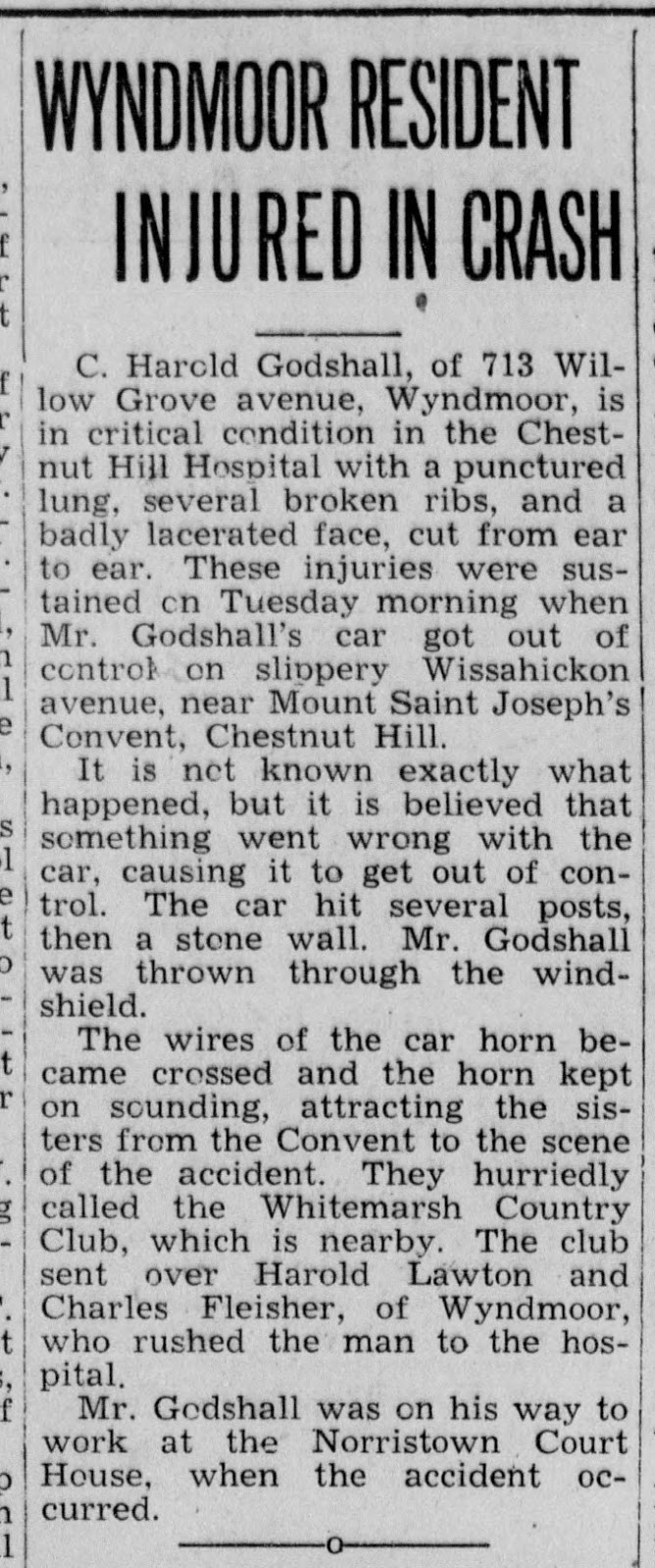
The Philly History Blog recently posted an article titled When City and Car First Collided, which is something of a social history of the introduction and rise of the automobile in Philly and concerns about safety from the start. Fascinating read, especially because it reminded me of several issues in my own tree. First, it reminded me the 1943 car accident my great grandfather was in. It also reminded me that the family this same ancestor married into were car enthusiasts and lastly that his own father had owned a carriage shop which went out of business thanks to the automobile. So this branch of my tree was heavily influenced by the automobile in many different ways.

Ambler Gazette clipping
from October 28, 1943
On Tuesday, October 26, 1943, at the age of 60, my great grandfather Chester Harold Godshall Sr. was involved in a serious car accident which nearly killed him while driving from his home in Wyndmoor, Montgomery County, Pennsylvania to work at the Norristown Court House (he was a civil engineer). There were no other cars involved but somehow he lost control of his car while on Wissahickon Ave (now Northwestern Ave) near where it met Germantown Ave and hit several posts by the side of the road before slamming into a stone wall which launched him from the car, through the windshield. Fortunately, the accident had caused the car horn to persistently sound, which attracted the attention of the sisters of a nearby Convent, Mount Saint Joseph's (now Sisters of Saint Joseph in Philadelphia) on Germantown Ave. The sisters called the Whitemarsh Country Club (now Whitemarsh Valley Country Club), which was located on the opposite side of Wissahickon Ave, and they sent over two men, Harold Lawton and Charles Fleisher, who rushed Chester to the Chestnut Hill Hospital. He had punctured a lung, broke several ribs, and was in critical condition at the time the Ambler Gazette reported the accident two days later. Fortunately, he recovered and lived for another ten years.

Though Chester, who was better known as Harold, was a civil engineer, back in the early 20th century, he had also worked as a secretary for his father's struggling carriage business originally called Germantown Carriage Works and eventually renamed to William H Godshall Inc. William had wanted his son to take over the business and after his death in 1922, Harold did so but not for long. It eventually went out of business in light of the rise of the automobile.
Harry Fallows and his daughter Emma Sarah proudly
showing off his automobile, circa 1908, probably rankled his
son-in-law's father, the owner of a failing carriage shop.

While William was probably muttering with bitterness over the growing popularity of the automobile, his son Harold was dating his future bride, Emma Sarah Fallows, whose family were somewhat controversially car enthusiasts. Emma's father Harry was a member of the Quaker City motoring club and won the Salem Cup in the Wildwood Auto Races on July 4, 1912 when he represented the Chase Car company. Harry's brother James owned at least three cars (though not necessarily at the same time) from as early as 1906 and had one repainted at one point. He and his cars had several mentions in the Ambler Gazette and there are also many surviving photographs the Fallows showing off their cars.

These two merging families really highlight the cultural history of the introduction of the automobile into society and what it meant for so many different people. One family struggling to hold onto their livelihood, another embracing the modern marvels that came around the turn of the century. I always imagine the early 20th century must have been an exciting time to be alive but for some, also a little frightening.

 With a little reworking, I took this content from my family histories for the Fallows and Godshall families. I will be posting their full histories within the next few days, as a part of the Family History Writing Challenge.

Tuesday, October 23, 2012

1918 Flu Pandemic

I'd like to highlight once again how you can use newspaper reports of what was going on in your ancestor's world even if there are no specific mentions of them. Recently, I wanted to know more about the 1918 Flu Pandemic that swept the world, infecting some 500 million people and killing somewhere between 20 and 50 million, and how it influenced my ancestors and their local communities. I already knew that none of my ancestors were reported in any (accessible) papers as ill during the time and none died in 1918 either. I do have one ancestor who died in Alabama in January 1919 and I am waiting on his death certificate to tell me if it was the flu. Though it was mostly waning by that point, you never know.

But for this, I focused primarily on the Ambler Gazette, a local newspaper in Montgomery County, Pennsylvania, just outside Philadelphia. The Fallows branch of my tree already had numerous mentions in the society section of this paper so I knew that this paper would give me a good picture of their community during the flu pandemic.

First, some background. At the time, it was known as the Spanish Flu because this particular epidemic was thought to have come from Spain. It's now believed that it began amidst the war, at a hospital camp in Étaples, France, spreading quickly among soldiers and staff. There had been precursors among birds and pigs, which highlights how easily bird flu and swine flu can mutate to infect humans, something we still fear today. From Europe, it spread outwards to Asia, Africa, South America, North America, and even the Arctic and remote islands. On July 22, Philadelphia public health officials issued a warning about the Spanish Influenza and in August, Boston was hit hard by it, arriving first at the docks. By late September, it was spreading to the rest of the country but Philadelphia went on with their scheduled Liberty Loan Drive Parade on September 28th, in support of the war effort. Afterwards, there were 635 new cases of the flu in Philadelphia and on October 6th, there were 289 flu related deaths reported for a single day.

Philly was a stone's throw away from the Fallows' East Willow Grove Ave home in Wyndmoor, Montgomery County and their daughter and son-in-law, the Godshalls, were just across the Philly border at 227 E Durham Street. But what was going on in their neighborhood? How was the community and local government handling it? I turned to the Ambler Gazette, which was issued weekly on Thursdays. This meant that the first mentions of the flu weren't ground breaking, since people probably would have read about it first in other, daily papers. At first, there were only a few mentions of individual cases reported on September 26, before the Parade in Philadelphia, but at this point, it did not seem like a huge concern to anyone. Indeed, even as late as October 3rd, Ambler was still planning to go forward with it's own Liberty Loan Drive Parade on October 12 (left), despite reports of other, smaller, local events being postponed or cancelled in the area and the nearby town of Norristown in the "throes of epidemic" (below).


Finally, a week later on October 10th, Ambler had to admit that the parade needed to be cancelled. In the clipping below and right, also including a report from Wyndmoor, they announce:
"Owing to the prevalence of the epidemic, it has been considered prudent to cancel all plans for the public demonstration and parade in Ambler on next Saturday afternoon, Columbus day, designated by President Wilson as Liberty Loan day."
In the account of Wyndmoor, though there is no mention of my ancestors in particular, you can see there are a number of reports of illnesses and the announcement of the closure of churches and schools. This was significant for my ancestors since they were very involved in their church activities and my great grandmother (from this family) had been a teacher in Wyndmoor before her marriage and still occasionally substituted afterwards. Whether she was substituting at that specific time, I'm not sure. She did have a two year old son, (my grandpop!) at the time so I'm guessing not, but she would have known much of the staff at the Wyndmoor Public School.

The mention of Dorothy Unruh's illness is significant as well since they were neighbors of the Fallows. And yes, Unruh is spelled correctly. It's a weird name, I know, but don't laugh because they were prominent land owners in the area and pretty wealthy.

Also on the 10th, information provided by Dr. Karl Schaffle in Massachusetts was printed in the Ambler Gazette with good advice about prevention and preparation, shown below. The Red Cross made notices as well (below) about the war effort and an order for 1800 influenza masks. Although the information about the Ambler parade being cancelled had obviously not yet reached them, note how Red Cross members were expected to participate in the demonstration despite the danger.


Wyndmoor was certainly not the only town shutting down. Most nearby areas, such as Flourtown or Horsham, were also closing churches and schools. It must have been worrying just to go out for necessary groceries. Would such a simple act cost you your life? Or the life of those you loved? At first, I was surprised when I realized that one of the numerous mentions of my ancestors going on one of their many vacations was right in the midst of all this. On October 17th, the Wyndmoor section of the paper writes:
"Mr. and Mrs. Harry Fallows are spending some time at Lake Hopatcong."
In the clipping to the right, you can see how right along side this report, there are also several announcements of illness and death related to the flu and shocking accounts of hundreds of bodies not yet buried laid out in a cemetery because there was no where else to put them and they couldn't be buried fast enough. Why on earth would my ancestors go on vacation in the middle of all this? It's hardly a time to kick back, relax, and enjoy yourself. I can only imagine that were trying to escape the risk of infection. Lake Hopatcong is a rural area where there was probably less contact with people and therefore a lower threat. Indeed, people were being advised to avoid crowded, public areas and what better way to avoid that than to spend some time at a remote lake? With that line of thinking, I'm actually surprised they didn't take their daughter, son-in-law, and toddler grandson with them.

In the same week, the Massachusetts Department of Health issued information about avoidance and treatment. Some of it, as you can see to the left, is not very dissimilar to the advice circulated regarding the more recent swine flu outbreak.

Riddled throughout all these articles are countless mentions of the names of the ill and dead. The search function on the Ambler Gazette initially highlights the words you're searching for in red (example below) and after searching merely for "influenza", some of the images of each sheet of paper are literally covered in red highlight. By this point, I was definitely getting an understanding of just how much this must have influenced my ancestors in the area, even if they were not infected themselves (and it's possible they were but it simply wasn't reported in the paper - if they were, they at least did not perish from it).

By the following week as reported on October 24th, we are starting to see more mentions of improvements and fewer new cases. There are still deaths and illness but there is light at the end of a very dark tunnel. Still, the Red Cross asks for donations of soups and other foods (right) to distribute to the sick.

Also printed on the 24th was an obvious attempt to keep fears at bay and prevent panic in yet another instructional advice article, shown to the left.
"Simply the Old Grip or La Grippe That Was Epidemic in 1889-1890".
I'm sure that was a great comfort to those with dead loved ones and did not sound patronizing at all (sense the sarcasm). It is true that it was certainly not the first flu epidemic (which went by many names including the Grip) but it did wind up being a more devastating case of it. The 1889-1890 influenza comparatively caused about one million deaths.

Finally, on October 31st (below), the Ambler Gazette reports more and more improvements and the Wyndmoor section notably has no mention of any new cases of the flu. It lists names of fatalities from their town in the last couple weeks, just one of the many areas of the sprawling suburbs of Philadelphia where there would be many more names. It also announced the reopening of two churches, one of which was the Grace Lutheran Church where my ancestors were members. Life was seemingly getting back to normal but with so many gone, it would never quite be the same. Below is an account from November 14th of how the deadly epidemic made orphans out of 50,000 children in Pennsylvania alone:


Never underestimate capitalism's ability to benefit from tragedy though. Below are examples of companies advertising treatments for the flu; amusingly, one of them is for plain old whiskey! And good old Vicks, still used today, cashed in big and had to report a lack of stock.


Of course none of these things will have saved lives, they just made the suffering a little easier. On October 19, Dr. C.Y. White in Philadelphia developed a vaccine and over 10,000 inoculations were given out through the Philadelphia Board of Health. Whether this played a significant role in reducing the spread of the disease in Philly is still debated. Numbers did decrease afterwards but some believe they would have done so naturally anyway at that point as the virus had run it's course.

And remember, this epidemic was spread worldwide so it's likely your own ancestors were somehow influenced by it as well, even if it was only indirectly. Don't overlook this important yet often forgotten part of history. The hardest part is finding the right newspaper for your ancestor's local area but if you're like me and you've already got your source and are looking for new ways to use it to find new information, this should yield fascinating results. Happy searching!

Sources:
Influenza Strikes: The Great Pandemic
City Snapshots: Philadelphia. Influenza 1918
Timeline. Influenza 1918
1918 flu pandemic
Access Pennsylvania Digital Repository