Showing posts with label 19th century. Show all posts

Wednesday, January 20, 2021

Augusta's Confederate Monument and My Family History

Sometimes, genealogy and modern politics have some overlap. 

In Augusta, Georgia, a giant, imposing obelisk stands as a memorial to Confederate soldiers. In particular, it hosts four life-sized statues of infamous Confederate military leaders, Robert E. Lee, Stonewall Jackson, William H.T. Walker, and Thomas R.R. Cobb (shown left), the latter of which is my 2nd cousin 6 times removed. It's a distant relation, for sure, but a significant one, given why this monument was erected in 1878 by the Ladies Memorial Association of Augusta.

Let's be clear about one thing - statues, monuments, and memorials are built in honor, respect, and celebration of the people, places, or events they represent. Monuments like this one are made in memory and respect of men whose only or primary contribution to history was to lead armies in the name of slavery. And when monuments like this are inscribed with quotes like the following, that fact becomes impossible to deny:

"No nation rose so white and fair 

None fell so pure of crime."

I'm not sure how anyone could say this is anything but blatantly racist, and this is the inscription found emblazoned under the feet of my cousin. That makes this a little bit personal for me - southerners like to shout about how this is their history, and their heritage. But for me, it literally is. 

And I say, tear it down.

The removal of statues like this isn't the removal of history. History belongs in museums and history books, which there is no lack of. There are plenty of Civil War and Confederate artifacts and memorials to be found in museums, where people can study and learn from them, and this monument could be one of them instead of being revered in the middle of town. When a memorial is erected in honor and celebration of Confederate leaders, it's honoring and celebrating slavery and racism. By not only leaving such a monument standing, but actively refusing to remove it, the government is not-so-subtly condoning a symbol of racism. We would never tolerate a statue of Hitler standing proudly in the middle of a city, paying homage and reverence to him, so why do we allow it for Confederate leaders?

Even if we remove all the slavery and racism from such symbolism (which isn't really possible, but just for the sake of argument), you're still left with a monument honoring men who tried to tear our nation apart with war and violence. Are we now going to see statues of the leading faces among the rioters who broke into the Capitol Building? Because they too are talking about civil war, they too are waving the Confederate flag, and they too believe their violence to be "fair" and "pure of crime". In reality, they are traitors, and so were Confederate leaders. And actually, many (if not all) of the rioters are also proud racists, just like Confederate leaders, as proven by the presence of white supremacy groups and Neo Nazi symbolism during the Capitol riot. Confederate leaders were also unabashed racists. This direct quote from my own cousin, Thomas R.R. Cobb, a Confederate General, proves it:

"This inquiry into the physical, mental, and moral development of the negro [sic] race seems to point them clearly, as peculiarly fitted for a laborious class. The physical frame is capable of great and long-continued exertion. Their mental capacity renders them incapable of successful self-development, and yet adapts them for the direction of the wiser race. Their moral character renders them happy, peaceful, contented and cheerful in a status that would break the spirit and destroy the energies of the Caucasian or the native American."

None of this means that every statue of every historical figure who ever did anything unethical should be removed. Yes, I am aware of the fact that most of our founding fathers were slaveholders, and that's certainly something I don't think we should hide from - we should talk about it, and we should teach it in schools. Our founding fathers were flawed, and that's something we have to accept. But the difference is, statues of founding fathers were not constructed in honor of them being slaveholders, they were erected in honor of all their positive achievements. Statues of Confederate leaders are produced in honor of their fight for slavery, and supporting that in the name of "history" or "heritage" is, frankly, bullshit. It's not in the name of history, it's in the name of racism and hatred. 

And if your heritage is racist, it's not something you should celebrate. Read about it in a history book, or visit a museum, or find something else about your heritage to celebrate that's not based on slavery, but do not protect a symbol of hate standing proudly in the middle of a city. 

Shame on the Augusta, Georgia government, and shame on everyone who enables them.

Thursday, October 8, 2020

Giving Birth on the Atlantic Ocean

I have two documented cases in my tree of ancestors giving birth on board the ship taking them from Europe to America, one during colonial times, and the other from the late 19th century. It always makes me wonder why a woman would ever travel like this while pregnant, especially during the last trimester. It's not as though travel by ship, even in history, took nine months and she couldn't have known, but in both cases in my tree, it was a matter of the journey taking longer than expected. Not nine months long, but long enough that she could have reasonably expected to have arrived at the destination long before the birth, and maybe even before the last trimester. Maybe it was even a combination of a longer than expected journey and a premature birth. In the second case, I think that may have been likely, because the baby sadly did not survive.

The first case is of a well documented ancestor, Rachel de Forest, the daughter of noteworthy Jesse de Forest, and wife of equally well known Jean/Johannes de la Montagne. While perhaps not exactly famous in mainstream history, Montagne actually has a Society of Descendants, and was a notable figure in colonial New Amsterdam, serving on the New Netherland Council and as First Councillor to both Director Willem Kieft and Director-General Peter Stuyvesant. Jean and his wife Rachel left Holland (Netherlands) for New Amsterdam on 25 Sep 1636 on board the Rensselaerswyck, obviously while Rachel was pregnant. Exactly how far along she was, we can't say for sure, but she gave birth 25 Jan 1637 while at sea, and the reason is probably because the journey wound up taking a surprising 23 weeks, not arriving until 5 March 1637. Normally, at this time in history, the journey across the Atlantic took about 6-12 weeks. It was common for the ship to make several stops in Europe before making the crossing, but this usually only tacked on a few weeks, not the 14 weeks it wound up adding to the trip. If they left in September and the journey was only supposed to take 3 months at most, Rachel might have reasonably assumed they would be in New Amsterdam by or around Christmas, and if she wasn't due until late January, she would have no reason to think she might give birth on board the ship. What went wrong? Why did the journey take so long? 

First, immediately after leaving Holland, the ship hit heavy storms in the English Channel that left them at the mercy of the battering winds and sea swells for a brutal six weeks. During this time, another woman on board actually gave birth as well, though I am not related to her. Anna Van Rotmers had a son she appropriately named "Storm". Though the boy's father's surname was Bradt, Storm later adopted the surname "Vanderzee" which literally means "from the sea". Seems he was quite proud of being born at sea during a brutal storm.

The ship made attempts to dock at either Falmouth or Plymouth in England, and although they got close, the storm ultimately made it impossible to dock. The ship's sails were all badly damaged and it wasn't until November 16th that it finally limped into the harbor of Ilfracombe, in Devonshire, England. 

This wasn't the end of their troubles. Not only did the bad weather continue, making it difficult for the ship to set off again once repaired, but while they waited out the storms in Ilfracombe, the blacksmith (who was being sent to the colony by the Dutch West India Company) argued with his assistant, which resulted in the assistant killing the blacksmith! The ship's officers immediately turned the murderer into the authorities at Ilfracombe, but to be sure they wouldn't leave during the investigation, the authorities moored their ship and removed the rudder. Between this and the weather, they were delayed another eight weeks. 

They finally left England (presumably with no blacksmith or assistant) on 9 Jan 1637 and the crossing of the Atlantic took a mere two months, as expected, but by now, Rachel was much further along than she had originally planned and wound up having her 5th child, Maria, on 25 Jan 1637 while still on board the Rensselaerswyck. Fortunately, both Rachel and Maria survived the ordeal, and Maria went on to marry my 9th great grandfather, Jacob Kip (a clerk for the council Jean served on). By the time they left England though, Rachel must have known that she was nearing her due date, and I wondered why she didn't choose to stay in England for the birth, and catch another ship to New Amsterdam afterwards. Maybe they didn't have the money - they had, after all, already paid for their trip on the Rensselaerswyck and staying in England would mean paying for room and board somewhere, plus the cost of another ship later on, all presumably without income while they waited. Additionally, waiting for the next ship may have meant waiting for months after the birth, not just a few weeks. However terrifying the thought of giving birth on board a ship must have been, it's likely that Rachel didn't have a choice at that point. Fortunately though, her own husband was a physician, so at least he was there by her side to help her through it.

The second case in my tree took place much later in history, in 1880. My 3rd great grandfather, Giovantomaso Scioli, was a poor Italian farmer, who was apparently intent on making sure his first child was born in America, because he and his wife would leave for the US just weeks before she was due to give birth. A risky choice, if you ask me.

After marrying my 3rd great grandmother Lorenza Palladino on 27 Feb 1879 in Monteroduni, Italy, they left a year later for the US on board the SS Australia (shown above, from NorwayHeritage.com) from London, England on 14 Feb 1880, while Lorenza was, of course, heavily pregnant. I do not know when or how they got from Italy to England, but the journey from England to the US should have taken about 1-2 weeks, yet the steamer did not arrive in New York City until 10 Mar 1880, about 3 and a half weeks from when it departed. We know why the ship was delayed, because it was documented in the newspaper as having had engine problems while at sea. Described only as a "disabled engine", it must have been running at only about half the speed it was normally capable of.

In addition, I believe Lorenza may have also given birth prematurely. On 28 Feb 1880, she gave birth to a little girl named after the steamship she was born on, Australia Domenica Scioli, who sadly died a mere 2 days later. In history, infant deaths were not uncommon, even if they weren't premature, but it could help explain how Lorenza wound up giving birth at sea. Let's say she wasn't due for another 5-6 weeks when they left, so a journey that should have only take a week or two, or maybe even three at the most like it did, should have still meant she would safely be in NYC weeks before her due date. Only if the baby was a week or two early would it have been a problem, and unfortunately that's exactly what may have happened. Of course, it's also important to remember that due dates in history weren't as exact as they are today and Lorenza could have thought her due date was later than it actually was.

The idea of giving birth in history seems daunting enough to begin with. Before modern medicine, the leading cause of death among women of child bearing age was child birth. Add to that having to do it on board a ship (pre-stabilizers, which help reduce the motion of the ship), in some cases probably without a doctor or even a midwife present, sounds terrifying. Unless you were lucky enough to marry a doctor like Rachel, the most you could hope for was another woman on board who had experience either giving birth and/or assisting in a delivery to help you through such an uncertain event. When you consider all this, it's a miracle both Rachel and Maria survived in the first case, even with her doctor husband, and that Lorenza survived in the second case, even if Australia Domenica didn't.

Sources:

Tuesday, July 25, 2017

How To Do Pre-1850 Research?

The will of Jonathan Gilbert, naming all his children (Charles
and Israel's names highlight)
It's one of the first questions people ask once they've been researching for a little while. Why do most branches seem to brick wall around 1850? How do I get back further?

So often, our main resources in genealogy are census records, and in the US, pre-1850 census records only list the head of household by name. This makes it difficult to identify families and find parents names of people who were adults and living independently from their parents by 1850. Additionally, most states in the US were not issuing birth and death records this early on, meaning we have to rely mostly on church records and obituaries. Many church records either haven't been digitized, making them hard to track down, especially if you don't know where to look because you don't know where specifically one was born or what church they attended, or they may have been lost or destroyed over time. Unlike civil records, churches have no obligation to archive their records, or even keep them in the first place. As for obituaries, often times they are only a brief death notice with nothing more than info on the individual's death and burial, and that's assuming they available online or you can find access to the right newspaper offline. Occasionally, you might see a burial record that name's the decease's father, but not always. So to say that records become more scarce before 1850 is putting it lightly.

It's frustrating, but the good news is, there are other sources. Records like probates, deeds, and tax lists are often some of the oldest records available, and recently, more and more of them are getting digitized. Now, I can't promise these records will always break down your brick walls but they are worth exploring, and here's my most recent example.

In search of the parents of my 4th great grandfather Charles Gilbert (1784-1861, Montgomery County, PA), I finally found them through probate and deed records alone. Firstly, I knew that Charles had a brother Israel Gilbert, because there is a local history book detailing one of Charles' sons, Seth, and stating he had an uncle Israel Gilbert (and yes, it also confirmed Seth as the son of Charles Gilbert and my 4th great grandmother Jane Sutch). Next, I was looking for deeds bought or sold by Charles, and one of them from 1811 mentioned Israel, so I knew I was looking at the right Charles Gilbert. It also mentioned several other Gilbert men, and indicated the estate of the deceased Jonathan Gilbert. My spidey-sense immediately tingled, as it sounded a lot like Jonathan was the father of all these men and his sons were taking care of his property after his death. But how do I confirm it?

Jonathan Gilbert's will confirming his wife's unique name,
shared with her granddaughter
I went looking for wills of a Jonathan or Jon Gilbert in the right area around 1811 and immediately found one dated 1808 and proved in 1809. It lists all his sons names, matching those in the deed, and his wife's name. The clincher? His wife's name was Dedemiah, a rather unique name shared by none other than Israel's daughter. Bingo! Mystery solved, with nothing more than a deed and a will.

Israel also had a son named Jonathan, probably named after his father, but given the popularity of this name, that alone wouldn't have been enough to convince me.

It doesn't always go this way, of course. Not everyone owned land, and not everyone had a will, and even when they did have a will, they did not always take the time to consider us future genealogists and list their children by name. Sometimes, probate records regarding the execution of the will, can name children though, so be sure to read those too, no matter how boring they seem.

Montgomery County, PA Deeds 1784-1866 can be found online (but not indexed yet) at FamilySearch.org
Montgomery County, PA Probates can be found at both Ancestry.com (indexed), and FamilySearch.org (not indexed)

Saturday, January 7, 2017

The Seedy Side of Censuses

The other day, someone mentioned an individual on the 1880 census with the occupation "thief" and that in the next census, he was in jail and his wife was now recorded as a "whore". I was intrigued by this because I was surprised one would admit to a criminal career, if not already in jail. And indeed, a quick search of the 1880 census by occupation "thief" turns up 74 results, mostly people serving time in jail.

However, a few are not in prison. Most amusing is one which actually says:
"'Thief' Would Dignify Him. To Low For Anything"
This was reported of a Wm. Cameron, 36, in West Del Norte, Rio Grande, Colorado. He was living with his wife so one has to wonder if she, perhaps an embittered and griping wife, was the informant. I can just imagine the conversation between her and the enumerator:
Enumerator: "And what does your husband do for a living, ma'am?"
Mary Cameron: "He's a good-for-nothing, lowlife scumbag, is what he is."
Enumerator: "I'm sorry, ma'am, that's not an occupation."
Mary Cameron: "Well, that's what he is!"
Enumerator: "How about 'thief'? Would that be close?"
Mary Cameron: "Thief?! Ha! That would dignify him. No, he's too low for anything. Write that down! Too... low... for... anything. That's right."
On a more serious note, there are many more people recorded as prostitutes, in one term or another. 155 people are described as a "whore" (yes, that actual word was used 155 times), while 4,891 people are reported as a prostitute/prostitution. Another 109 were noted under "house of ill fame/repute" or "sporting house", and one woman even a "bordello." 42 were "harlots", 27 "bawds", and 19 women were called "strumpets". Another 49 had something to do with a "pleasure house" or being a "lady/woman of pleasure" or "pleasure girl", not to be confused with a lady of leisure, but amusingly one said:
"Gratifying The Pleasure Of The One Paying Her Board"
I wonder who was paying her board? I guess whoever he was, she made it worth his while.

All in all, they added up to about 5,293. And they are not all women. Barring any recording or transcription errors, 125 of those 5,293 prostitutes were male, although some of them may have been managers and not prostituting themselves. Indeed, 164 individuals, some male, some female, were recorded as some kind of keeper, madam, or proprietor of a brothel, prostitution/pleasure/sporting/bawdy house, house of ill fame/repute, or "whore house", and 24 men were some kind of "pimp" such as a "harlot pimp".

I'm guessing actual numbers were probably even higher than this. There were likely people who lied about their occupation, and there might have been others recorded under some terminologies I'm not thinking of at the moment.

I recommend you stop reading now if you don't want to delve into the more disturbing side of this data: ages.

There were 256 individuals who were 17 and younger. Of those who were 14 and younger, the majority were Chinese. Technically, I even found a few who were 10 years old and younger, but I highly suspect most, if not all of them were actually just children of prostitutes. One of them, 5 years old, had a question mark next to the occupation and the youngest was 8 months, so I think the enumerator often just marked down "prostitute" for everyone living in a brothel without paying attention to their age. As such, it's difficult to tell what the youngest age of an actual prostitute was. Let's hope it was much higher than what this data suggests on the surface.

Apologies if you now feel the need to take a shower.

Update: Apparently the city of Philadelphia even had it's own guide book of brothels in 1849, amusingly titled "A Guide to the stranger, or Pocket companion for the fancy, : containing a list of the gay houses and ladies of pleasure in the city of brotherly love and sisterly affection."


Source:
  • 1880 United States Federal Census [database on-line]. Provo, UT, USA: Ancestry.com Operations Inc, 2010. 1880 U.S. Census Index provided by The Church of Jesus Christ of Latter-day Saints © Copyright 1999 Intellectual Reserve, Inc. All rights reserved. All use is subject to the limited use license and other terms and conditions applicable to this site. Original data: Tenth Census of the United States, 1880. (NARA microfilm publication T9, 1,454 rolls). Records of the Bureau of the Census, Record Group 29. National Archives, Washington, D.C.

Wednesday, November 25, 2015

Account of Civil War POW

While researching descendants of my ancestors, I came across this interesting story, taken from "A brief history of John Valentine Kratz" by Abraham Fretz, pages 104 - 106:
Alonzo Philip Kratz, born July 26, 1845; died Feb. 12, 1865. At the age of seventeen he enlisted in Doylestown, Pa., on Aug. 8, 1862, as a private in Company F, 128 Regiment Pa., Vol., for nine months in the United States services. The reg't., soon went to the front. His first letter was dated at Camp Wells, Va., Aug. 12, 1862, from which it appears that army life agreed with him, he says: ''We don't get victuals like at home, but what we do get is enough and healthy; soft bread comes this way once a week." After the battle of Antietam he wrote, ''It was a hard fight, and I do not want to get in another like it. The rebels loaded their guns with a large round ball and three buck-shot, these flew around us like hail. We loaded our muskets with a large pointed ball, and it did some execution. A soldier who has once fought for his country, will never forget it, neither should he be forgotten." On Jan. 16, 1863 at Fairfax Station, Va., he says. "Our winter hut is built; it is of logs two feet high. and our tent is the roof: It is a comfortable house that will keep us dry and warm." On Mar. 25, 1863 he wrote from Brook's Station, Va., "We have five weeks yet to serve; we have been in several skirmishes besides the great battle Sept. 17 (Antietam), and there may be another big fight this spring. before our time is out. Gen. Hooker is getting impatient at this inaction. There is some talk among the boys of re-enlisting, but I think I will go home, although I don't believe I shall be satisfied with home life as long as the war is going on." The anticipated battle was Chanecllorsville, through it he passed without a scratch, and was discharged at the end of his term of service with the following certificate. "This is to certify that Alonzo Philip Kratz was one of the most patriotic soldiers in Company F, (commanded by C. K. Frankenfield), always at his post performing a soldier's duty cheerfully, and I can recommend him as the bravest of the brave, in meeting the foe and daring in battle. T. J. Kline. Orderly Sergt., Co., F. V2S Pa.. Yol.  
He came home in June 1868. and seemed glad enough to get back to "God's country again; but the outdoor life of a soldier, who so often slept with the blue vault of heaven for a covering, had completely changed his disposition. It was weeks before he could sleep on a soft bed, and enjoy a good meal. His patriotic spirit finally prevailed. to take up arms again; he always spoke of the Artillery service as being the most agreeable, and least dangerous to life and limb; that he would go in the heavy Artillery next. With this object in view, he went to Philadelphia shortly after New Years day, 1864, and enlisted in Battery D, 112 Regt., Penna. H. A. The regt. was, however, supplied with muskets, and served as the "2 Penna. Provisional Volunteers," there being more demand for that branch than Artillery: and he was promoted to Corporal of Company I. The regiment was mustered as "Veteran". and immediately went to the front leaving behind fifty brave and true men. of which number he was one for detached duty in Philadelphia. After guarding various places in the city for three months, he was sent to his regiment in the field, Apr. 24. 
A letter dated July 8, 1864. near Petersburg, Ya., gives an account of the fierce fighting of the rebels at the Welden R. R.. where they charged the Union lines six deep without breaking it; also that they had blown up two rebel forts, and are mining another and a bigger one, and when ready to explode, they will tight day and night if necessary to capture Petersburg, Va. His last letter from the field, is dated July 17, 1864, in which he says, "have been acting as sergeant for two months, and expect to be promoted to that office, as soon as the captain recovers from wounds received in battle," The coveted promotion never came. He was captured July 29, at the explosion referred to (Burnside's mine), and carried away into captivity. He was confined in the famous Libby prison at Richmond. Va., for a while and then removed to the stockade pen at Danville, Va. The 'last letter'' received from him was written in the latter place, dated Aug 3d, 1864; it was mailed at Old Point Comfort, and did not reach home until October 19, 1864. It was written with a led pencil in two hand writings, the first half was in his writing, which gave the date and circumstances of his capture, and where he was a prisoner. The last half showed unmistakably, that it was erased and written in another hand; this purported to give the comfortable quarters he had, kind treatment he received at the hands of the rebels, and the quantity and quality of healthy food given him. 
After the close of the war it was learned that he was an unwilling guest of rebeldom six months, and died Feb. 12, 1865 of starvation and exposure. He is buried in the National Cemetery at Danville, Va., grave 130, section A., division four. A brave and patriotic life sacrificed for country and flag. Battles he was in: Antietam, Va., Sept. 1862. Chancellorsville, Va., May 1863. Ream's Station, Va., June 1864 (Weldon R. R.). and Burnside's Mine, Va., July 1864. 

Tuesday, September 29, 2015

Interesting Clippings: Heir to Four Million

While doing research with newspapers, I came across an interesting article about a man named Ansel White in Port Angeles, Washington who was the sole heir of a 4 million dollar estate in New York and apparently never knew it. The man died in 1888 and it wasn't until 1895 when his grand nephew finally found him and his death information, that allowed he and 15 others to inherit the 4 million instead. The nephew traced White from Utica, New York to Missouri, and then to California where it was assumed he drowned in the San Francisco Bay. The nephew put an ad in the paper there and it was answered by a former neighbor of White, confirming the identity of White and his death.

4 million split 16 ways would have been only $250,000, but this was in 1895, and as we all know, $250,000 was worth a lot more in 1895 than it would be today. How much more? Calculating the equivalent worth is complicated and depends on the type of value in question. I like to use MeasuringWorth.com to give me an idea of historical money worth, and in this case, I would use one of the three "Income or Wealth" values.

The "historic standard of living" value would be $7,270,000, the "economic status" or "prestige value" would be $60,400,000, and the "economic power" is $275,000,000. That's still a pretty big range, but it gives you an idea that today, they would have still been multi-millionaires.

In comparison, the original 4 million would have been relative today to a range between 116 million, to 4.4 billion.

Sunday, April 12, 2015

Names Crossed Off Passenger List

First and second pages of NY passenger list of Taormina
with names crossed off, Jan 28, 1914
I've recently seen a couple misunderstandings about what it means when someone's name is crossed off a passenger list. The first was that it means the individual died while on board. This is sometimes true but not always. The other assumption was that it means the individual never got on board to begin with. Also sometimes true, but again, not always.

What it really meant was that the person did not get off the ship. As mentioned, that could be because the person died on board, or because they never got on board to begin with, it could also mean that the individual didn't get off the ship at that port of arrival but rather remained on board until disembarking at a secondary port of call. This was the case with some of my ancestors, who arrived in New York on January 28, 1914 on board the Taormina - their names are crossed off so they didn't got off the ship there. There is then a second passenger list from their arrival in Philadelphia a couple days later on January 30, 1914 where their names were not crossed off.

Meanwhile, I have an infant relative in my tree who was born and died on board a ship in 1880 but her name is not crossed off the passenger list on her arrival. It does note "died" beside her details but she's not crossed off (see below). I see the crossing off more commonly in 20th century passenger lists.

Australia Domenica Scioli was born and died on board the ship she was
named after in 1880 - while it notes she died, her name is not crossed off

First and second pages of Philadelphia passenger list of
Taormina with names of those crossed off in NY,
Jan 30, 1914
The ship had a record of who boarded at the departure port and then the immigration officers at the port of arrival made a copy of those lists, crossing off the people on their copy who didn't disembark at that port. The passenger lists we see are usually the copies that were made at the port of arrival from the ship's records. The immigration officers probably didn't care why an individual on the passenger list didn't disembark and therefore didn't always note whether it was due to an on-board death, or whether they were just carrying onto the next port of call, or whether they never boarded to begin with. Their job was probably just to record who disembarked at their port of call.

So if you see an ancestor or relative whose name is crossed off on a passenger list, don't assume they died on board, or never boarded to begin with. Do some more investigating to see if the ship carried onto another port of call where they might have disembarked. If you're not finding anything by searching for the person's name, try searching by the arrival year and the ship's name. The arrival port officers were working off of the ship's records, which meant the handwriting could sometimes be misinterpreted and copied incorrectly (this doesn't mean a misspelling was a permanent name change). And of course, there's always the digital transcription which could be incorrect too and preventing you from finding the record by the individual's name. This also works for when you may have gotten an individual's immigration data from a naturalization record but can't find the passenger list by searching by name. Of course, by the time of naturalization, the individual may have been misremembering the exact details of their immigration so if you don't find the passenger list by the arrival date and ship name, you may need to make use of wildcards in the name. You can use a '?' in place of a letter, or an '*' in place of several letters but you must have at least three real letters in there for it to work.

Happy searching!

Wednesday, April 8, 2015

US Immigration Stats in History

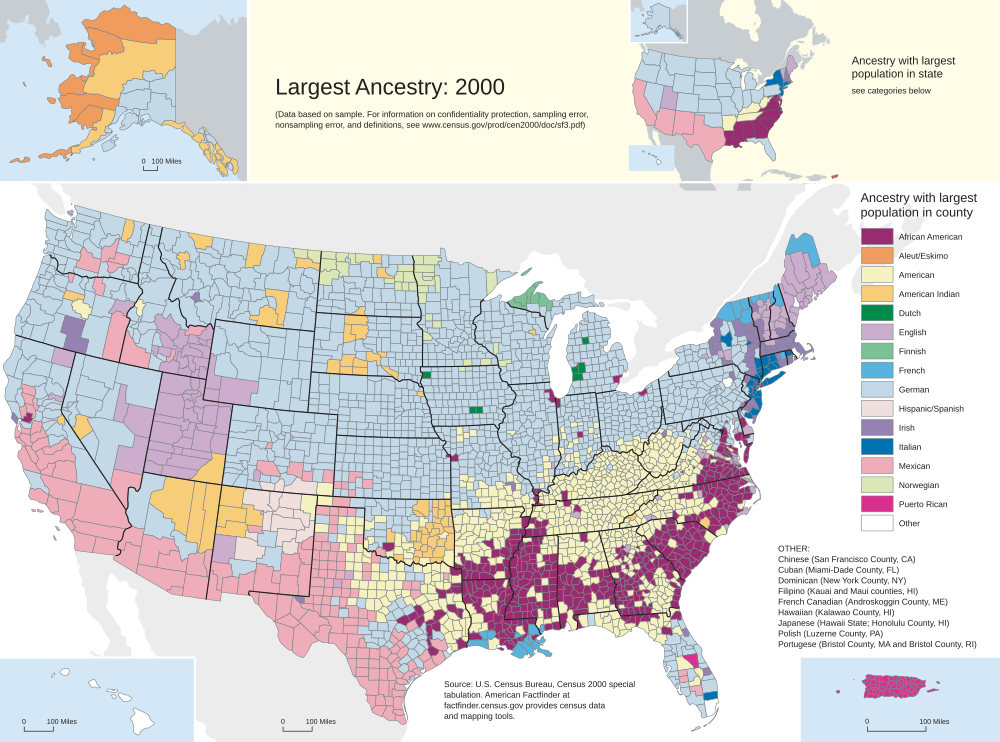
2000 US Census Data on Self Reported Ancestry
I often see people trying to determine which European ethnicity most Americans are descended from. Some attempt to use self reported ancestry from census data to show the major European groups Americans today claim to descend from. The trouble with this is that self reported data is unreliable and most Americans are a mix of ancestries but only able to report one. Many actually reported 'American', which although technically may not be inaccurate (if you have ancestors born in the US, then you have American ancestry - the census did not ask what our non-American ancestry was), it's not helpful for these purposes. Probably because of these reasons, the US Census has since dropped this question and therefore the most recent data for ancestry is from 2000.

Others try to calculate which group most Americans today have roots in by using immigration numbers plus basic multiplication to determine their population growth. The trouble with this is that the multiplication is an estimate, and again, so many Americans today are a mixture of European ethnic groups. In the end, we can only say that it's impossible to determine with any real accuracy which single European ethnic group most Americans today are descended from. But the immigration stats are still helpful by showing us the largest European groups to legally settle in the US.

Over the course of history, from colonial times up to 1969, the largest groups to immigrate were the Germans totaling just over 7 million, followed by the British totaling over 5 million. The Italians came in a close third, also equally just over 5 million, with less than 100,000 fewer than the British numbers. Finally, we have the Irish amounting to slightly more than 4 and half million. Those from Austria-Hungary came in fifth at a little over 4 million, and then the Russians with just over 3 million. Finally, we have those from Norway-Sweden with barely over 2 million, and if you add in the Danes and Finnish to maximize the Scandinavian results, it still only equals about 2 and a half million. The spreadsheet (linked below) shows numbers for more groups in case it interests you but none of them exceed 1 million.

When estimating the amount of descends today from each of these groups, it's important to consider the time periods in which they immigrated. The longer an immigrant has been here, the more descendants they will likely have because they had more time to multiple. For example, the Italians may have had more immigrants than the Irish, but the largest period of Irish immigration occurred decades before the bulk of the Italians arrived so theoretically, it's possible the Irish have more descendants. Considering many Irish and Italians intermarried, it would not surprise me if they were about equal though.

With this in mind, if you look at the stats I compiled in this spreadsheet, you'll see that the Germans and British not only have the highest immigrant numbers in total, but also are the only groups to have been consistently immigrating in mass numbers since colonial times all the way up to 1969. I think it's safe to say that most Americans today have German and/or British ancestry. It would probably be impossible to determine which out of the two of them would rank higher, and many people probably also have some other groups mixed in there - personally I also have Italian and Norwegian, but not everyone else will. But it seems obvious from these stats that most Americans with European heritage have some German and/or British ancestry, even if they don't know it.

Sources:
  1. Demographic History of the United States
  2. US Department of Homeland Security Yearbook 2008

Monday, April 6, 2015

Dating Old Photographs

Example of cabinet card with
photographer's details - this photog'
was at this address 1879-1887
Like me, you may have a collection of old photographs handed down to you with no knowledge of who the portraits are of, or even when they were taken. Here's a few tips to help you out.
  1. The Photographer. Many photos may be printed on paper and mounted to stiff cardstock and stamped with the photographer's name and address in the margin or on the back. Using directory records, you can track when that photographer was working at that particular address, narrowing down the time period in which the photo must have been taken. More details on this can be found here: Mystery Photos.
  2. The Fashion. Get to know the clothing and hairstyle fashions of different eras. This article from SheKnows has many useful links to websites that detail fashion from the 19th and 20th centuries. I make the most use out of the University of Vermont guide which also has info on dating photos based on all different topics, not just fashion. Don't be fooled into thinking people in rural areas didn't receive the latest fashions from magazines and catalogs, or that older people didn't stay up to date with modern fashions. See the common myths on this website. Pinterest can also be a useful source to finding images of popular fashions from different decades.
  3. The Format. The materials used to create the original image (watch out for copies made from the original in much later eras) can be very useful in dating them:
    • Daguerreotypes. The first publicly available photographs were daguerreotypes from 1839 until about 1860. Peaked in popularity in the 1840s and early to mid 1850s. A positive image was produced on a sheet of silver plated copper polished to a mirror finish and mounted in a protective hard case. More info.
    • Calotypes. Available from 1841, the process produced a translucent negative on paper, allowing positive prints to be created from the negative. This created a softer image, often desirable for portraits. Despite these advantages over the daguerreotype, the calotype did not replace it and both processes remained popular until about the late 1850s/early 1860s. More info.
    • Albumen print. A paper photograph with a positive image created from a negative (typically a negative from a collodion process which created a negative image on glass). Invented in 1850 but not popular until 1855 when it became the dominant form photographic positives. Peaked in popularity from the 1860s to 1890s when used for carte de vista and cabinet cards (see below). More info.
    • Ambrotypes/collodion positive. First available from 1854 and popular for a brief period of time in the late 1850s/early 1860s before superseded by tintypes. You likely won't see any after 1865. They created a positive image on glass. Required mounting in protective hard case. More info.
      A tintype, probably from the late 1880s
    • Tintypes. A positive image produced on a thin sheet of metal, no mounting required but sometimes mounted in a paper mat. Available from 1856 and most popular during the 1860s and 1870s, but still remained in use up to the early 20th century, though by that point it was considered a novelty. More info.
    • Carte de Visite. A small albumen print (54.0 mm/2.125 in by 89 mm/3.5 in) typically mounted on thicker card measuring 64 mm/2.5 in by 100 mm/4 in). Patented in 1854 but not popular until 1859 and remained so throughout the 1860s and 1870s until the larger cabinet cards eventually replaced them. They were popular as calling cards to be traded among friends and visitors. More info.
    • Cabinet Cards. A larger paper photograph (originally albumen but later processes used other types of paper) mounted on thick cardstock measuring 108 by 165 mm (4¼ by 6½ inches). Introduced in 1866 and most popular during the 1870s and 1880s, beginning to decline in the 1890s, though they did not completely disappear until the 1930s but were rare by that point. A cabinet card with a true black and white photo (not sepia) was likely produced in the 1890s or later. Those photos with the photographer's name and address stamped on the margin or back (such as discussed above) were usually Cabinet Cards. More info.
    • Film/Paper. The first translucent negative sheet film was produced in 1885, with rolls of film as we know it today available from 1888. In 1900, the first Kodak Brownie was released and sold for only $1 (about $28 today), with the film for it costing only 15c, making photography affordable for the masses and giving birth to the "snapshot". Positive images were produced on simple, unmounted paper. 
There is an excellent and more advanced guide to print types available at PhotoTree.com.

The Horse in Motion, 1878
Misconceptions and Myths.

I see a lot of misunderstandings about photography in history and perhaps dispelling them will also help people understand the time period in which a photo might have been taken. 

Exposure times. Many people seem to think that in history, the length of time required to take or expose a photograph was so long, one wasn't able to smile or move. This was true in the very early days of photography, but not by the late 19th century. The first daguerreotypes and calotypes in the 1840s had exposure times as short as 5 minutes in optimal conditions but later their exposure times were reduced to only a few seconds by 1864 with the invention of the collodion process in 1851 followed by improvements on it which increased sensitivity to light. Granted, this was in optimal (bright sunlight) conditions, but I have photographs of small children starting from the 1860s (shown below), which wouldn't be possible without exposure times measured in seconds because we all know small children won't hold still very long (and I don't care what time period they were from, small children still had little patience or self control). By 1871, the gelatin dry plate method made exposure times short enough that cameras could be hand held (ie, fraction of a second).

Small child, circa 1867
By 1878, technology shortened exposure times to a fraction of a second, about 1/25th of a second. Have you ever seen "The Horse in Motion", a sequence of photographs of a horse and rider at a gallop, analyzing it's gait frame by frame (shown above)? That was done in 1878. Without getting too technical, anything that is fast enough to capture and freeze the motion of a galloping horse is more than fast enough to capture a smile or movement of a human being.

Of course, it's reasonable to assume that not all photographers had the most advanced equipment the moment it became available. But it's also reasonable to assume it wasn't too long after 1878 before most photographers were using equipment that allowed them to photograph with exposures of at least only a few seconds, or even a fraction of a second.

So why aren't there more photographs of people smiling or moving around from the late 19th century? It's probably due to the fact that until about 1885 or 1900 at the latest, photography was not affordable to the masses and the processing could be complex. Therefore, the industry was very much controlled by professional photographers and that meant that getting one's photograph taken was a formal event. The concept of the candid photograph didn't really exist yet, and people's only basis for a formal image of themselves stemmed from paintings, where there was no smiling or moving around. So the idea of this as a formal portrait carried over into photography until the advent of the candid photograph. There are examples of candids in the 1880s and 1890s, but it really took off in 1900 with the introduction of the Kodak Brownie, which practically anyone could afford.

Detail. Many people also seem to think that pre-20th century, photographs didn't have much fine detail to them. And while it's true that many surviving photographs from the 19th century don't have much fine detail, that doesn't mean the technology didn't exist to capture it. Just look at some of the photographs of US presidents dating the 1850s and 1860s! While these were probably taken by some of the best photographers in the country, that doesn't mean such detail was exclusive to the best of the best photographers. Take for example the image to the right, which was likely from the 1870s or early 1880s. Note the fine detail in the strands of his hair and mustache.

Sources:

Monday, February 23, 2015

Italian Research: One Mystery Solved

Maria D'Amore 1887 Birth in Polizzi Generosa,
mentioning her unmarried parents
I had been stuck at a brick wall for a while on my Italian branch, mostly because so few Italian records are available online, at least for the regions most of my research is in. One of these brick walls was my 2nd great grandfather, Agostino D'Amore. According to family members, he was born in Sulmona, Italy on Aug 13, 1846 and as a solider, was stationed in Pachino, Sicily where he met his wife, Rosaria, and had children with her. However, his passenger list into the United States said he was born in Pachino. I decided to have a look for his birth record in Sulmona anyway, since those records are actually available online from the Italian National Archives.

I searched Sulmona's births from 1844-1848 without finding him so then I began thinking he was actually born in Sicily. First of all, it turns out that he did not meet his wife in Pachino. His wife was born in Polizzi Generosa, where their first child, Maria, was also born so I checked Polizzi's birth records (found online at FamilySearch.org) for Agostino thinking maybe he was born there too, but with no luck. I also searched for his marriage to Rosaria in Polizzi in the few years before the birth of their first child with no results. Puzzled, I finally got a translation of Maria's birth record (I know enough about Italian records to extract names and dates but that's about it) and what it told me was very surprising but totally explained the problems I was having. Maria had been born out of wedlock. That explained why I couldn't find a marriage record for Agostino and Rosaria before Maria's birth!

Agostino D'Amore and Rosaria Potestio
marriage in Pachino, 1891
It also named Agostino's occupation as Carabinieri, Italian National Police. So there was some truth to the family stories. I also knew that the rest of their children had indeed been born in Pachino so sometime after Maria was born and before their next child was born, they had moved from Polizzi to Pachino. I began to become concerned that Agostino and Rosaria had never actually married but just lived in a common law marriage. After all, if they left Polizzi for Pachino to escape the scandal of having a child out of wedlock, it would have been easy for them to show up in Pachino claiming they were already married and no one would be the wiser. I had looked for the marriage in Polizzi after Maria's birth but still not found it. But I really needed a marriage record because it would tell me where Agostino was born. On his children's birth records, it only listed where he was residing at the time, not his birth location. And his death certificate from Pennsylvania didn't specify anything more than Italy.

So I crossed my fingers and ordered the microfilm for Pachino marriages during this time period because they aren't available online anywhere. I had little hope of finding it - I'd convinced myself they never married and I would never find out where Agostino was born. I also ordered the film which included Pachino births for the period he was born in hopes that his passenger list had been correct and I would find him here, even if I didn't find his marriage record. And when the films came in, I checked the births first because I had more hope of finding that than the marriage.

How wrong I was! I didn't find his birth in Pachino but I did find their marriage! Turns out they married Jan 1, 1891, about six months prior to the birth of their second child. To me, this seems to suggest that their society might have accepted one "mistake" by having a child out of wedlock but two? No, it was time to get married, and quickly because Rosaria would be starting to show soon!

Agostino D'Amore's 1849 Birth in Sulmona
Finally, the marriage record told me that Agostino had indeed been born in Sulmona, just as I originally thought! So why hadn't I found his birth record in Sulmona? Because he was born in 1849, and I'd stopped looking at 1848. Stupid, stupid, stupid. I could have avoided this whole fiasco by just searching a wider year range. However, that might have meant that I wouldn't have gotten the translation that told me their first child was born out of wedlock, an interesting little tidbit. So sometimes my stupidity has a silver lining!

My other reason for wanting to find a marriage or birth record for Agostino was to figure out his parent's names. On his death certificate, his father is listed as something that looked like Dibero or Libero and his mother was listed as "Nana", which was clearly not her name but just what her grandchildren called her. With Agostino's birth and marriage records finally found, it told his father was Liberio D'Amore and Maria Majorano. From there, I managed to search the Sulmona records to find Libero and Maria's parents and even some of their grandparents. Finally, I got past that brick wall!

Thursday, September 11, 2014

Why Probate Records Are So Important.

Today, I made a remarkable discovery. Well, it's remarkable to me. It was accomplished almost entirely with the Pennsylvania Probate Records found at FamilySearch.org and is a testament to how important these records are and how much you can learn from them if you take the time to find and study them. It also proves research before the almighty 1850 US Census can be done.

Ann Sutch Will 1827 mentioning brother Richard
Shoemaker.
I had been searching for the parents of my ancestor, Ann Shoemaker, for a while. All I knew of Ann was that she married Daniel Sutch, had 4 daughters, and then died in 1827 in Gwynedd, Montgomery County, Pennsylvania. I did not even know when she was born but I approximated it around 1760. But I did also know she had a brother named Richard. I discovered this from her will in the Montgomery County Probate Records, proved in 1827, which specifically named her "brother Richard Shoemaker" as executor of her will (shown above right). This not only gave me her maiden name but also a brother's name to research. It was difficult though, because all I knew of Richard was that he was probably alive (and an adult) in 1827, and likely lived in Montgomery County. But Shoemaker was a common name in that area and Richard was not uncommon either. Without knowing anything else about him, how could I confirm records to be the Richard I was looking for?

Well, in the Proceedings Index for Ann (Shoemaker) Sutch, there were some listings for Orphan Court Dockets. These are often records that have something to do with the will of a deceased person after it was proved. There were two dated 1838 which turned out to be a petition and answer for the replacement of trustee Richard Shoemaker, deceased, with someone else. The petitioners were E. Jones and Job Roberts (I promise this will be important later on). This suggested that Richard Shoemaker, brother of Ann (Shoemaker) Sutch, died sometime in or soon before 1838. So I went looking for a Richard Shoemaker who may have had probate records dated around 1838. There was only one in Montgomery County who fit with this and although there was no will listed, there was an Admin Bond date for Aug 5, 1837 in Horsham and the Admins listed were Job Roberts and Evan Jones. So I knew I had the correct Richard Shoemaker because Jones and Roberts were listed in the Orphan's Court record for Ann Sutch, sister of Richard Shoemaker.

But that's not all. Once I entered Richard's death year as about 1837 in Horsham, a Quaker record on Ancestry.com popped up for a Richard Shoemaker who died July 10, 1837 in Montgomery County (subscription required to view this record). I looked at it and although it didn't say he died in Horsham (there was no death location at all), it did say his father was Ezekiel Shoemaker who had died 1816 in Horsham. I already had a hunch this was my Richard Shoemaker because in the Estate/Proceeding Indices, there was only one Richard Shoemaker who died in or around 1837 in Montgomery County (and if he died in July, a probate record in August made perfect sense). But just in case there was another one who perhaps didn't have any probate listings at all, I decided to research Ezekiel.

Firstly, I noticed on the Proceedings Index right above my Richard Shoemaker there was another entry for a Richard Shoemaker who died around 1790 in Horsham and his executor was named Ezekiel Shoemaker. I looked at his will first and sure enough, Ezekiel was his son. Best of all, two of his daughters married into the Roberts family, which linked this elder Richard and son Ezekiel back to my Richard, because if you recall Job Roberts was listed in my Richard's probate records (who would have been this elder Richard's grandson). Granted, Roberts is a common name too but there's starting to be too many coincidences to ignore. Additionally, according to other family trees, my Richard also married a Roberts.

Ezekiel Shoemaker 1816 Will naming his daughter,
Ann "Such" (Sutch).
I looked up Ezekiel in the probate records and fortunately, he had a will and sure enough, in his will he names "my daughter Ann Such" (shown left). So not only do I now have proof that Ann was the daughter of Ezekiel, I also already have Ezekiel's father's name as Richard, and Ezekiel's siblings names as mentioned in Richard's will! A wealth of information, with the exception of one record, came entirely from these probate records.

To top everything else off, I then found a Quaker death record for Ann Sutch who died 1827 naming her father as Ezekiel Shoemaker of Horsham (subscription required to view this record). These must be new records added to Ancestry.com since I'm sure I scourged the internet looking for another death record for Ann once I found her will and knew she died in or before 1827. My search would have been a hell of a lot easier if I had just found this record first! Regardless, I still would have gone in search of Ezekiel's will to find out more about their family (like his wife's name) so the point still stands that probate records are important.

For some reason, there is a secondary record with no indication of the source or repository attached to some Ancestry.com member trees that claims Ezekiel's daughter Ann "died young". I hope I have been able to conclusively prove that this is not true with all these primary records I've mentioned and provided links to. Family trees put Ann's birth year as 1764, not far off the estimated birth I made around 1760, so if this is true she would have been 63 years old when she died in 1827. She married Daniel Sutch and had four daughters named Jane (b. abt. 1788, m. Charles Gilbert), Sarah (b. abt. 1791, m. William Davis), Ann (b. abt. 1792, m. Homer Dubree), and Hannah (b. abt. 1805, m. Joseph Amber). Some information on their family can be found in the Ambler Gazette.

So don't overlook probate records as an important method for finding that elusive previous generation. It may take a lot of digging and it may not always lead back to what you're looking for but you will likely discover something you didn't know before.

Saturday, March 1, 2014

A Spinster's Chance in Hell of Marrying

Think an "old" spinster in history didn't have a chance in hell of ever marrying? Often I see people with this misconception, that in history, once a woman was passed a certain age, she had little to no hope of ever marrying and would be considered an old maid. The specified age varies, some people seem to think it was as low as 18! Others are a little more realistic and put it around early to mid 20s.

In my experience, the average age at first marriage for women was actually in the early to mid-20s and therefore an unmarried woman of this age would not necessarily be considered an old maid, doomed to a barren, solitary life. Though there are plenty of examples of women who married for the first time aged 30+, this is closer to the age group I would label "old maid" or "spinster" since this is the smallest age group of women marrying for the first time. But it was certainly not unheard of. Consider the fact that childbirth took many female lives and left widowers with young children and no mother to take care of them. Often, a man might be pleased to take an older, never before married second wife to look after his children. It would mean he wouldn't have to take in her fatherless children from a previous marriage and since he already had children by his first wife, he would not have been as concerned about whether his second wife was still young enough to bare children or not. Of course, plenty of women then and now are able to start having children well into their 30s and even 40s but it does become less and less likely as time goes on.

But take, for example, my recent venture into studying the marriages of Butler County, Pennsylvania. I have ancestry there, mostly around the mid 19th century, and for the purpose of my family history writings, I wanted to get an idea of the average age that a woman would marry for the first time in this location during this time period, and also at what age the local law said a woman could marry without a parent's or guardian's consent. Unfortunately, the Pennsylvania County Marriages collection at FamilySearch.org only have marriage records for Butler County going back to 1885 but it was as close as I was going to get to the mid-1800s. Here are the results, I hope you find the stats as interesting as I do, though please keep in mind that different locations and different time periods may have different results, particularly regarding the age at which one can marry without consent of a parent or guardian needed. However, I would not be surprised if at least most of Pennsylvania had similar results, just based on my general experience doing genealogy research. If I had the time, I would do this for each available county in PA but for now, I sampled 300 records (out of about 630, basically the first half of folder 004811571) of the 1885-1886 records to get these stats.

In Butler County, PA, anyone under the age of 21, male or female, needed consent from a parent or guardian to marry. While this doesn't mean that marrying under 21 was unusual, especially for women, it does go against our idea that children grew up faster and married significantly younger, as teenagers. Needing consent to marry before the age of 21 suggests that people under this age were viewed as too young to make their own decisions without guidance and approval. In fact, the term "filia" was often used to refer to those under 21, which is a legal term for a child or minor. Compared to today's laws where people reach the age of majority and can marry without consent from the age of 18, the laws from the 1880s seem very conservative.

84% of men were marrying for the first time, while 95% of women were marrying for the first time.

The average age of men at their first marriage was 26. Only 4% of men married under the age of 21 and therefore required parent or guardian consent. This is not unusual in a time when a husband was expected to support his wife and children so men were encouraged to wait until they had either steady work, set up their own shop, or established their own farm before they married and began having children. The youngest men married at 18 years old so there were no cases of men marrying under 18 at all. This suggests men were not able to marry under the age of 18 even with consent of a parent. The oldest age at which a man married for the first time was 47.

The average age of women at their first marriages was 23 and 30% of women married under the age of 21, requiring their parent's or guardian's consent. This means the majority of women certainly did not marry as teenagers, but that it wasn't unheard of, with 22% of women marrying under 20. The lowest age at first marriage for a woman was 15, suggesting girls under this age could not at all, even with consent. The highest age at which a woman first married was 49 years. Take that, spinsterhood!

Now let's look at some of the age differences between the bride and groom, since there also seems to be a misconception that it was very common for a teenage girl to be married off to a 30+ year old man. Again, not unheard of but also not the norm. In 88% of cases, the bride and groom were within an age difference of 10 or fewer years. In fact, in 10%, the bride was actually older than the groom! Of the remaining cases in which there was a higher age difference of 11 or more years, 30% of them had a teenage bride (or in other words, 4% out of the total had an age gap of higher than 10 and included a teenage bride). The largest age different was 25 years, the groom being 47 and the bride 22.

Lastly, I did record some data from second (or third) marriages as well. The average age for a man at the time of a second (or third) marriage was 41, with the youngest age being 25 and the oldest 64. For a woman, the average was 40, with the youngest being 23 and the oldest 50. Divorce was certainly taboo but don't kid yourself that it never happened or that it was illegal - there were 4 cases where the groom remarrying had divorced his first wife and one case where the bride had divorced her first husband.

Today, the average age at first marriage for men across the U.S. is 29 and for women, it's 27. So while it's true that people tended to marry younger in the past, it was not so drastic as some people seem to think, with the averages instead being around 26 and 23 respectively (at least for Butler County, PA). I recall once hearing someone say that in the past, if one wasn't married by 18, they were "done", or had no hope of marrying. Hopefully, with these examples, I have helped to dispel these kinds of myths.

Update: I have since compiled another 225 marriage records from 1891, also in Butler County, Pennsylvania, just to be sure the previous year I calculated wasn't some kind of fluke and found the stats were very similar.

  • Average age at first marriage for men: 26
  • Average age at first marriage for women: 22
  • Oldest man marrying for the first time: 49
  • Youngest man marrying for the first time: 19
  • Oldest woman marrying for the first time: 45
  • Youngest woman marrying for the first time: 15
  • 4% of men married under the age of 21 and therefore required parental consent
  • 32% of women married under 21 and required parental consent
  • 89% of men were marrying for the first time
  • 95% of women were marrying for the first time
  • Average age of men marrying for 2nd or 3rd time: 38
  • Average age of women marrying for 2nd or 3rd time: 34
  • 25% of men marrying for the 2nd/3rd time had been divorced
  • 17% of women marrying for the 2nd/3rd time had been divorced

Thursday, September 19, 2013

Interesting Clippings #19: Great Train Wreck of 1856

On July 17, 1856, two trains travelling towards each other on the same line collided between the railway stations of Camp Hill and Fort Washington in Whitemarsh Township, Montgomery County, Pennsylvania. At the time, it was the deadliest train accident to have ever occurred and the death count was likely over 60.

This caught my eye because I had several ancestors near Whitemarsh Township at the time, mostly in nearby townships of Cheltenham, Springfield, and Upper Dublin. I often wonder what my ancestors made of such national news happening practically at their doorstep. Later, in 1901, one of my own relatives would die in a train accident around the same area.

The partial article to the left is a clipping from the New York Daily Tribune on July 18, 1856, which had been printed in the Philadelphia Bulletin the day before. You can read the full article for free from the Library of Congress and you can read more about the Great Train Wreck of 1856 on Wikipedia.

Sunday, August 11, 2013

Interesting Clippings #17: Historical Uses of Cod Liver Oil

Ambler Gazette
Nov 3, 1898, p8
Cod liver oil is high in omega-3 as well as vitamin A and D. The health benefits of omega-3 are a relatively modern discovery, it's popularity skyrocketing only in the last couple decades. But historically, the vitamin content of cod liver oil was understood and it's for this reason that cod liver oil was often marketed as cures and treatment for a number of different ailments with varied results.

Today, cod liver oil is still used to aid in the treatment of arthritis and multiple sclerosis and one study has even suggested that it may also aid in the treatment of cancer, though this is not to say these diseases can be treated with cod liver oil alone! Cod liver oil is also recommended to be taken during pregnancy as it's believed to reduce the risk of diabetes.

Ambler Gazette
July 30, 1896
page 4
Historically, it was marketed to treat or cure anything from the common cold and poor digestion to tuberculosis and pulmonary problems but how effective it was is really open to debate. We know today that tuberculosis is a bacteria that is easily treatable with antibiotics and therefore has been nearly eradicated from the developed world. So could omega-3 and vitamins really cure a bacterial disease? Probably not but they could have helped boost one's general health and immune system, which may have aided in one's natural recovery.

Granted, I'm certainly no medical expert but I recently read Germs, Genes, & Civilization: How Epidemics Shaped Who We Are Today which talks a lot about how our resistance to certain infectious diseases grew over centuries and in addition, how infectious diseases were forced to become weaker so that they might spread more easily and survive. Because of both of these natural occurrences, many diseases which were once extremely fatal had a relatively low mortality rate later in history, despite a lack of effective medical treatment. Therefore, it's somewhat understandable how and why people of the past believed in treatments which we now know probably did little to nothing. Over time, it could have been said "since the use of cod liver oil, mortality rates for tuberculosis have dropped by x%" when in reality, they were just seeing a natural decline over time. This is why we still shouldn't jump to conclusions when we see all these statistics about modern medical treatments too - it's difficult to know for sure when we're seeing a direct cause and effect rather than there being other influences at work.

Scott's Emulsion, as seen advertised in these historical newspaper clippings, is actually still in production, although I imagine they no longer market it as a cure for tuberculosis!

Friday, August 9, 2013

August 9, On This Day in My Family Tree

164 years ago in 1849 my 4th great grandmother Ædel Bergitte Hansdatter Friis died of typhoid and cholera in Norway, Racine County, Wisconsin at the age of 66. Her husband followed her a mere six days later of the same diseases. They had only been in America for just over a year before their deaths, having emigrated from the parish of Herad in Vest-Agder County, Norway. It's sad to think that came to America for a better life but had they not, they might have lived longer. They are both buried in Norway Lutheran Church Cemetery.

Ædel's name is spelled with a letter called "ash" which was common in Old English and is still found in alphabets of certain languages today, including Norwegian.

Source: