Wednesday, August 29, 2012

Mystery Photos

Among the plethora of photographs and documents of our ancestors that my mother inherited from my grandmother was a bundle of photos mostly from around the late 1800's of unknown individuals (frustratingly, no names written on them). Since I have pictures of all my direct ancestors on my mom's side going back four, sometimes five generations, it's safe to say none of them are of my own ancestors. So I suspect they were either extended family/distant relatives or friends of the family, most specifically, the Rorer and perhaps Fallows branches. How do I know this? Well, it's partly dumb luck and partly an educated guess.


Two of the photos in the pile are of the same guy (shown above) who also happens to be in a tintype (below) of a group shot containing my ancestor Mary Anne Rorer (far right in the photo) when she was looking particularly like a young woman (based on other pictures I have of her), probably before she was married in 1887. So probably sometime in the 1880s.


Mystery guy has very distinctive lips, right? Hard to miss. Definitely the same guy in all three images, though in the first one he might be a little older. And by the way, Mary Anne had no living brothers and her only known uncle was childless (no known aunts) so mystery guy is probably not a first cousin either. He could only be a distant cousin or friend.

To help confirm the time period, I decided to look up the photographer named on the print of the mystery guy when he was looking about the same age as he is in the tintype. I did this by using the directory records on Ancestry.com. Year by year, I looked up a photographer by the surname of Applegate in Philadelphia at the address Vine and 8th Streets and found James R Applegate worked there from 1871 to 1904 (he'd worked as a photographer prior to this but at a different address so I ruled that out).

I was lucky that the print of mystery guy had the photographer's details on it, not all do. I was also lucky to find him in a group shot with my ancestor so I could get a good idea of who he was associated with in my tree and when. Though I'm still investigating the individuals and photographers of the other images in the pile, many of them are of the same style and therefore probably around the same time period. And knowing that the Rorers and Fallows were something of socialites (and therefore had friends with the money to purchase multiple prints of a photo and distribute them to friends and family) and what appears to be enthusiasm for photographs, it seems likely that they received pictures of friends or family members, perhaps even swapping them with ones of themselves.

I will be posting more of the mystery photos in hopes that someone with a copy of the same picture, who knows who they are, will do a reverse image search like Tineye and find my blog and tell me who they are. My hopes aren't high but if I never put them out there for people to find, they'll never be found.

Monday, August 27, 2012

Historical Fiction and Author's Notes

I'm going to take a slight diversion from the topic of genealogy for a moment and address an issue concerning historical novels. I am a historical fiction enthusiast as much as I am interested in non-fiction and genealogy but I am not the type that requires my fiction to be perfectly accurate. It is, after all, fiction and some creative license should be expected.

What concerns me is the issue of the Author's Note in the back of many historical novels in which it's become common for authors to detail which parts of the novel are factual, which are grey areas, and which are complete fabrications. This would normally be a great little educational tool but readers tend to take this as gospel, which they unfortunately shouldn't. In two specific cases, I have come across an Author's Note that contains false statements of fact.

The first of which was Jeanne Kalogridis' The Borgia Bride. It's an excellent work of fiction based on Sancha of Aragon, wife of Joffre Borgia (son of Pope Alexander VI, Rodrigo Borgia). But in her Author's Note at the end, she claims:
"Historians have speculated for centuries as to who actually poisoned Alexander VI and his eldest son. The mystery has never been solved."
My understanding is that most historians feel there is no conclusive proof that Alexander and his son were even poisoned at all. In fact, after reading The Borgias and Their Enemies by Christopher Hibbert, I am more convinced that they were merely the victims of a naturally occurring bacterial or viral infection. Take a look at the timeline detailed in Hibbert's work of non-fiction:
"On August 5, just four days before Cesare was due to leave Rome, father and son accepted an invitation to dinner at the villa of Cardinal Adriano Castellesi in the countryside some miles outside of Rome. On this occasion it was Cesare's health that caused the greater anxiety, since he was not only suffering from pain in his stomach, but also, according to Burchard, he was "much irritated by the skin on his face in the lower part, which falls apart like rotten leaves and results in a pus that he is much concerned to hide with his mask." On their arrival at Castellesi's villa, father and son were both extremely thirsty and asked for cups of wine, which they drank "most gratefully." It was a sultry evening, and the guests dined alfresco, thankful for the shade cast by the trees in the garden. The next day their host felt ill and went to bed; a week later the pope also took to his bed; Cesare then fell ill; so did several of the cardinal's other guests, as well as some of his servants. Poison was naturally suspected."
The illness Cesare was suffering from prior to the incident was Syphilis, though probably of no importance regarding this. Hibbert does mention that poison was suspected; it often was. But people at the time had little understanding of illness, disease, and poison. After all, they still believed malaria was caused by "bad air". With the knowledge we have today, one only needs to look at the timeline of events (which I've bolded) to understand that it could not have been poison. After the dinner at which they were supposedly poisoned, the host first falls ill the next day. A full week later, the pope takes ill and soon after, so does Cesare and several of the other guests and servants who had attended the dinner. I admit I am no expert on poison but I've never heard of one which, after only one dosage, takes a week to kick in and then kicks in hard. I can not see how that would even be medically possible. Gradual poisoning wasn't possible, not with so many ill who were all only in the same place one night. It seems more likely to me that this is the result of a natural disease and the timeline we're seeing is due to the incubation period (the time between one is infected and one shows symptoms). The host of the night was already infected but not showing symptoms yet (at least not strong or obvious ones, he could have been ignoring minor, beginning symptoms in order to host the party) and was unknowingly infecting many others at the dinner, since one can be contagious during the incubation period. With an incubation period of about one week, everyone else at the party who had been infected suddenly comes down ill too.

Surely, that makes more sense than an unknown poison which, after only one dose, takes a week to kick in and then somehow is powerful enough to kill? And ultimately, the fact of the matter still remains that most historians don't conclusively believe Alexander's death was the result of poison. I did not have a problem with the use of poison in the novel but I do have a problem with the author claiming that Alexander and Cesare were indeed poisoned when there is no proof of that and little evidence.

The second inaccurate Author's Note I came across was found in Jessica McCann's All Different Kinds of Free, a novel based on the life of Margaret Morgan and the Prigg vs Pennsylvania case regarding slavery laws and whether escaped slaves in Pennsylvania could be returned to their owners in the south or not, especially with no documented proof of their ownership. Margaret Morgan had claimed to be free but was captured and returned to the south where she was sold into slavery. In the Author's Note, McCann claims that Margaret was indeed free, not a slave, when she went to Pennsylvania and as evidence of this states:
"In fact, in the 1830 U.S. census, she, her husband and their children were recorded as 'free blacks' by the county sheriff."
It's true that there is an 1830 U.S. Census record of a black Jerry Morgan, who McCann claims was Margaret's husband, living in the right area. What she fails to inform the reader of is that Margaret's husband's name is lost to history and that in the 1830 census, only the "head of household" is recorded by name. Here is where knowledge of genealogy research does come into play a little bit because every genealogist knows that you can't make assumptions like this. McCann is assuming Jerry Morgan was Margaret's husband without any proof of it since Margaret is never named on the census herself. Could it be an accurate assumption? Yes, it's possible that Jerry Morgan was Margaret's husband and that they were free and therefore Jerry's name was recorded on the 1830 census. But it's also possible they were escaped slaves whose names were never recorded on the 1830 census and Margaret's husband's name was something else entirely. Naturally, it goes without saying that regardless of their slave status, Margaret's fate (being sold into or back into slavery) was immoral. But that doesn't justify making false statements to suit one's agenda. I certainly don't have a problem with Margaret being portrayed as free in the novel or even if the author personally believes Margaret was free - I would like to believe the same thing. But she still needs to be clear about the facts in the Author's Note, which she wasn't. Had she explained that the census record may not be Margaret's family but that she believes it is, fair enough, I'd have no complaints. But don't claim something is factual when you're actually only making assumptions.

While I respect all the hard work and research that goes into any historical novel, it's important to remember that if you would not use it as a credible source for an academic study, it's best to take it with a grain of salt. You wouldn't cite the Author's Note from a novel in an academic report of the topic so don't take it as gospel. The author can make mistakes or might be motivated to exaggerate the facts, even within the Author's Note, to lend authenticity to their story, making it more interesting to the reader. It's possible these were rare cases and that most Author's Notes can be trusted; I am not criticizing all historical novelists, I respect and admire most of them. But as I am not an expert in all fields of history, how can I know what to trust and what not to? So just keep this in mind the next time you read an Author's Note in a historical novel.

I will step off my soapbox now and return to genealogy in my next post!

Friday, August 24, 2012

Tyler State Park

Tyler State Park is a 1,711 acre small but beautiful and historic state park. It has no connection to my own family history aside from the fact that my parents currently live in walking distance to it. If you're a history lover, the thing you'll most enjoy about the park is the historic houses, some dating back to colonial times. Unfortunately, I wasn't able to track down any specific information on them while I was there - I thought the park office would have a pamphlet or something but apparently the history of the area is only worth a small little corner of their park information pamphlet.

So what it does tell us is that the land was owned by George F. Tyler, who acquired it in stages between 1919 and 1928. So prior to his ownership, portions of it had been broken up and owned by different people. Tyler's family originally lived in the Solly Farm House (right) until their mansion (above) was built but they continued to vacation in it after moving into the mansion. The mansion is now the administration office building for the Bucks County Community College and Solly House was functioning as a hostel up until recently but is now vacant, though Hostelling International are still leasing it apparently. Sadly, it doesn't appear that anyone is taking care of it right now and if someone doesn't start soon, this local icon could deteriorate fast. I can only hope there are future plans for it. The above/right photo of Solly House is merely the original house, many larger extensions were added to the back, as you can see below.

The Tyler's farm had one of the finest herds of Ayrshire diary cattle in the county, as well as poultry, sheep, pigs, and a stable of about 25 horses. Their plentiful crops were mainly used to feed their livestock. They also had several servants - a dozen in 1920 including but not limited to five maids, two laundresses, a cook, and a governess for the family's children who were twelve, nine, and five years old at the time. By 1930, the Great Depression may have even been influencing them as their staff had reduced almost by half, dropping to only seven, mostly maids and also a cook and a butler. By 1940, the servant numbers had gone back up to ten including three maids, two waitresses, a cook and a valet, all working 60 hours a week. Before purchasing the land that would become Tyler State Park, the family lived at 296 Old York Road in Montgomery County. They only had one child at this time and employed a maid and a cook. This information was obtained from census records, hence my inability to make out some of the occupations of servants. George Frederick Tyler had been born in Newport, Rhode Island on August 10, 1883 and married his wife Stella Elkins around 1907. They had three children: Sidney, Molly, and George Jr.

Another icon of Tyler State Park is the Schofield Ford Covered Bridge. Originally built in 1874, it burnt down in 1991 and was rebuilt with authentic materials and methods in 1997. It's the longest covered bridge in Bucks County, shown below.

I wish I could say more about some of the other beautiful historic homes in the park which have been kept up better. Ten of them are currently leased out to residents who care for them. I also wish I had more information on the different pieces of land before they all came into Tyler's possession - after all, he only acquired the first portion of it in 1919 but the land had been settled since colonial times. And I'm sure the Solly House was once owned by a family named Solly but whether it has any connection with the other Solly Farm currently in another area of Bucks County, I don't know. These were the things I was hoping to find out from the park office. Regardless, below are some of the other lovely historic houses and barns to be found in the park and more photos of the back of the Tyler mansion as well.


Addendum: I was browsing the Library of Congress (great resource, by the way) for maps and came across one for Philadelphia and Bucks County from 1681. Curious to see if I could find the area that would become Tyler State Park, I attempted to overlay Google Maps on it and then drew a rough outline in Photoshop. Below is the result, though keep in mind that it's approximate - I could not quite get the maps to line up exactly right and I'm not sure the scales were entirely equal. But this should give you a rough idea of who the original lands of the park area were owned by.


Wednesday, August 22, 2012

Cemeteries

Recently, I made a trip home to PA (I currently live in England), in Bucks County. I try to use the opportunity when I'm there to do some offline family history research and organization I can't do in England. Right now, it's mostly visiting cemeteries and helping my mom scan all the old photographs of our ancestors. This last trip, we found a bunch of photos of people we don't know. I think they were friends of our ancestors but there's no names on them so sadly, I may never figure out who they are.

As for the cemeteries, we visited several, most were successful but I had some unclear records that led me astray. One death record told me the individual was buried at "Chestnut Hill Cemetery" and I found some reference that suggested a place called Ivy Hill Cemetery (where several other of my ancestors are buried) was once called this. But the individual wasn't buried there. Her husband's death record just said "Methodist Church" so I thought maybe we'd have luck at the Chestnut Hill United Methodist Church. I wasn't even sure they had a cemetery. We pull into the parking lot in the back and sure enough, there is a very small cemetery of old looking headstones. My hopes weren't high - old headstones can be too eroded or damaged to read and what were the chances my ancestors were among this very small group of headstones? But sure enough, my mom spotted the family we were looking for.


As you can see, they are hard to read. And you may also note that there are four graves in the plot but only three close-up shots. The fourth is not a part of our family and yet, we were missing a family member too. There was a husband and wife and then the mother of the husband but where was the father? Many of the headstones were broken, fallen over, grow into the ground, etc, but no sign of one like that with the same style headstone in the plot. We went to the church office and there found a very friendly and helpful pastor who was enthusiastic about restoring the cemetery. He explained that sadly, there are no records of who was buried there so they are at the mercy of being able to read the stones. He also explained that originally, the individuals were buried in the front of the church but when the building was rebuilt, the headstones had been moved to the back (but not the bodies). I suspect that during the move, someone wrongly associated the unrelated individual because it had the same style headstone so they were all lumped together. I also suspect that my missing ancestor was buried there but at some point, whether before or after the move, his headstone was lost or grown over.

The church is certainly lucky to have a pastor there who is dedicating his time and efforts to restore what is left of the cemetery. He showed us some of the gravestones he'd already carefully restored and they looked very good. He even encouraged us to come back with some shovels to remove the first few inches of grass and dirt to see if we could find the missing headstone! Unfortunately, we didn't have time for that during this trip but maybe someday.

Also interesting was that I found another one of my ancestors buried at Zion Lutheran Church aka Union Cemetery of Whitemarsh (not to be confused with Whitemarsh Cemetery) but he had previously been married in the Presbyterian Church of Chestnut Hill. Wikipedia tells me that some Presbyterian churches have "entered into unions with other churches such as Congregationalists, Lutherans, Anglicans, and Methodists." So perhaps it was not so strange for my ancestor to make this change of religion. He was, after all, born in England and a member of the Church of England before immigrating so it wasn't his first switch. It will make an interesting tidbit in my family history writings.

At another cemetery at the First Presbyterian Church of Springfield, we found two of my ancestors buried there and behind them were four headstones with the names of (some of) their children but no date.


I'm kicking myself for not thinking about that more at the time and asking the office about it. Especially when I came home and looking at my tree, found I had records of some of them buried elsewhere. Did the parents buy the plot and headstones in preparation for their children but later the children decided to be buried elsewhere? Or were some of them just never paid to have the dates added? More investigation is needed on that. If anyone else has come across something like this, please let me know what you found!

Monday, August 6, 2012

Colonial Facts and Stats: Culture and Life


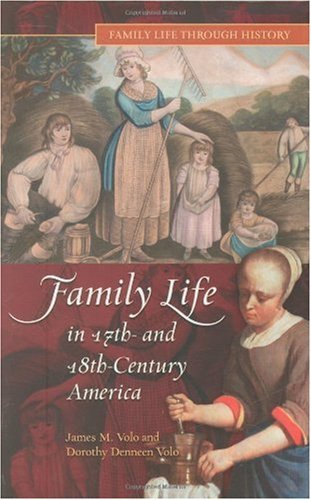
Continuing on from the post about immigration and settlement with interesting facts about the 17th and 18th centuries, the following are related more to culture and life in the colonies. Everything is from Family Life in 17th- and 18th-Century America by James M. Volo and Dorothy Denneen Volo, which I highly recommend buying, though the facts below may seem extensive, it's only a very small portion of this highly informative book.

Culture and Life:
  • Puritans and Quakers were often literate and many Germans and Dutch may have been literate in their own languages too. In the 17th century, men on the frontier had a literacy rate around 50%, which grew to 65% by the early 18th century. German Protestants and French Huguenots may have been as high as 90% literate. By comparison, today's literacy rate is about 86% so the colonial rates were lower but not as low as what people might assume. Women were twice as likely to be illiterate in the south and mid Atlantic while the difference was not so great in New England but this may have only been an indicator of ability to write rather - reading rates may have been higher.
  • New England Puritans and frontier Scotch-Irish supported schools, but southern aristocrats and sectarian Quakers and Pietists tended to "distrust" institutionalized instruction. So education ranged regionally from home schooling to university education.
  • In 1625 Virginia there were about 460 indentured servants but only 22 blacks (some being slaves). Dutch farmers generally only owned a few slaves in contrast to the large numbers on Southern plantations.
  • Autumn was the healthiest period of the year due to moderate temperatures and recent harvests. Winter brought rheumatic pains, consumption, and lung disease, then Spring was riddled with pleuresies, inflamatory fevers, distempers, and colds, and Summer had epidemics of cholera, dysentery, typhoid, assorted fevers, and both bloody and black fluxes. Scurvy was also a health problem through the winter. 
  • In some parts of the Chesapeake, 25% of children would lose at least one parent by the time they were 5 years old, 50% by age 13, and 70% by age 21.
  • Widows often continued to run the family business (such as shops or taverns) after their husband's death.
  • Child mortality rates in the overall colonial period ranged from 20% to 30% (today it is only about 1%). Men who survived into their 20s had a good chance to living to about 70 years. Women who survived to adulthood had a lower life expectancy of 65, due to dangers of pregnancy and childbirth - women who survived past childbearing years could expect to live as long as men. Average life expectancies which quote 40-50 year age ranges include child and infant mortalities. 
  • Reproduction was considered such an expectation that bachelors and spinsters were scorn and childless couples seen as disfavored by God. Though not as effective as today's methods, contraceptives were available but not well known, approved of, or used. As a result, some families had as many as 12 to 14 children and the population grew very fast. In New England, from 1700 to 1750, the population almost doubled to 400,000 and the average number of children rarely dropped below 7. Fathers quickly became unable to partition enough of their farm land among all their children which forced them to move out of the community and find land elsewhere. Women were reproducing so quickly that they would sometimes conceive again before fully recovering from their last pregnancy and either miscarry or give birth to underweight infants who died early. White women generally nursed for 2 years which can be a natural contraceptive (but it's effectiveness is reduced if not nursing full time) - plus some cultures banned sexual relations while the wife was still nursing. Slaves tried to extend the period of contraception by nursing for 3 years. 
  • In the south, the average number of surviving children per family was lower, around 5 or 6, because the child mortality rate was much higher. Almost half of children never reached adolescence.
  • The Dutch had large families but could expect about a third of their children to die young.
  • It was not unusual for children to be farmed out to other families to learn a skill or trade, especially in Puritan homes and especially after the death of one of the parents (i.e. if the mother died, the daughters might be sent to other homes to learn domestic skills).
  • The average age at first marriage for women in New England was about 22 to 23 years old. In the south, it was much lower, only 18. In Quaker families, it was 24 and within the Dutch communities, 22. Dutch men typically married between ages 23 and 25, especially in rural areas (those in the city tended to marry later). 
  • Premarital pregnancy in New England was rare as long periods of privacy before marriage were nearly impossible but there are records of "seven month" births after marriage, of which there were more in the 17th century than the 18th. Rates were higher in the south, reaching 40% in some areas, as was fathering children out of wedlock (almost 12%). The Puritans often didn't record illegitimate births and the Dutch often omitted marriage or birth dates from records in attempts to brush such embarrassments under the rug.
  • Families in the south tended to maintain closer ties to extended family than communities in the north and nepotism was common. Female relatives would often get together to trace their families lineages, especially those of aristocratic background. Intermarriage between second and third cousins was promoted in the south, to keep their money, power, and social standing within the family.
  • Almost 60% of southern males owned no land and were instead tenant farmers or indentured servants or slaves.
  • Initially, Quakers and other minorities religions were prosecuted in many colonies, Pennsylvania being the only exception.
  • Unlike other communities, Quakers gave their women much authority, especially within the family unit but also in their religion - 12 female Quaker ministers could be found between 1690 and 1765.
  • The Germans contained many different dialects and religions including Lutheran, Mennonite, Moravian, Baptist, Amish, and Calvinist. Lutherans and Calvinists were similar to most mainstream English Protestants but other pietist sects were viewed as radicals and closer to the Quakers. Germans were more hierarchical and patriarchal in their families with more children (average of 9 with about 75% surviving to adulthood) but otherwise very similar to Quakers. But Germans of all types rarely married outside their nationality.
  • Baptists were known as "Dunkers" for their practice of total immersion during baptisms. There were about 300 original "Dunkers" in the colonies and 90% of them were from Schwarzenau, Krefeld, or Friesland.
  • The Moravians paid Native Americans for the land they settled.
  • In the 1740s, there were more Dutch families who owned slaves than English, typically no more than 6 slaves per household.
  • Women slaves generally bore about 6 children in their lifetimes and were often shown indulgence a few week before giving birth and allowed four weeks to recover after giving birth before going back to work in the fields, taking their newborn infant with them.
  • Marriage between slaves on different plantations was discouraged but more common among smaller farms where available partners were fewer. Husbands were generally given "weekend passes" to visit their wives, starting after a half day work on Saturday and returning Monday morning.
  • Slave owners often made gifts of their slaves to their children, especially as a wedding gift.
Check back soon... yet more to come!

Saturday, August 4, 2012

Colonial Facts and Stats: Immigration and Settlement

According to Family Life 17th and 18th Century America by James M. Volo and Dorothy Denneen Volo, "fewer than 20% of those now living in America can trace their ancestors to the 17th and 18th century [in America]". So if you're one of those fewer-than-20%, here's some interesting factoids and demographics about life in colonial times that you may find informative about your ancestors (all found in the above mentioned book), keeping in mind that many of the stats are approximate. They may be particularly helpful if you're writing a family history, I have worked a number of these facts into my own. I really recommend buying the book to pick out your own personally relevant facts but it is a textbook and therefore pretty expensive so here's some of the highlights for me. There's so much to share, I will start with some immigration and settlement facts and include other subjects in future posts.

Immigration and Settlement:
  • There were seven major groups to migrate to British North America in the 17th and 18th centuries: four different waves of Britons (Puritans, Royalists, Quakers, and Scotch-Irish), the Dutch, the Germans, and the Africans. While there were other minority groups, if you have colonial ancestry, they were likely British, Dutch, German, and/or African. 
    • The British mostly settled in New England, the wider area of the Colony of Virginia (not the state), the lower Delaware River Valley, and the back country of Georgia and the Carolinas.
    • The Dutch mainly settled in New Amsterdam and along the Hudson River.
    • The 18th century saw the flood of German speakers who settled in Pennsylvania, New Jersey, and New York.
    • Most Africans were of course brought over unwillingly as slaves but recent research suggests a minority may have been indentured servants or even free craftsmen.
  • About 250,000 people left Britain between 1607 and 1660, though not all went to North America, more than 100,000 went to the Caribbean and another 100,000 to Ireland.
  • Most recent research (keeping mind this was released in 2005) estimates the number of Africans slaves brought over to North America was around 400,000.
  • 39% of immigrants were between 25 and 59 years old, 35% were between 14 and 24 years old, 25% were children under 14, and only 1% was over 60.
  • Women and girls made up nearly half of the early English colonies (versus the near-absence of female immigrants to New France and New Spain), though Virginian immigrants were dominated by single men while family units of immigrants were more common in New England. By the late colonial period, men outnumbered women 3 to 2.
  • The first mass migration was in 1630 with 700 Puritans to Plymouth. By 1640, more than 21,000 people had come to New England.
  • Of the approximately 200,000 people who crossed the Atlantic to settle in British North America in the 17th century, sixty percent (120,000) went either to Virginia or Maryland. The peak period of this immigration was during the three decades after 1630.
  • More than 20,000 immigrants went to Massachusetts between 1630 and 1640 but then, during the English Civil War, there was a reverse flow of immigration as a third of Puritan males returned to England to fight in the Parliamentary armies. During the Commonwealth, many Royalists and Catholics immigrated to Virginia and Maryland. 
  • 23,000 Quakers from England and Wales immigrated to the Delaware Valley between 1675 and 1715 after much religious persecution. As pacifists, they encouraged religious tolerance and actively sought out immigration from diverse religions and had good relations with the natives.
  • Plymouth, Massachusetts Bay, New Haven, Connecticut, and Rhode Island were established by Puritans, Maryland by Catholics, and Pennsylvania by Quakers. After the Restoration, many Royalists in Virginia and the Carolinas were more interested in trade and farming than religious freedom.
  • Prior to 1660, the numbers of immigrants to Virginia and the Carolinas was about 45,000 but by 1660 the population was reduced in half by disease, starvation, and Indian attack.
  • Scotch-Irish were around 50,000 Presbyterian Scots who immigrated to Ulster, Ireland under the encouragement of James I. But after suffering religious persecution by Catholics and the loss of their political influence with the death of the last Stuart monarch in 1715, as well as a series of bad harvests, they began to move to the colonies, settling mostly in the Appalachian back country of the south (and making up more than 90% of the population in those areas, the small remainder being German speakers) from 1718 to 1775, though the first settlement was in 1632 along the east coast of Maryland. Those arriving after 1728 gravitated towards Maryland, Virginia, and the Carolinas. Total number of Scottish immigrants may have been as high as 250,000.
  • In the 18th century, the Dutch influence was so strong in New York and into the Delaware Water Gap that some families with English roots were attending Dutch church and speaking the Dutch language within two decades of their arrival.
  • The first German-speakers began arriving in Pennsylvania around 1683 in search of religious tolerance but a larger group of more than 2,000 from the Palatinate went to New York in 1710 after the worst agricultural season in modern European history. Many migrated from there to Pennsylvania but some travelled up the Hudson River. From 1717 through the next 50 years saw the biggest migration of German speakers, in one year alone there were nearly 12,000 who arrived in Pennsylvania. Somewhere between 2,000 and 4,000 were Mennonites.
  • Most German immigrants were from the lower Rhineland (about 42% were from the Elector Palatinate) but some people identified as German were actually from Switzerland, Alsace, Westphalia, Silesia, Saxony, or other Teutonic regions. 
  • The lineage of most African Americans can be traced to only a few dozen tribes from the western part of Africa who were mostly agricultural and often already more knowledgeable about farming than their white masters.
I hope you find these facts as interesting and helpful as I did! More to come soon...

Thursday, July 12, 2012

The Importance of Addresses and Directory Records

There are many sources for finding an address. Census records from 1880 and later have house number and street name fields (though some enumerators were neglectful of recording them) and of course there are directory records. For men, the World Wars draft records list their home addresses. Also, sometimes things like death records can list the deceased's last residence.

But what can an address tell you about your ancestors? Aside from being able to pinpoint where they lived and, if the building is still standing, be able to see the actual home they lived in, what can it tell you?

I recently got the answer to this question with one of my 3rd great grandfathers, Robert Russell. I had found an 1881 death record of his infant daughter Rebecca and their residence was listed as 17 West Carson Street in Pittsburgh, Ward 33. From that, and with the help of Steve Morse's Enumeration District Finder, I found Robert on the 1880 US Census at the same address, which I previously hadn't been able to find because his age and place of birth were royally screwed up. So addresses are important to begin with because they can help you track down hard-to-find census records. But what about directory records?

I knew Robert lived at 17 West Carson Street during 1880 and 1881 and according to the census, he was a blacksmith. Armed with this knowledge, I set out to find out roughly how long he lived at this address by using the City Directories collection at Ancestry.com. I prefer to search this collection manually, since it has been transcribed by OCR (optical character recognition) which results in many mis-transcriptions and even leaves some entries completely un-transcribed. This means searching by name or address may not turn up all the results available. So I mess about with page numbers until I hone in on "Russell" for each directory year. To my dismay, I can not find a single entry for Robert Russell at 17 West Carson Street, even in the years 1880 and 1881 when I know he lived there. It's possible he was simply unlisted but what I do find is a lot of entries for a Robert Russell at 17 Sligo row, which is often followed by "Carson" or "W Carson" and/or "33d wd". There seems to be some connection here but what is this "Sligo row"?

Googling Sligo row doesn't give me any results but Sligo itself is the name of a town and county in Ireland (it's also a borough in Clarion County, Pennsylvania but that's irrelevant to my search). This suggests Sligo row was a section of the city heavily populated with Irish immigrants, which makes sense because Robert is an Irish immigrant himself. But how do I know 17 Sligo row is the same address as 17 West Carson Street and why are they being given different names?

First, I suspected that "33d wd" is short for "33rd Ward", which would match the Ward 33 mentioned in the death record detailed above. To confirm this, I go to the front of the directory where it lists common abbreviations used and sure enough, "wd" stands for "Ward". So I have a stronger connection between 17 Sligo row and 17 West Carson Street but what it is exactly? The directories also have street listings in the beginning, detailing where the street is located in reference to the surrounding area, however, Sligo row is not among them. How strange.

I eventually find it as "Sligo block" in an earlier directory record from 1875 and suddenly it clicks: Sligo row is a single, specific block of West Carson Street. I could have stopped here and assumed it was just a block nicknamed after an area of Ireland. But I'd never heard of this before (just one single block being named after a town/county) so I kept digging.

Another directory record from 1874 calls it "Sligo mills" so I decide to Google this and see what kind of results I get. Googling historic information is very hit and miss, sometimes you find exactly what you're looking for, other times you find nothing relevant at all. Fortunately, this time it was the former. "Sligo mills, Pittsburgh" turned up a result for a website about a historical Sligo Iron Works which states it was also known as Sligo Iron Mills. The website says it was located at 121 Water Street (not West Carson) but my intuition is telling me that there is a connection. After all, Robert was a blacksmith and this is an iron mill. There could have been a block on West Carson Street where a number of Sligo employees lived; maybe the company even owned the housing on that block and provided it for their employees. An 1872 historical map of this section of Pittsburgh suggests that at one point, Water Street actually dead ended before reaching Sligo Iron Works while Carson Street ran right through it. The map also shows that the company which owned Sligo Iron Works (Lyon, Shorb & Co.) also owned several, smaller properties on Carson Street that look like residential housing. Maybe these were the block known as Sligo row (sadly, they are not numbered on the map).

Certainly, they are all related somehow and in the middle of it is my ancestor Robert Russell, which gives me some insight into perhaps where he worked but certainly the area where he lived. And all this because I found a record saying his address was 17 West Carson Street. This may seem boring to some but I hope that my trail of research can inspire others to dig deeper and follow similar leads of their own. Don't just collect locations or addresses, explore the areas and find out more. Where will addresses you find lead you?

Friday, July 6, 2012

Forgotten Relatives

Everyone has them in their tree - those relatives, such as the sibling of one of our ancestors, whose descendancy has died out at some point, meaning they have no living descendants and therefore may not even be listed in anyone else's tree. Either they never had children themselves or maybe they only had one or two children who died young or never had children. Or maybe they died young themselves.

I always take an interest in these people, despite the fact that I am not descended from them, because I think it's a shame when they are forgotten and because they were a part of my ancestor's lives.

For me, one of these relatives is my 3rd great granduncle, Clinton Rorer. He was 63 when he died, not unattractive, and had been a wealthy and prominent man in the community; a farmer, a sheriff of Montgomery County, PA, a founder of the Chestnut Hill Casino Company, a Freemason, a congress nominee, and a share holder in the Blue Mountain Railroad Company. So he was certainly very far from an "invalid" whose prospects of marriage and children were nil. And it's not like he was the elephant man (see photo below), uglier men have married and had children. He seemingly chose not to marry and therefore never had any known children (he could have had illegitimate children but if that was the case, they have been lost to history as far as I know). Modern minds tends to assume he was homosexual but there are many other possibilities. With all his wealth, he may have felt that he could never be sure that any woman he married was not just after his money and social status. Maybe he was just a romantic who wanted to marry for love but never found it; or maybe he did find it but it was unrequited or maybe she died before they had a chance to marry. Another possibility, though perhaps far-fetched, is suggested in the fact that Clinton’s sister Mary also never married. Could it be there was a secret incestuous relationship between them?

It's certainly a mystery and one that I am forever on the search for more information and insight. Clinton finally succumbed to kidney disease and his wealth went to his two nieces, one of whom was my second great grandmother (who then proceeded to spend, spend, spend with her husband until nothing was left by the time of their deaths for their descendants to inherit - thanks for that!).

It's a shame that such an interesting man has no descendants to remember him and so I've taken special interest in his legacy so that he is not completely forgotten to history. I encourage everyone to do the same with their own "forgotten" relatives - don't overlook them just because they are not your own ancestor.

A part of me feels that if someone is remembered, it somehow makes their life more meaningful. It's sad to think that I myself might be forgotten in time when I either have no living descendants or none of them have taken up an interest in their family history. I suppose that is part of why I do this, because each person in my tree was a real, living person just like me and it saddens me to think that their legacy might be completely lost to time and history, as my own could be. It's frightening to think of how insignificant most of us are in the grand scheme of things that we could be so easily forgotten.


Clinton Rorer
December 31, 1835 - December 12, 1899

Tuesday, June 26, 2012

Losing Yourself in Newspapers

I could spend hours reading old, historical newspapers, which is funny because I don't tend to read current newspapers (between the internet and TV, I don't feel the need). At first, I would search them for the names of my ancestors, occasionally pausing to be amused by some of the advertisements. But once I had pretty much exhausted that, I started looking up major and local events which, although may have had no direct impact on my ancestor's lives, would have certainly been events which they read about in the very same papers. The idea of reading the same articles my ancestors would have was kind of cool to me, even if it didn't really help with my research, it does help me better understand their world.

I mostly read the Ambler Gazette, available from Access Pennsylvania Digital Repository, because some of my ancestors were in and around this area (and because the major Philadelphia newspapers don't have an online historic archive). It's really easy to lose myself in reading articles and learning more about the world my ancestors lived in and history of the areas I partially grew up in as well.

One of the more interesting articles I found was one about some local victims of the sinking of the Titanic. I was recently reading a novel that involved the Titanic (The House of Velvet and Glass - I highly recommend it, btw) and it inspired me to look up contemporary newspaper articles on it. In the Ambler Gazette, I found a tragic article about a couple in North Wales, Pennsylvania who received a message from their daughter-in-law informing them that their son (her husband), Austin VanBilliard, and his two children were aboard the Titanic. The couple had been unaware of this as Austin had wanted to surprise them with an early visit. At the time of the article, it was unknown whether Austin and his children survived or not. Upon looking at a Titanic victim's list, I discovered that sadly, none of them survived and I also noticed that the recovered remains had been buried in the same cemetery in Flourtown that some of my own ancestors are buried in. While it's doubtful that my ancestors knew this family, it still hits home how real history is.

Here's a clipping of the article that caught my interest:


But sometimes, the things that take my interest are more mundane. When I know the names of the churches my ancestors attended, it can be useful to look them up in newspapers and see what events or activities were going on in my ancestor's church life. It can also give me an idea of when significant local organizations or buildings were founded. Reading about this stuff is like watching your home town evolve in real time, which is not a feeling you get from reading a history of a location.

So don't overlook or dismiss newspapers just because you don't find (or have already found) a mention of one of your ancestors. Explore their world and get lost in it.

Sunday, June 10, 2012

Writing a Family History

I am by no mean a professional or even skilled writer. I do my best but mostly, what I write, including this blog, is for my own personal enjoyment and if you think it's crap, well, you could very well be correct.

Nonetheless, I have painstakingly and lovingly written family histories for each branch in my tree and continue to amend them and build on them. I can't tell you how to be a great writer but I can tell you how I organized and broke down my own family tree into stories and some of things I've included in them to flesh them out a bit.

First, I broke each "chapter" down by surname. So each chapter is dedicated to a surname and once that name gets "daughtered out", I make a note to refer to the family history of the name she married into. There is occasionally some overlap and I had a nightmare with Norwegian patronymic names but I've succeeded in mostly dividing each woman's story up by pre-marriage and post-marriage. This is generally easy since there is sadly often not much to say about women, especially before marriage, because there is much less documentation on them. And because of this, there is often not enough information on a certain surname to compile a worthwhile story. In some cases, I have only a woman's maiden name and nothing more or sometimes I'll have her parents names too but not enough information on them to write something. In cases like this, I won't create an dedicated chapter for them but merely mention them in the chapter of the family she married into. If I later find more documentation on this family, I'll give them their own story. In rare cases, when a lineage was daughtered out immediately too many times, I lumped them altogether in one chapter.

So each family history begins with the oldest generation I have discovered for the family and works its way forward in time until it gets daughtered out or reaches current time. This means whenever I find another, older generation, I have amend my story to include them. But I just feel it makes more sense to work chronologically forward.

But first, I start each chapter by giving an explanation about the history, origins, and meanings of the family name. For this, I mostly use Ancestry.com's surname look up. Since they have changed the design of their website slightly, I haven't been able to easily find this little tool without Googling it so it's a bit of a hidden feature but it's been invaluable to me and therefore I've bookmarked it. Not only does it give me the origins and meaning of a family name but also a bunch of stats on things like immigration and regional settlements associated with this name. All facts I can use to flesh out my family history in the introduction. I will also use this space to mention any alternate spellings.

Next, comes the hard part: actually writing your ancestor's story. At first, it may seem like you don't have enough information to write anything significant or substantial about your ancestors. You may have their vital data and some census records but how do you make that into a story? At the same time, you may also feel overwhelmed. Where to start? My family histories have absolutely been a gradual evolution - I started with the bare bone facts and vital data. Starting with the oldest person in a branch, I wrote down his name, when and where he was born, who he married and when and where, then listed his children's names, his occupation and finally when and where he died plus when and where his wife died and where they are buried. If I didn't know a piece of this info, I simply said so. Then it was on to do the same thing with the next generation. Over time, once I had the basic timeline of the family down, I just gradually added more and more detailed information and I still am today!

Once you have the bare bone facts down, you have to look at all the details and analyze what they really mean. Don't just state when and where someone was born, married, and died anymore - look at their age, how old were they when they got married in comparison to how old their spouse was? How old were they when they died? How old were their children when they died? Did any of their parents outlive them? What impact may this have had on the family? Sometimes, you can only speculate but this is what really makes family history so interesting.

Here's some other details to look at and consider:
  • How old was each mother when she first and last gave birth? Sometimes, this might surprise you. I have found many woman who gave birth to surviving children well into their 40s and sometimes even their early 50s! It may also be noteworthy to mention the age of the father too, though it's less impressive for a man to father a child in his 50's than it is for a woman to give birth at that age.
  • Did any children in the family died young or in infancy? How many and how old were they? Though not an uncommon occurrence in history, reflect on what it must have been like.
  • Names: who was named after who? What does this tell you about the family and their relationships? In one of my branches, a young woman named Jessie died in her early 20's before she was married. A year later, her brother (my ancestor) named his son Jesse after her and two years after that, her sister named her daughter Jessie too. For not just one but two members of the family to name a child after the same sister tells me that this young woman was obviously a much loved and cherished member of her family and they must have grieved her death greatly. These are the kind of clues you can pick up from something as simple as namesakes.
  • This brings me to the point of being sure to research your ancestor's siblings, nieces, and nephews thoroughly too. Just because you did not descend from them does not mean they are not worth examination. They were a part of your ancestor's lives and can often give you important information about the family and therefore, your ancestors.
  • Where did your ancestors live? Did they stick in one place, did they move around a lot? Keep in mind, especially earlier in history, that borders and names of places can change and that it may not have necessarily meant that your ancestors moved. Include a note of any location name changes.
  • Where were your ancestors buried? If local, get a picture of the gravestone. Did they leave a will? What did it say? What can you infer from what it entailed and what was given to whom?
  • Go over census records with a fine-toothed comb. Later census records have a ton of details, all of which can be used to tell your ancestor's stories. Earlier records don't have as much information but are still invaluable to telling your stories. Here's some things you can use from them, keeping in mind not all are available from all census years:
    • Get specific addresses when you can, look them up, see if they've been knocked down, explain where exactly the address was located. If the building is still standing, get a picture.
    • Who was living together? Was it just dad, mom, and kids or was there a grandparent living with them in their old age? Any adult siblings or even cousins? Lodgers/boarders? Maids? Whoever they were, be sure to mention them. Even if they were not related or if you have no idea who they were (early censuses didn't list relationships), they were a part of your ancestor's lives. Speculate on why they might have been living there.
    • Number of years married. This is only found on later censuses and it's only approximate but it's a good substitute if you can't find any other records of your ancestor's marriage.
    • Mother of how many children and how many living. Again, only on later censuses but this is important for getting a total count of how many kids your ancestor's had. If a child died before the age of 10, they would not be recorded on any census so it can be easy to miss them.
    • Place of parent's birth. This can be inaccurate but if many censuses say the same thing, it can be useful when you have not yet found the names of an ancestor's parents. This will at least tell you where the family was a generation ago. So you can start off your story by saying something like "John Smith was born in Pennsylvania on May 3, 1818. His parents are yet unknown but they were also both born in Pennsylvania which means this family might have immigrated during colonial times." Again, don't just list where someone was born, think about what it means.
    • Citizenship. If your ancestor immigrated but you don't know when, this will give you an idea (it's not always accurate) and also whether they've naturalized or not. All important information to be added to your story. Also, once you have the immigration year narrowed down, you may be able to find some other immigration records too.
    • Occupation. This is an obvious one, not one that most people overlook when viewing census records. But what can do you with this information aside from mention it? For starters, look at the occupation from each and every census year. Some people spend their own lives in one industry but others jump around or grow and mature in their field. I have one ancestor who was first a tile setter, then a boilermaker, then graduated to a treasurer/secretary of a boiler manufacturing company. It's worthwhile to note changes and evolutions like this. Additionally, get more details on what the occupation entailed. Some might seem obvious or self explanatory but sometimes you can find and add interesting details anyway.
    • Months not employed/whether employed or out of work. This can be found in various later censuses worded very differently which means it's often overlooked. Depending on how it's worded, it tells you either whether your ancestor was out of work at any point in the last year or whether they were currently out of work. This can be crucial to your ancestor's story, especially during the 1930 and 1940 censuses when the Great Depression kept a lot of people out of work. 
    • Veteran status. This may not tell you much that you can use in your story but it will tell you whether or not to look for military records which, if found, can then give you a lot to add.
    • Education. Up until 1940, this mainly just told you whether the individual was literate and whether they attended school in the last year. Worthwhile but limited info. In 1940, we now get to see the highest level of school completed for every individual. This can be very interesting and definitely should be included in your story.
    • Home Data. On later censuses, this will tell you whether your ancestor's home was rented or owned and what the value of the property was or how much they rented it for. All worth mentioning in your story. Earlier censuses will only tell you the value of the real estates and personal estate but this is still useful. Also important is comparing the numbers from all census years. While keeping inflation in mind, how did the value of your ancestor's property change over time? What does this tell you about them?
  • If your censuses don't tell you a whole lot, look for tax records. They can go pretty far back in history and often provide more details than the census. For example, the 1840 and earlier censuses tell us virtually nothing but an 1840 (or there about) tax record might tell you the acreage and value of any buildings or structures on the land as well as the amount and value of livestock. If you can find more than one tax record over the years, compare two of them and talk about how the family's situation improved or declined and why that may have happened.
Course there are many other details you may be able to include from other sources you've collected. This just gives you an idea of what to look at and how to extract more information from it. The key is to look at what the facts mean, not just list the facts themselves.

Also a crucial way to flesh out your ancestor's story is to do research on local and worldly events going on around them. How did all the different wars influence them, even if they were not in the military? How did the Great Depression effect them? Look for lesser known or more regional events too. When I found an uncle who owned stock in the Blue Mountain Railroad company, I launched into the history of the company, including the Great Railroad Strikes of 1877, caused by the collapse of the silver mining industry, now known as the Panic of 1873. In another family, I noted that having lived close to the rivers in Pittsburgh, their home may have received water damage from a flood that occurred there in 1907. In another family, though none of them joined the Civil War, they were living in the important border state of Kentucky, just outside of Hopkinsville. I brushed up on Hopkinsville's involvement in the Civil War and related how it might have influenced my family.

You should also read up on the everyday lives of people in different time periods and locations to understand the world they lived in; what was normal, what wasn't, how people lived, what their customs were, etc. It may not tell you exactly what happened in your ancestor's lives but it will give you a good impression of what typical life was like for someone at that time and then you can apply some of that to your ancestor's story. For example, if you find a woman who died in childbirth, you could mention that in the 19th century (and earlier) childbirth was the number one leading cause of death among women of childbearing age. Just one of the many little factoids you can weave into your family histories.

Once you start working your way forward in time, you can also incorporate any personal information you've gotten from living family members. Interview the oldest people in your family, ask them about their parents and grandparents and what their personalities were like. Though you're limited by how far back this can go, it will add a more personal and human touch to the story.

I think that about covers it. While some branches will have a wealth of information to use and others will be lacking, with all of these ideas, you should be able to build something substantial enough to make it worth writing and reading. Good luck and have fun!