Ancestry.com, 23andMe, FamilyTreeDNA, and now even MyHeritage all offer DNA tests related to genealogy. To determine which DNA test you should buy, you should first determine your motivation for doing so. There's generally one (or more) of four reasons to buy a genealogical DNA test:
1. You're a genealogist (hobbyist or professional) looking for new ways to explore more about your ancestry and possibly break down some brick walls in your tree
2. You're not a genealogist and just interested in your ethnic background
3. You're adopted or looking for an unknown biological parent
4. You are looking for a genetic health report
(A potential 5th reason would be if you want to determine if a known relative is actually a biological relative - for example, if you suspect your father is not your biological father and want to confirm or deny it. Or if you want to determine whether a sibling is a full or half sibling. As long as you both test with the same company, all 4 companies will provide this information).
(Note, it's okay if you want to skip to the final conclusion below, I won't be offended! I've also created a
comparison chart, similar to the
comparison chart from ISOGG, which is also useful).
The next important thing to understand is that there are three different types of DNA tests: Autosomal DNA, Y-DNA, and mtDNA (mitochondrial DNA, you may have heard of this if you've ever obsessively watched Forensic Files). Here's an explanation of each:
Autosomal DNA is typically the test that most people are looking for, as it's the only one that includes an ethnicity report, and it's also the only one capable of providing a health report (though not all companies include a health report, more on that later). It includes DNA from your autosome chromosomes 1-22, and from the 23rd chromosome, the sex chromosomes. That means it includes DNA from all branches of your tree (back to a certain variable point). It is gender neutral, which means both men and women can take it, and it will not exclude anything based on gender.
There's two main parts to the autosomal DNA test - your ethnicity report, which is largely an estimate and should not be taken very literally, and your match list, a list of other testers (from the same company) who you share DNA with. You will not share DNA with all your distant cousins though, and the more distantly related you are, the less likely you will share DNA. It also won't be able to tell you how you relate to any of your matches - it can only estimate a degree of relationship, not which side or branch they are from. You have to work with your matches and their trees to figure this out yourself. Despite this, the autosomal DNA test is an ideal option for adoptees because it's the only test that will provide matches from all your ancestors, not just one specific line.
Be aware that the ethnicity report often isn't able to narrow the results down as specifically as many people would like. Don't be misled by commercials - no DNA test can narrow it down as specifically as "German" or "Scottish", not with any accuracy at least.
The autosomal DNA test also includes data on the X chromosome, which is one of the sex chromosomes. Males are XY, females are XX. For males, the raw data will include some data on the Y chromosome, but most companies don't provide a Y haplogroup (explained below), and none of them provide matches on the Y chromosome. Most companies allow you to see matches on the X chromosome - more details on which companies provide what will be included further on.
Y-DNA is a test that can only be taken by males, because they have a Y chromosome. If you are female, you can have a male relative like your father or brother or paternal uncle or cousin take the Y-DNA test for you. What this means is that Y-DNA only follows the direct paternal lineage - ie, your father, your father's father, your father's father's father, etc (it does NOT include your entire father's side - ie, it does not include anything from your paternal grandmother's side). No female ancestors contribute to or pass along Y-DNA. Because surnames typically follow the direct paternal line as well, it means that surnames and Y-DNA can often be connected and so there are many Y-DNA projects you can join for your surname. For male adoptees or men looking for a unknown biological father (or paternal grandfather), it means the Y-DNA test may help you identify the surname of the man you're looking for. Be aware, this is often dependent on how many Y-DNA matches you have, and what their surnames are. For adoptees, I recommend taking both the Y-DNA test and the autosomal DNA test, if you can afford it. If your Y-DNA matches suggest a certain surname, go to your autosomal DNA matches and look for people who have that surname in their tree.

In addition to a match list, the Y-DNA test also provides your Y haplogroup. What is a haplogroup? It's a label given to a grouping of genetic markers which every so often mutates. The parent haplogroup goes back to prehistoric times. Every time there is a new mutation it narrows down a new group and there is a new identifier attached to the haplogroup name. What this means is that haplogroups aren't particularly useful for recent genealogy and only really tell you about the migration patterns of your prehistoric ancestors. Some haplogroups are specific to certain races or ethnicities - meaning it may be able to tell you whether your direct paternal lineage was European, African, Asian, Native American, etc. But it probably won't help you identify a recent ancestor by name.
The Y-DNA is more expensive than the autosomal DNA test and there are a few different options to buy, depending on how many markers you want to include. The more markers, the better quality of the results, but also the more expensive. The more markers, the more specific the haplogroup will be, and the more specific and reliable the genetic distant with your matches will be (
see the genetic distance chart at FTDNA). Due to the fact that it's more expensive, I would not recommend the Y-DNA test unless you have a question on the specific paternal line.
mtDNA (mitochondrial DNA) is a test that can be taken by both males and females, as we all have mtDNA, but similar to the Y-DNA test, it only provides results from the direct maternal lineage - ie, your mother, your mother's mother, your mother's mother's mother, etc (it does NOT include your entire maternal side - ie, it does not include anything from your maternal grandfather's side). Unfortunately, since surnames don't normally follow the maternal line, mtDNA tends to be less useful for recent genealogy than Y-DNA. If you are an adoptee, you may want to consider taking the mtDNA test in addition to the autosomal DNA test, but keep in mind is it more expensive and may not provide any useful matches or data.

Like the Y-DNA test, the mtDNA test also provides a haplogroup. They work the same as Y-DNA haplogroups, identifying groups of genetic markers that mutate every so often and date back to prehistoric times. For example, my mtDNA haplogroup is T2b. The parent group of markets is identified as 'T', the '2' represents one mutation, and the 'b' represents another. This does not mean I've only had 2 mutations, only that these are the only two identified so far as an existing, known new group. If enough people are found with the same additional mutations as myself, new groups and therefore more numbers and letters will be added to my haplogroup. Like Y-DNA, mtDNA haplogroups really only show you the prehistoric migration routes your ancestors took and while they may be able to identify the race or ethnicity of your direct maternal line, it likely won't help you identify a recent ancestor by name.
In my opinion, mtDNA is only really useful if you happen to get a very close match, which is unlikely since the database of mtDNA testers is relatively low. Even then, a "close" mtDNA match still may not be related within a genealogical time frame.
Now that you understand the different tests, I will go through and detail the pros and cons of each company, which types of test they provide, and give my advice on them depending on what you're looking for from the tests.
 |
| A screenshot of my ethnicity report from AncestryDNA |
AncestryDNA from Ancestry.com
Ancestry.com used to provide Y-DNA and mtDNA tests, but they no longer do so. Currently, they only provide the autosomal DNA test, which does not include any haplogroups. You will receive an estimated ethnicity report (called Genetic Ancestry) and you can see
the 26 regions and categories available here. The info they provide about each category in your results are very detailed, but the accuracy of the ethnicity report is fairly average - some find it more accurate than others.
You'll also receive your list of DNA matches with other testers, in addition to a few other features and tools unique to Ancestry.com like Genetic Communities (shown below - these have now been renamed "Migrations"), DNA Circles, and New Ancestor Discoveries. Genetic Communities (now "Migrations") finds groups of people who share DNA and have the same, known ancestry in a certain area. This is somewhat of an attempt to narrow down your genetic ancestry to more specific areas. DNA Circles finds groups of people who share DNA and have the same ancestor in their tree - so this is not available if you don't have a tree attached to your DNA test. New Ancestor Discoveries are basically DNA Circles for people who are not in your tree (yet), so you will still get these if you don't have a tree.
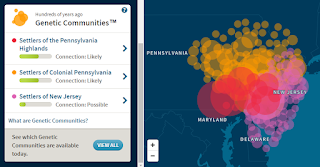 |
A screenshot of my mom's Genetic Communities unique to
AncestryDNA |
The major benefit to AncestryDNA is that they have the largest database of testers, which means you'll get the most DNA matches to work with. Their database is international, because the test is available in 35 different countries, the full list of which can be
found here, however the majority of testers are in the US.
The major downside to AncestryDNA is there is no chromosome browser. A chromosome browser is important to identify matching segments among multiple people you match (triangulation). That doesn't mean you can't have success with AncestryDNA, but in some cases it may make things more difficult. In part, because of this, AncestryDNA does not identify matches on the X chromosome.
AncestryDNA does not provide a health report so it is not an option for people who want an integrated health report, however, there are affordable, third party sites that will accept Ancestry's raw DNA data to provide you with a health report. These will be detailed later. AncestryDNA also doesn't include any mtDNA or Y-DNA haplogroups, although as discussed previously, haplogroups aren't really very useful for recent genealogy anyway so there's nothing really lost here.
Another downside is the fact that Ancestry does not accept raw DNA uploads from other companies. This means unless you test with Ancestry, you can't get results from them and that actually means that in spite of being a negative, it makes the most sense to test with AncestryDNA and then use your raw DNA data from them to upload to other companies that do accept them.
The method of collecting your DNA may be important since some older people have difficulty producing saliva - AncestryDNA's method is a spit tube. You have to fill it to a line. If you're struggling, you can cover it with plastic wrap and set it upright in your fridge and try to add to it later. Also try a little bit of sugar on the tip of your tongue to help stimulate saliva, and/or chew gently on your cheek.
AncestryDNA does not allow you to opt out of DNA matching.
Pricing is normally $99, however, there are often sales ranging from $69 to $89, typically for Mother's Day, Father's Day, Black Friday/Christmas run up, National DNA Day (yes, that's a thing, April 25), and sometimes other times of year like St Patrick's Day. They can also be somewhat spontaneous - this year they had a random "Summer DNA Sale" for half of August.
Conclusion: Apart from the lack of a chromosome browser, AncestryDNA is a good option for adoptees, people looking for an ethnicity report, or genealogists wanting to break down brick walls in their tree, especially if you are already a subscriber there and host your tree there. It just makes sense to have your tree, DNA, and major records resource all in the same place. Non-subscribers are not able to view the full trees of their DNA matches, which may be limiting. However, you can contact your DNA matches and ask them for an invite to their tree, which would allow you access. Trees are important to figuring out how you relate to someone. Particularly for adoptees, using trees to mirror them in your search for biological parents is essential. AncestryDNA is not an option for a integrated health report, but third party options to upload to are available.
 |
| A screenshot of my 23andMe ethnicity report |
23andMe
There are two autosomal DNA tests available from
23andMe - the "ancestry-only" test which does not include a health report, and the "ancestry+health" test which does includes the health report. Although they are both autosomal DNA tests, they both include an mtDNA haplogroup and, if you are male, a Y-DNA haplogroup. It may not be your most specific haplogroup since they are working with limited mtDNA and Y-DNA data, and they do not include any mt or Y matches with other testers. If you're looking for an mtDNA or Y-DNA test, this is not a shortcut, it is not a true mtDNA or Y-DNA test.
In my experience, most people seem to feel the accuracy of 23andMe's ethnicity report (called Ancestry Composition) is better than other companies. However, it is still an estimate and unlike other companies, they have these "Broadly" categories that can't be narrowed down further (see above or below for examples). The descriptions of each category are also rather short, not very detailed, and the map showing the areas covered is small and not very detailed (see above). They do provide some features that other companies don't, like chromosome painting (shown below) which shows you which portions of your chromosomes they placed into different regions, and a timeline that shows an estimate of how long ago your ancestor of a certain ethnicity lived.
Their full list of 31 regions/populations can be found here.
 |
Chromosome painting at 23andMe shows the portions of
my chromosomes they've associated with which groups |
The major downside to 23andMe is that they no longer support any family trees. As discussed, trees are important to figuring out how you relate to your DNA matches, and essential for adoptees. Of course, you can host a tree on another website and post a link to it in your 23andMe profile, but most people don't do this, and even if they do have a tree hosted elsewhere, it is very cumbersome to try to work on two different platforms. Similarly, most people report that their matches at 23andMe are more likely to not respond to their attempts to communicate. This is probably because many people at 23andMe tested there for the health report, and may have no interest in the genealogical side of things.
23andMe does provide a chromosome browser but their interface isn't always intuitive and the chromosome browser can be found in two different places, with the harder one to find including more data.
 |
A portion of the list of rare diseases carrier status,
a part of your health report at 23andMe |
The health report is the feature that sets 23andMe apart from the other companies. However, although they are gradually adding more and more health reports, they are lacking many of the health issues most people want to know about, like tendency for cancer, heart failure, etc. These may get added as time goes on, but at the moment, many of the health reports are your carrier status for rare diseases that you may never have heard of and are probably negative for (see example right). There's also 4 genetic health risks that might be more common, but there's only four of them (Late-Onset Alzheimer's Disease, Parkinson's Disease, Alpha-1 Antitrypsin Deficiency, Hereditary Thrombophilia). There are a few other "wellness reports" and "traits" reported, but they are mostly things you probably already know about yourself, like whether you're likely or unlikely to be lactose intolerant, whether you're a deep sleeper or not, what color your eyes are, etc. You can actually get a more comprehensive health report from third party companies where you can upload your raw DNA data. As 23andMe add more and more reports though, this may change.
Like AncestryDNA, 23andMe does not accept raw DNA uploads from other companies so if you want results from them, you have to buy their test.
23andMe is able to ship to over 50 countries,
listed here, though health reports will not be available for most of them (
those are listed here).
23andMe's method of collecting your DNA sample is a spit tube. See details above for tips on collecting from a dry mouth.
You can opt out of DNA matching with 23andMe if you wish to.
Pricing is normally $99 for the ancestry-only test, and $199 for ancestry+health. 23andMe do not often have sales - the only time I've seen their tests on sale were actually through Amazon, and even that is not often.
Conclusion: 23andMe would be good for people who just want an ethnicity report, or health report, but because of the lack of trees and responses from matches, it would not be ideal for adoptees or genealogists wanting to break down brick walls in their tree. If you have the money and inclination, I would still encourage testing with them though, since they don't accept uploads from other companies. If you want a health report but can't afford 23andMe's health test, there are third party sites that will accept data from 23andMe (details below).
FamilyTreeDNA
 |
A screenshot of my mother's ethnicity report at
FamilyTreeDNA |
FamilyTreeDNA, commonly abbreviated to FTDNA, offers autosomal DNA (called "Family Finder"), Y-DNA, and mtDNA tests. They are really the only company to offer Y-DNA and mtDNA. Other companies (named lower down) may offer them, but typically don't provide a match list.
Just like the other companies, FamilyTreeDNA offers an ethnicity report (called myOrigins), and a DNA match list. It does not include a health report. It does support family trees, and offers a chromosome browser and other tools for working with your matches (like the matrix tool, for triangulation, see below).
They also accept raw DNA data from AncestryDNA, 23andMe, and MyHeritage, for only $19 to unlock your full results.
 |
FamilyTreeDNA's Matrix tools for seeing which of your
matches also match other select matches |
The major downside to FamilyTreeDNA is that their ethnicity report probably ranks 3rd out of the 4 companies covered here. Granted, they are the only ones attempting to identify Sephardic Jewish ancestry, all other companies only include Ashkenazi. They also split Native American into North and South America, whereas 23andMe and AncestryDNA lump them together. But if you're not one of these groups, it's probably not important.
A full list of their 24 regions included can be found here.
Since they offer full mtDNA and Y-DNA tests, their autosomal DNA test does not include haplogroups like 23andMe does, however, as discussed, haplogroups aren't particularly useful for recent genealogy anyway. They have partnered with Vitagene to offer a health report for $49 but be aware that Vitagene also accepts data from 23andMe and AncestryDNA for a health report of the same cost, they just aren't partnered. Additionally, the FTDNA health report from Vitagene is only available for those who bought a test with FTDNA, not for those who uploaded their raw DNA data from another company. And as discussed, there are other third party sites that provide a health report and accept uploads from FamilyTreeDNA too.
FamilyTreeDNA will ship to "most international locations" - the only countries they list as unable to ship to, due to customs restrictions, are Sudan and Iran.
More details here.
The method of collecting your DNA sample is a cheek swab, some people with dry mouth may find this easier to use.
You can opt out of DNA matching with FamilyTreeDNA if you'd like to.
Pricing is normally $89 for the autosomal Family Finder test but can sometimes be found on sale for $59-$79.
Pricing for Y-DNA normally ranges from $169 to $359, depending on marker amounts (see above info on Y-DNA for details), but you can sometimes find them on sale for less.
Pricing on mtDNA is normally $79 for "mtDNA Plus" or $199 for Full Sequence, but you can sometimes find them on sale for less. The mtDNA Plus test might be tempting for only $79, but this will only be relevant to ancient/prehistory. If you want any chance of having results/matches from a genealogical time frame, you have to buy Full Sequence.
Conclusion: It's the go-to place for Y-DNA or mtDNA. While FamilyTreeDNA offers all the tools necessary for working with your autosomal matches, which is necessary for genealogists and adoptees, the ethnicity report isn't the best, and if you don't mind the $19 fee, it makes more sense to test with another company and upload to FamilyTreeDNA. If you're not interested in dealing with multiple companies, and you're not that bothered about the ethnicity report, then FamilyTreeDNA is the best option for a slightly lower cost. They do offer a health report from VitaGene for an extra cost, but you can get a VitaGene health report if you test with other companies too, so it's not exclusive to them.
 |
| A screenshot of my ethnicity report at MyHeritageDNA |
MyHeritageDNA
MyHeritage are newcomers to autosomal DNA testing (they do not provide mtDNA or Y-DNA) and therefore their database of testers is very small - you will have few matches compared to other companies, although it is growing fast. Additionally, I've had a poor experience with their matching system, where most of my matches can not be found as matches to either my mother or my paternal grandfather (whose tests are both on MyHeritage too). However, they can't all be matches to my paternal grandmother, especially considering she was Italian and none of these matches are Italian. There are a few articles about MyHeritage's unreliable matching found
here and
here. It seems they have an abnormally high amount of false positive (or false negative) matches. Hopefully, this will be fixed in the future, and as their database grows, it will become more useful to genealogists and adoptees. They also do not offer a chromosome browser, or many tools for working with your matches, like a shared matches/in common with tool available from all 3 of the other big companies.
The other major downside is their ethnicity report is also very inaccurate for most people at the moment - I expect that will improve with time (all companies periodically update their ethnicity reports), and their database will grow with time as well. The maps are fairly detailed though, and one bonus to their ethnicity report is that they break Native American down into three regions, more than any of the other 3 big DNA companies, so if you are Native American, this may be a good option. They also have five Jewish populations. MyHeritage don't like to name all their regions/populations available until you've taken the test, but there are 42 of them, and you can see a
map of their coverage here and I've also created a
spreadsheet with them listed here.
MyHeritage does not offer mtDNA or Y-DNA tests, only autosomal DNA, and does not include any haplogroups like 23andMe's autosomal DNA test does, but again, haplogroups aren't very useful for recent genealogy. MyHeritage also does not offer a health report, and at this time I do not think third party health sites will accept raw data from MyHeritage (this may change with time).
Like Ancestry.com, MyHeritage is also a genealogy website that offers a database of records and resources for genealogy research, for a fee. They also offer family trees and you can attach your tree to your DNA results, however their trees are limited to 200 people within them if you don't subscribe, which could be promblematic if you or your matches don't have complete trees to work with. If you subscribe to MyHeritage already, it would make sense for you to have your DNA test there. However, because MyHeritage currently accept uploads from other companies (23andMe, AncestryDNA, and FamilyTreeDNA) for FREE, it doesn't make much sense to buy their test when you can get the same results for free by testing with another company and uploading your raw DNA to MyHeritage. I imagine they are currently only offering the uploads for free because their database of testers is so small and they are trying to build it up. Once they have a better established database, they may start charging for uploads. So I'd recommend getting your raw DNA data uploaded there as quickly as possible, while it's still free.
MyHeritage don't seem to detail what countries they are able to ship to, but they do offer the test to be purchased in different currencies, including USD, EUR, GBP, and ILS.
The method of collecting your DNA sample uses a cheek swab.
They do not allow you to opt out of DNA matching.
Pricing is normally $99, though they currently have a long running sale for $69, probably to entice people and more quickly build their database.
Conclusion: Due to the poor ethnicity report, small tester database, unreliability with matching, lack of tools for your match list, the limitations of not having a subscription, no health report (and not supported by third parties who provide health reports), and the fact that they accept free uploads from other companies, I would not recommend buying a test from MyHeritageDNA, regardless of your reasons for testing. It makes more sense to buy with another company and upload to MyHeritage. If the current sale price appeals more to you, keep an eye out for sales from AncestryDNA.
Other Testing Companies
 |
| LivingDNA Europe break down |
The above four companies are certainly not the only ones to offer DNA tests, but they are the main (only?) ones which are geared towards genealogy and include both ethnicity and DNA matching with other testers, all for the most affordable cost. The following companies don't offer DNA matching and yet are often much more expensive.
LivingDNA offers the greatest break down of your ethnicity report - 93 populations in total, including 20 regions within Europe and 21 regions just within Great Britain/Ireland, but this also makes it highly speculative and possibly not very accurate. Also note they have no Jewish categories. Biggest complaint is they overestimate British results. They do not offer matching (but are planning to add it soon) or a health report, but do include autosomal, mtDNA and Y-DNA. They do not accept uploads from other companies but are looking into adding it for autosomal only. Normally $159.
 |
| My DNATribes Ethnicity Report |
DNATribes offers a greater break down for Native American regions (seven), but regions for Europe are very broad (only 4), and they do not offer matching or health report. Focus is more on ancient "deep" ancestry, not recent. They do accept uploads from other companies for $50 (option for that is
found here). They do not offer mtDNA or Y-DNA. Normally $119.
AncestryByDNA (not to be confused with AncestryDNA) uses an outdated method of determining your ethnicity report and is therefore very unreliable. Unsurprisingly, they are shutting down Sep 30, 2017. They do not offer matching, health reports, or allow uploads from other companies. Offers autosomal, mtDNA, and Y-DNA. Pricing no longer available due to discontinuation.
National Geographic's Geno 2.0 (The Genographic Project) focuses on ancient DNA, not recent genealogy, and does not offer matching, health report, or allow uploads from other companies. Includes autosomal, mtDNA, and if male, Y-DNA. Normally $199.95.
Genos is a company that provides your full genome and is therefore extremely expensive at $499. It does not provide any ethnicity or matching. They do provided a health report of sorts but their FAQ is careful to say, "We provide information like population frequency and related health traits. We do not provide interpretation, and do not specialize in addressing conditions." Unless you need your full genome for a specific medical reason your doctor has requested, this is probably not worth the money.
African Ancestry is obviously a test for people of African descent. They provide Y-DNA, and/or mtDNA, not autosomal. They offer highly specific results of where in Africa your ancestry is from, but keep in mind it's only from one direct line, not your full ancestry. They do accept mtDNA or Y-DNA uploads from other companies for $210. They do not offer matching or health reports. Normally $299 for either Y-DNA or mtDNA (so $598 for both). That's pretty expensive, and I couldn't say whether the results are worth it as I'm not African.
Vitagene is primarily a DNA test which provides a health report, and also includes an ethnicity report. They do not provide DNA matching with other testers, or any mtDNA or Y-DNA. They will provide a health report only (no ethnicity) for uploads from AncestryDNA or 23andMe for $49, or if you tested with FamilyTreeDNA there should be an option on your dashboard to order a health report from Vitagene for the same cost (if you uploaded to FTDNA from another company, this is not an option within FTDNA). They will also sell you supplements/vitamins and a diet and fitness plan based on your DNA health report. Normally $99.
Third Party Options
 |
| One of the many admixture calculators available at Gedmatch |
One of the great things about DNA is that there are independent sites that provide further analysis on your raw DNA data, for small fees or even free. They do not sell DNA tests themselves, they only take the raw data from whatever company you tested with and analyze it.
Gedmatch is the go-to third party site for DNA analysis. It accepts uploads for free from 23andMe, AncestryDNA, FamilyTreeDNA, MyHeritageDNA, and WeGene (below). It offers multiple different admixture (ethnicity) calculators, a list of your closest matches from people who have uploaded from all different companies regardless of which one you tested with, and a more detailed comparison with any one particular person/test. It does not include a health report and the main criticism is that it's not very user-friendly. For a guide on the admixture calculators,
see my blog article on it.
WeGene is a site that focuses on Asian ancestry, it's not really ideal for others. They accept free uploads from 23andMe and AncestryDNA, but currently not FamilyTreeDNA or MyHeritage. Includes ethnicity report, mtDNA and Y-DNA haplogroups, and health report. Unclear on whether they provide matching?
 |
| DNA.land's ethnicity report |
DNA.land is similar to Gedmatch and is also free, they accept uploads from 23andMe, AncestryDNA, and FamilyTreeDNA, but not from MyHeritage (at this time). They only offer one ethnicity report (as opposed to Gedmatch's many), and their match lists are small, as they have a smaller database of uploaded tests. No health report but they do have a "trait prediction report" which may be a precursor to a health report. They also give you the option to participate in medical studies. It's a project run by the Columbia University and the New York Genome Center.
Promethease will provide a health report from data from 23andMe, AncestryDNA, and FamilyTreeDNA for only $5, and from Genos for $10. It is fairly comprehensive, but only really tells you what genes you have that are associated with what conditions. You should really consult a doctor for a medical opinion on it.
GENOtation is a free tool from Stanford University that analyzes your 23andMe or Lumigenix data for ancestry and health reports.
LiveWello will provide a health report for $19.95 from your 23andMe, AncestryDNA, or FamilyTreeDNA raw data.
Final Conclusion:
If you're a genealogist or adoptee, to get the best value, I recommend testing with AncestryDNA or 23andme, and then uploading your raw DNA data to MyHeritageDNA for free, and to FamilyTreeDNA for only $19 to unlock your full results. If you want health reports, you can upload to Promethease.org for only $5. That way, you wind up spending a max of about $125 for results from 3 companies and a health report (and any free third parties you choose to upload to). You'll get the most out of your money this way. If you have the money and inclination, buy from both AncestryDNA and 23andMe, then upload everywhere else, as then you'll have access to and matches from every company. If you don't have the money or inclination, I would prioritize buying AncestryDNA over 23andMe, since 23andMe doesn't offer family trees, and AncestryDNA have the biggest database of testers. If you're really on a tight budget, and can't afford $120-125, then I would say test with FamilyTreeDNA, since it's less expensive and has all the tools you need.
If you're thinking "wow, I'm not
that into this, I just want my ethnicity and/or health report and I'm good with it from just one company, I'm not interested in the rest," then I would recommend 23andMe or AncestryDNA. However, I would also remind you that the ethnicity report is only an estimate, the true value of the test is with the DNA matches. If you're not inclined to upload to Promethease.org for a $5 health report which is arguably more comprehensive than 23andMe's $199 test right now, then 23andMe is your only option for a health report. If you're not even interested in DNA matching then perhaps you could even consider Vitagenes for an ethnicity and health report for $99.
If you're just looking for ethnicity and no health report, 23andMe have the most accurate ethnicity report in my experience, followed by AncestryDNA, then FamilyTreeDNA, and finally MyHeritage coming in last (this is based on my experience with all 4 companies, managing 3 kits, and on years of communicating with other testers who typically agree with this assessment, and additionally the opinion of the
International Society of Genetic Genealogy). So although they are less expensive, MyHeritage has terrible ethnicity reports at the moment, and although FamilyTreeDNA has improved their ethnicity report recently, it is still sub-par if you ask me. You get what you pay for. That said, different companies often have more break down in one region or another. 23andMe has a greater break down of East Asia than AncestryDNA does, but AncestryDNA has a greater break down of Africa than 23andMe. For a complete comparison,
check out the spreadsheet I made. Given that Ancestry's DNA test is more commonly on sale than 23andMe, if you're not desperate for 23andMe's health report and there's no rush, I'd recommend waiting and snagging AncestryDNA when it's on sale. You'll be waiting much longer if you wait for 23andMe to go on sale. However, if not being able to opt out of DNA matching is a deal breaker, then go with 23andMe where you can opt out.
If the spit tube is a deal breaker, then FamilyTreeDNA is your best option.
Of course you are free to make your own decision based on the information provided! This is just my opinion, but it is based on years of experience with all 4 companies and some of the third parties. I also created a
quick reference chart that compares the companies as well.


