Wednesday, February 6, 2013

Family History Writing Challenge Day 6: Frantz, Knepper, and Lindesmith

I merged these three families into one chapter because they all get "daughtered out" after one generation so I didn't have enough detail to give them each a dedicated chapter. Frantz, Knepper, and Lindesmith are all believed to be Swiss or German colonial families who first settled in Pennsylvania before moving to Ohio. As with many colonial branches, there are some facts which are still up in the air.

Join the Family History Writing Challenge.

Tuesday, February 5, 2013

Family History Writing Challenge Day 5: Fallows

The Fallows family is one of my favorites to research and write about, I think because there is SO much information on them. They were fairly wealthy and so there's hundreds of mentions of them in their local newspaper and dozens of surviving photographs - even a scrapbook I think my great grandmother made! Plus, my grandmother collected some more personal and character information on them, I gather from her mother-in-law before she died. This adds a personal touch to it, which can be rare in some parts of genealogy - we collect facts but how much do we really know about the character of these individuals?

Originally, the Fallows were a poor family from the Oldham/Royton area of Lancashire, England during the industrial revolution until my 3rd great grandfather, Josiah Fallows, immigrated to America in the mid-19th century to make a better life for himself. And that he did! By the time he died, he owned a large estate in Montgomery County, Pennsylvania and produced a brood of seven boys (what a household that must have been to grow up in!). The Fallows married into the Godshall family.

So here's the latest update of one of my longest family histories - 3,134 words, 23 sources, 14 photographs (I mean to add more photos, there are literally dozens more): Fallows.

Join the Family History Writing Challenge.

Monday, February 4, 2013

The Automobile and It's Impact

The Philly History Blog recently posted an article titled When City and Car First Collided, which is something of a social history of the introduction and rise of the automobile in Philly and concerns about safety from the start. Fascinating read, especially because it reminded me of several issues in my own tree. First, it reminded me the 1943 car accident my great grandfather was in. It also reminded me that the family this same ancestor married into were car enthusiasts and lastly that his own father had owned a carriage shop which went out of business thanks to the automobile. So this branch of my tree was heavily influenced by the automobile in many different ways.

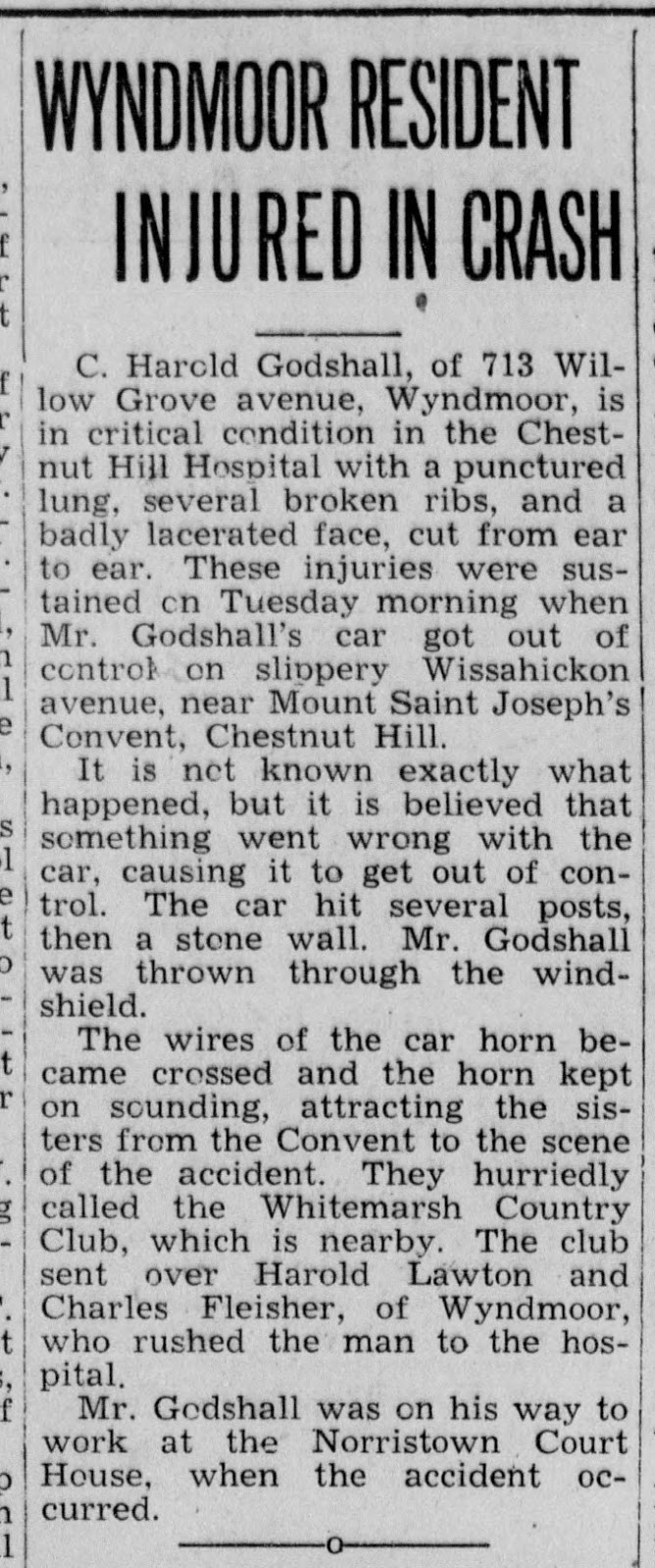
Ambler Gazette clipping
from October 28, 1943
On Tuesday, October 26, 1943, at the age of 60, my great grandfather Chester Harold Godshall Sr. was involved in a serious car accident which nearly killed him while driving from his home in Wyndmoor, Montgomery County, Pennsylvania to work at the Norristown Court House (he was a civil engineer). There were no other cars involved but somehow he lost control of his car while on Wissahickon Ave (now Northwestern Ave) near where it met Germantown Ave and hit several posts by the side of the road before slamming into a stone wall which launched him from the car, through the windshield. Fortunately, the accident had caused the car horn to persistently sound, which attracted the attention of the sisters of a nearby Convent, Mount Saint Joseph's (now Sisters of Saint Joseph in Philadelphia) on Germantown Ave. The sisters called the Whitemarsh Country Club (now Whitemarsh Valley Country Club), which was located on the opposite side of Wissahickon Ave, and they sent over two men, Harold Lawton and Charles Fleisher, who rushed Chester to the Chestnut Hill Hospital. He had punctured a lung, broke several ribs, and was in critical condition at the time the Ambler Gazette reported the accident two days later. Fortunately, he recovered and lived for another ten years.

Though Chester, who was better known as Harold, was a civil engineer, back in the early 20th century, he had also worked as a secretary for his father's struggling carriage business originally called Germantown Carriage Works and eventually renamed to William H Godshall Inc. William had wanted his son to take over the business and after his death in 1922, Harold did so but not for long. It eventually went out of business in light of the rise of the automobile.
Harry Fallows and his daughter Emma Sarah proudly
showing off his automobile, circa 1908, probably rankled his
son-in-law's father, the owner of a failing carriage shop.

While William was probably muttering with bitterness over the growing popularity of the automobile, his son Harold was dating his future bride, Emma Sarah Fallows, whose family were somewhat controversially car enthusiasts. Emma's father Harry was a member of the Quaker City motoring club and won the Salem Cup in the Wildwood Auto Races on July 4, 1912 when he represented the Chase Car company. Harry's brother James owned at least three cars (though not necessarily at the same time) from as early as 1906 and had one repainted at one point. He and his cars had several mentions in the Ambler Gazette and there are also many surviving photographs the Fallows showing off their cars.

These two merging families really highlight the cultural history of the introduction of the automobile into society and what it meant for so many different people. One family struggling to hold onto their livelihood, another embracing the modern marvels that came around the turn of the century. I always imagine the early 20th century must have been an exciting time to be alive but for some, also a little frightening.

 With a little reworking, I took this content from my family histories for the Fallows and Godshall families. I will be posting their full histories within the next few days, as a part of the Family History Writing Challenge.

Family History Writing Challenge Day 4: Skaar-Eiesland and Bruskeland-Eiesland

I know this throws the alphabetical order out of line a little bit but this chapter was originally a part of another chapter (which was called Eiesland) and in light of new info and complicated Norwegian names, I've decided to give this family their own chapter. This also means I'll have more than 28 chapters to cover so I'll also be posting both today.

Anyone with Norwegian heritage knows how common patronymic names are - that is, the practice of one's surname being a combination of one's father's Christian name plus a suffix of "sen" (son) or "datter" (daughter). This presented a problem in my family history book of what to call the family as a whole! Each generation had a different surname. I decided to call the family by their farm name, since this is often attributed to their names in records, but this also presented the problem of there being more than one farm in different generations of the family. In this case, there were only two farm names for each chapter so I decided to just use both: Skaar-Eiesland and Bruskeland-Fladen. I have yet to come across more than two farms for the same family but I think if I did, instead of hyphenating three or more names, I'd just go with the most prominent name or two.

Skaar was a farm in the parish (like a township) of Konsmo, in the county now know as Vest-Agder. Eiesland was located in the parish of Lyngdal of the same county. Bruskeland was a farm in Laudal and Fladen was in Lyngdal, both also in Vest-Agder. At the time, the county was called Lister Og Mandal until 1919. The Skaar/Eiesland family married into the Bruskeland-Fladen family before moving to the Mid-West of America in the mid-19th century and marrying into the Friis/Fries family (more on them in a few days).

Join the Family History Writing Challenge.

Sunday, February 3, 2013

Family History Writing Challenge Day 2 and 3: Cobb and Demore

I did actually complete Day 2's family history update yesterday and then, like a nincompoop, wound up forgetting to post it!

So Day 2's family history was Cobb, another colonial branch, this time from Kent, England and Virginia. The Cobb family married into the Smith family and settled in Kentucky.

And today's family history is one more recent and therefore closer to my heart. The family of my Italian paternal grandmother, Demore (which was originally D'Amore), who settled in Philadelphia. I have removed some of the information for the sake of privacy of living family members.

Join the Family History Writing Challenge.
Friday, February 1, 2013

Family History Writing Challenge Day 1: Clemens

In preparing to do a complete update on all my written family histories during the February Writing Challenge, it occurred to me that I have exactly 28 of them to update. I have 29 in total but I recently updated one of them when I found some new information on that family. So I have just the right amount to update one a day, which should not be overwhelming. Thanks to The Family History Writing Challenge, I am finally getting this done and doing it in a way that won't be too much all at once.

I will share my family histories here on my blog in case it's of use to anyone else researching the same families or in case anyone wants ideas on how to structure a written family history (though I will be editing out info on living people for privacy reasons). My style might be dry but at the moment, my goal is just to convey the information as thoroughly as I can, not necessarily to embellish my ancestor's lives. Remember, you can take this as far as you want or do it however you want - if you want to do more or less than I have or in a completely different way, you're only doing it to please yourself. Mine is written like a book with a chapter for each family name. I work in chronological order, opening with a history of the family name (this became difficult with some of my Norwegian branches!), and typically finishing it up with either a reference to the chapter a daughter married into or with the deaths of her parents. I tend to put the first mention of my direct ancestor's names in bold, so I can follow my direct line more closely. This is because I often include a lot of information on siblings too.

I will go in alphabetical order which means my first family to update is Clemens (click to read!), a colonial Mennonite family who married into the Kratz family (who married into the Godshall family). It's fairly short since it only includes three generations and not much is known about the women going this far back. I am linking to my Google Docs because when I tried to copy and paste it into Blogger, all the formatting went haywire (despite both pieces of software being owned by the same company, apparently that does not ensure consistency). These are formatted to be compiled into an ebook, which is why the photos are just displayed at the end instead of interspersed throughout the article, like they were when I originally published my (now terribly outdated) family histories with My Canvas. Eventually, I plan to do another more creative and visual printed book. Someday.

Tuesday, January 22, 2013

Family Tree Maker: Relationship Calculator

You may already know about this one but for those who don't, this is a handy little tool in FTM that allows you to see the relationship between two people, which is especially useful if you have reason to want to know the relationship between two distantly related people in your tree and it's too complicated to work out yourself.

I recently I had reason to use this tool when I discovered that a half sister of one of my ancestors married the half brother of another one of my ancestors. Yeah, try working that one out. Instead, I let FTM do the thinking for me.

While in the "People" view, select "Tools" and then "Relationship Calculator", shown left.

If you've already selected one of the two individuals you want to include, they should already show up when the Relationship Calculator opens. Probably, the other individual will be the home person. It doesn't really matter because you can change both individuals once in the calculator.

Just click the icon immediately the right of the individual's name, the one that looks like a folder with lines on it. Then select the names you want include and then their relationship should show below the names with the "path" of their relationship displayed to the right. If your situation is like mine, where there is more than one relationship between two people, you can choose which one to view in the drop down box where it displays the relationship. You can also click on the button at the bottom of the window which says "View Relationship Chart" - I found this visual path display easier to follow. All of this is shown in the screen shot to the right. You can print the chart but unfortunately you can't save it (and trust me, I've tried recreating it in the "Publish" section with the Relationship Chart - no luck).

In this case, there was no blood relation between husband and wife but the relationship calculator is also very useful for cousin marriages and working out their degree of relation. In these cases, you will see a name or names listed under the section "Nearest common relative(s)" and around the bottom right there will be numbers for Civil Degree and Canon Degree which are the degrees of relation as defined by Civil Law and Canon Law.

By the way, the hardest thing about doing these FTM tutorials is making sure I haven't inadvertently displayed information about living people in my tree when taking the screen shots!

Sunday, January 20, 2013

Antiques: Slot Machine

Mills Novelty Co. Skyscraper
1c slot machine, 1932.
One of my favorite things about family history is all the antique heirlooms that get passed down generations. I think my favorite of my family's is my grandmother's old slot machine. It was labelled Mills Novelty Co. so after a bit of online research, I discovered this model was made in 1932 and known as "Skyscraper", appropriately named after it's design. I could only find 5 cent versions of this online but ours is definitely a penny machine.

It came into our family when my great grandfather found it dumped by the side of a road, all the money having been stolen out of it. He took it home, fixed it up, and it's been in our family ever since. As a child, I spent many hours entertained by putting penny after penny in and pulling the handle. My grandmother kept a container of pennies just for us grandkids to use with the slot machine and I can remember begging her for more pennies when the cupful she'd first give me would run out. It's a miracle I didn't grow up to develop a gambling addiction! But I suppose it's different when you can open the machine and get all your money back.

Detail of the brand name.
It doesn't look in great condition but I think it just needs to be cleaned; it probably hasn't been used since I was a kid. It still works, though apparently sometimes it breaks and fortunately my uncle knows how to fix it.

Of the 5c versions of it I found on the internet, sometimes the black paint is blue instead. One of them sold for $1,200 in 2007, another is currently being sold for $2,100, and an ebay auction recently sold one for $1,278. Other auctions have starting bids around $400 but are estimated up to $5,200.

Does anyone know why I can't seem to find another 1c version of this model? Were they rarer? Older? Any additional information would be welcome!

What antique treasures have you inherited?

Thanks to my mom for the pictures!

Wednesday, January 16, 2013

Think Outside the Household

1850 US Census showing patriarch listed separately
from family household.
This is another one of those "how could I have missed this?" moments. Sometimes, I get so caught up in trying to find a family on a census that I forget to look for an individual on his or her own. Recently, I was reminded of this when I assumed a male ancestor died before the 1850 US Census was taken on June 1 because I had already found his wife and children living together but he was not listed among the household.

Land ownership map showing the
two properties of my ancestors.
In fact, he was still alive and recorded on the census, he was just listed separately. Why? Because, as I should have remembered, I had a land ownership map which proved he had owned two separate properties - one large, main one where I think the family was living and another, smaller lot not far away. My guess is that my ancestor was tending to the secondary property when the census taker came around. And sure enough, I found him listed on the very same census page, just two house away from his family! He was only listed by his initials, which is probably another reason why I overlooked him or why he wasn't showing up in any auto hints. I am unsure whether he was actually permanently living there or just there temporarily to tend to the secondary property but I lean towards the latter being the case.

This is also a reminder of why land ownership maps can be very important! Without it, I may have still been scratching my head as to why my ancestor was listed separately. I might have assumed he had a second property but without confirmation, the facts would have remained muddled.

1850 US Census showing son apprenticing in another
household.
Also be sure to look for missing children with other households - a neighbor or relative may have taken in a child if the family didn't have enough living space (or financially couldn't support all their children) or if the child was actually helping out around the property of an older neighbor or relative or may have been apprenticing with the head of the household. I also thought a child of the same family may have died before 1850 but then I found him apprenticing as a blacksmith with another family.

Sunday, January 13, 2013

Writing Your Family History

If you're thinking about writing your family history - or you've already started but need a nudge to pick it up again, check out The Family History Writing Challenge. This can help jump start your writing and offer support. It starts February 1st and runs for the month. Try not to get overwhelmed though - remember that you only have to take this as far as you want to.

For me, it will hopefully motivate me to update all my family histories. Since I already have most of them written up, I usually update them whenever I find new records or new information on an individual or branch. But lately, I got behind on my updates, so much so that I now can't remember what needs to be updated. This means I basically have to go through my whole tree and compare every branch to every corresponding family history and see what, if anything, needs to be added to the family history. It will probably be very time consuming, which is why I've been putting it off. So hopefully the challenge will motivate me to get this done.